
Equity markets continue to hover near record highs, but the options markets are sending a different message. Derivatives trades are increasingly positioning for a sector-specific shock, centered around technology.
The key warning signal comes from a relationship between the Nasdaq 100 – the most popular tech index- and the broad market. The volatility ratio between these indexes indicates that investors are far more concerned about the future of growth stocks than headline equity prices would suggest.
The Highest Since 2007
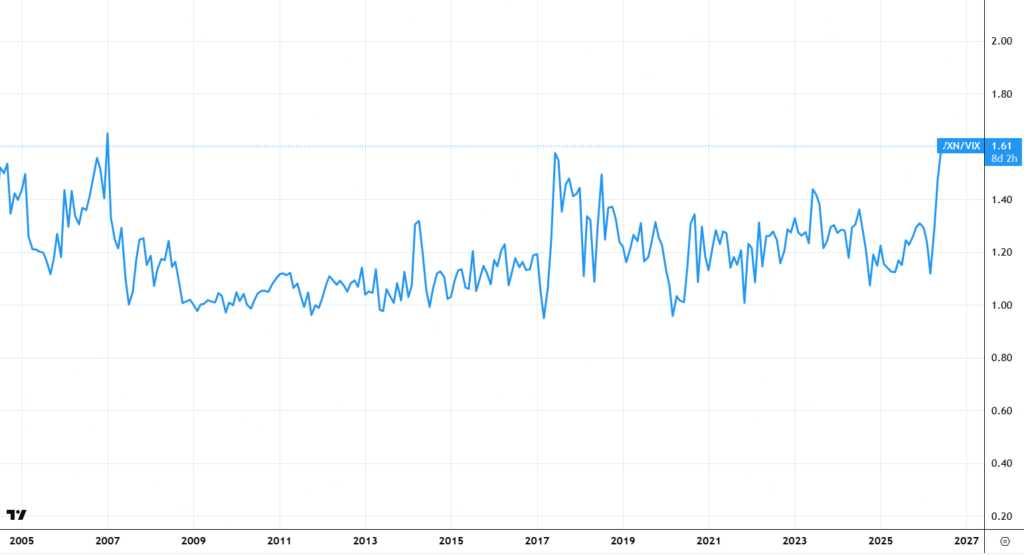
The VXN/VIX ratio, which compares implied volatility between the Nasdaq-100 and the broader S&P 500, has surged to 1.61.

VXN/VIX monthly chart, Source: TradingView
According to the monthly chart, it is the highest level since January 2007, even with major equity benchmarks remaining near historic highs.
To understand why this matters, it helps to break down the components. The VIX, often referred to as Wall Street’s “fear gauge,” measures expected 30-day volatility for the S&P 500. The VXN performs the same function for the Nasdaq-100.
When the ratio between the two rises sharply, it indicates investors are paying a significant premium for protection against a technology-led decline relative to a broader market selloff. The fear is becoming concentrated rather than widespread.
According to Apollo’s Chief Economist Torsten Slok, the divergence “reflects investors demanding far more protection on AI names than on the broad market.”
That disconnect is often associated with late-stage market cycles, when investors remain optimistic on the surface but quietly increase hedging activity in the market’s most crowded trades. The obvious focus today is artificial intelligence.
Hedging the Capex Race
Over the past two years, investors have rewarded technology companies for their aggressive AI ambitions, pushing valuations to elevated levels.
At the same time, the capital expenditure cycle has accelerated into the hundreds of billions. Hyperscalers have engaged in an AI race to build data centers, acquire advanced chips, and expand the infrastructure. The choice was simple – spend or get left behind.
Yet, that spending wave creates enormous expectations.
Microsoft Corp. (NASDAQ:MSFT) continues to invest heavily in Azure AI and related infrastructure, with capital expenditures tracking toward more than $190 billion.
Alphabet Inc. (NASDAQ:GOOG) has raised its own spending plans into a range of roughly $180 billion to $190 billion, while Amazon.com, Inc. (NASDAQ:AMZN) has surprised analysts with projections approaching $200 billion as it expands AWS capacity and AI-focused data centers.
However, these investments must eventually generate matching revenue growth. If management starts mentioning slower monetization timelines, weaker cloud demand, or softer returns on AI spending, investors could quickly reassess current valuations.
That risk is what the options market appears to be pricing today. While the broader market remains calm, volatility traders are increasingly focused on tech repricing.
Protection against a tech shakeout has emerged even as the major indexes remain relatively calm. Historically, that kind of divergence is rarely something the market can ignore indefinitely.
Price Action: Microsoft shares were up 1.11% at $371.41, Alphabet shares were down 2.10% at $342.33 and Amazon.com shares were down 0.79% at $230.94 during premarket trading on Tuesday, according to Benzinga Pro data.
Image via Shutterstock
Recent Comments