
Billionaire investor Ray Dalio expressed his views on Monday on why Bitcoin (CRYPTO: BTC) has not fulfilled its anticipated role as a safe-haven asset.
Transparency A Bane For BTC?
Dalio pointed back to the arguments he made during the All-in podcast dated March 3.
“First, Bitcoin lacks privacy. Transactions can be monitored and potentially controlled, which is why central banks aren’t looking to hold it,” said the founder of Bridgewater Associates.
As expected, the view drew rebuttals from Bitcoin advocates.
Veteran trader Oliver L. Velez argued Bitcoin’s lack of privacy is not its weakness, but rather its great strength, providing an excellent alternative to the “opacity” of today’s financial system.
Increasing Correlation With Tech Stocks
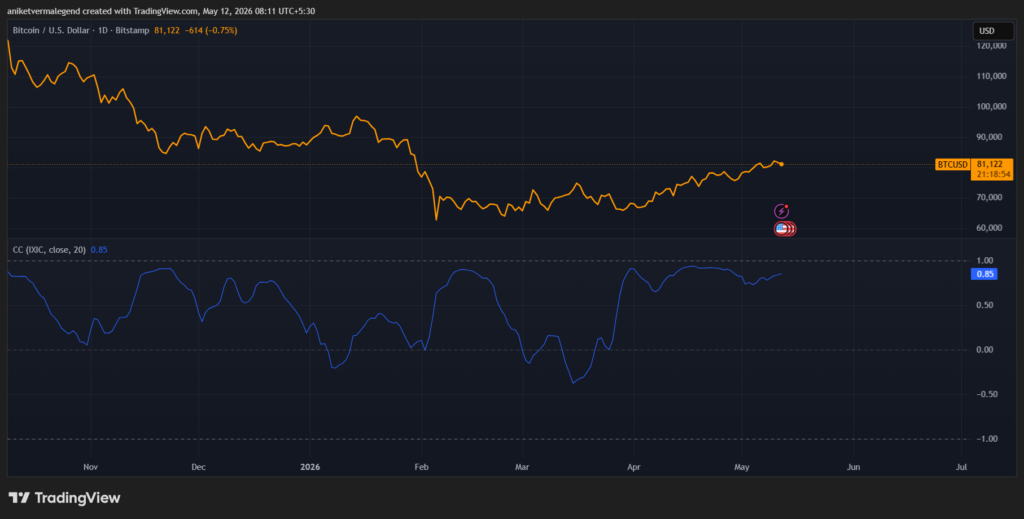
Dalio then pointed to Bitcoin’s “high correlation” with technology stocks, arguing that when investors face pressure elsewhere in their portfolios, they sell BTC to cover losses.
Notably, Bitcoin’s correlation with the Nasdaq Composite has indeed surged from 0.16 to 0.85 since the Iran war began, according to data from TradingView.

Bitcoin’s Resilience During The Iran Conflict
Dalio also pointed to Bitcoin’s “small and controllable market” as a limiting factor, contrasting it with gold, which he believes is more “widely held and deeply established.”
Bitcoin has lagged gold over the past year overall, but it has outperformed the yellow metal since the Iran war broke out on Feb. 28.
| Asset | Gains Since Iran War Began +/- | 1-Year Gains +/- | Price (Recorded at 9:48 p.m. EDT) |
|---|---|---|---|
| Bitcoin | +23.12% | -21.84% | $81,150 |
| Gold |
-10.35% | +46.28% | $4,731.92 |
Saylor’s Argument
Michael Saylor, Bitcoin advocate and Strategy Inc (NASDAQ:MSTR) Executive Chair, joined the debate by arguing that BTC serves as a “suitable global collateral.”
He highlighted that since Strategy’s shift to the Bitcoin Standard, the cryptocurrency has outperformed gold with superior risk-adjusted returns.
Disclaimer: This content was partially produced with the help of AI tools and was reviewed and published by Benzinga editors.
Photo: Memory Stockphoto / Shutterstock
Recent Comments