
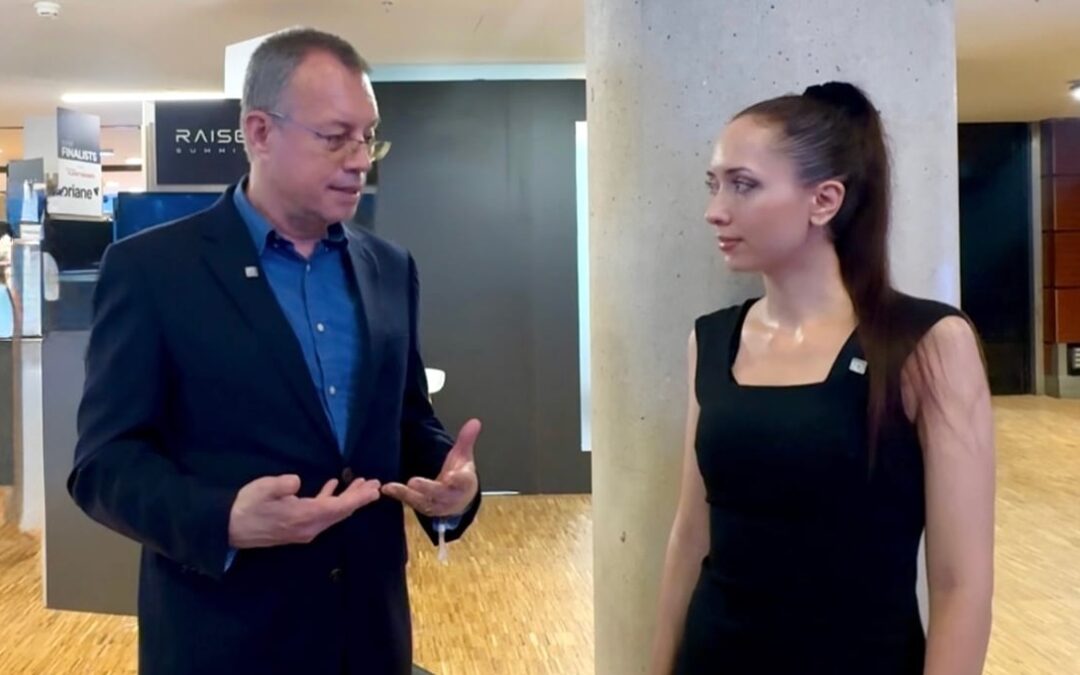

Credit: Ion Stoica(Co-Founder&Executive Chairman Databricks, co-Founder Arena) with Anna Tutova(Founder AI Crypto Minds) at RAISE AI Summit in Paris.
In a quiet conversation just before Databricks signed a $188 billion funding round, co-founder Ion Stoica laid out why enterprise AI is moving from “tokenmaxxing” to “valuemaxxing” and what it means for everything from open source to jobs.
On 16th July Databricks announced that it signed a term sheet for a strategic funding round of $3B, that values the data-and-AI company at $188 billion. Led by Coatue and expected to close later this summer, the deal is the latest sign that investors are still racing to back enterprise AI at almost any price.
But in a quiet conversation just before the news broke, Databricks co-founder Ion Stoica wasn’t talking about valuations. He was explaining why the real race is no longer about building the most powerful model. It’s about helping companies pick the right one, for the right job, at the right cost.
Ion Stoica, a serial entrepreneur and UC Berkeley professor, now splits his time among Databricks, the distributed-computing unicorn Anyscale, and his newest venture, Arena. The latter grew out of a 2023 Berkeley research project that posed a deceptively simple question: when two chatbots answer the same prompt, how do you know which is better?
How Arena Became the Referee of the AI Wars
“We give people answers from two random, anonymized large language models,” Ion Stoica said. “The users can pick which one is better. Based on this information, we compute a rating very similar to Elo rating in chess or maybe ATP in tennis“. Arena quickly became the industry’s neutral ground. Before launching a new model, labs from Google to xAI to Anthropic now test it on Arena, hungry for unfiltered human feedback. The site lets anyone compare the top proprietary and open-source models and in exchange, collects the prompts and preferences that become a data moat. Arena then packages that into evaluation products for model providers, helping them not just benchmark but actually improve their systems.
The platform is already evolving beyond human feedback. Ion Stoica revealed Arena is building its own models to simulate users and predict preferences, enabling automated evaluation at scale. That same technology powers Max, an intelligent routing product that picks the best model for a given prompt, potentially under cost constraints, and is already available to users.
The next frontier is agentic AI. Arena recently launched evaluations for agentic workloads and is enabling agentic modes on its site, tools like OpenManus that are “very popular, going very fast.”
Ion Stoica’s own model-hopping habit mirrors the multi-AI strategy Databricks just placed at the center of its new fundraising. “I’m choosing all the top ones: Claude, Open AI`s GPT, Google Gemini. For the most important tasks, I compare them using Arena. For the same questions, they are going to emphasize different things in the answers, even if all the answers are high quality. And it’s good to see and to contrast between the answers to get an even better answer.” That instinct, that no single model rules them all, is exactly the bet Databricks is scaling with its Unity AI Gateway, a governance layer designed to help enterprises manage cost, security, and reliability across any model they plug in.
The $188 billion round accelerates that vision. The company plans to pour capital into Unity AI Gateway, into Genie (an AI coworker that converts business data into trusted actions), and into Lakebase, a serverless Postgres database built for AI agents. In the announcement, CEO Ali Ghodsi framed the pivot in a single phrase: enterprises are moving from “tokenmaxxing” to “valuemaxxing.” Ion Stoica’s daily workflow already lives there.
The Open-Source Gambit
Ion Stoica has long been an open-source evangelist. Databricks itself grew out of Apache Spark, the open-source data processing engine he helped create at Berkeley’s AMPLab. But his support for open-source AI models comes with a hard-nosed caveat.
“Obviously, you want open source, people will not use an open source model just because it’s open source, at least in most cases…they have to be very high quality“, – he said. “We do have the large open source models which are very high quality, a lot of them coming from China today.”
That observation lands differently in July 2026 than it would have a year ago. With US export controls tightening on the most powerful American models and China signaling potential export controls of its own, Ion Stoica sees a geopolitical tailwind for open source. “I think we are going to see more and more organizations, enterprises betting on the open source models because they provide the most reliable access to intelligence”.
He noted how quickly the landscape shifts: “One year and a half ago or two years ago, the best open-source models were from the US: Meta’s Llama models and so forth. Things are changing fast.”
On AI Bubbles, Jobs, and Why Humans Still Matter
The geopolitical dimension doesn’t shake his conviction that value, not just capability, will decide winners. Nor does the uneasy question hanging over the whole industry: are we in a bubble? “Obviously there is real value in AI, demonstrated by the revenue of OpenAI and Anthropic,” Ion Stoica said. “With any kind of new technologies, you are bound to overshoot, so probably there will be a correction, because humans are emotional. And there is an old saying that things are never as good as they seem and they are never as bad as they seem. So, it’s always kind of a correction. And given the magnitude of the capital, which is invested in AI, I think that any correction, even a small correction, will have a reasonably big impact“. He doesn’t think it’ll be harsh. But the physics is clear: what goes up must be corrected.
His optimism is rooted in a sober view of automation. “AI right now is like a tool. It`s a very powerful tool, but at the end of the day a tool. Say you are going to use AI and you are going to build a product, that adds new features to a product and so forth, so use all these very powerful coding engines. At the end of the day, if you are going to release it, deploy it, sell it, and something wrong happens, you as a human are liable. It’s not Anthropic or OpenAI, or Google and so forth. So, therefore, you still have to be in control about what you release because you are responsible for what you are releasing.”
He broke problem-solving into three stages: deciding what to solve, generating a solution, and verifying it. “What AI automates more and more is the middle part: generating solutions. But still, as a human, you come up with what you want to build and so forth, and you are going to have to be in charge eventually. Actually the bottlenecks are humans coming up with what to solve, trying to figure out and to make them comfortable that indeed the solution generated by AI solves the problem.So, if humans are the bottleneck, this is an opportunity for new jobs.” The people who will thrive, he said, are experts, deep domain specialists who can judge whether an AI’s output holds up. “The best people who are going to get the most out of it are experts, the people who know how to use this tool the best.”
The Three Rules for Building the Next Unicorn
Ion Stoica has started and scaled multiple companies now: from Databricks to Anyscale, to Arena. When asked for advice for today’s entrepreneurs, he doesn’t talk about prompt engineering or model architecture. He talks about passion, trust, and bets.
“Number one, you start a company because you are passionate about the problem that company is going to solve,” he said. “You shouldn’t start a company just because you want to start a company, you want to own a company, you want to be the CEO of the company.”
Rule two is about the team. “There are going to be ups and downs. And as humans, when things are going down, you are going to start to point fingers and you are not going to point fingers to yourself. So, that kind of trust is very important to move over these kinds of hardships.”
Third, “You have to make a bet. If you don’t make a bet and you do things like everyone else is doing, then it’s much harder for you to differentiate and compete, especially since the companies you are competing with will be bigger than you. So, you have to make a bet, and if you are right, then you are going to have a tremendous advantage because others didn’t do it, and by the time they see that your bet was correct, then they have to catch up. So, you have an advantage.”
At Databricks’ recent Data + AI Summit (35,000 attendees in person, another 100,000 online) the company announced around 100 new products and features. Ion Stoica wouldn’t comment on the IPO question, but the market has already made its own bet. With a $6.9 billion revenue run rate growing 80% year-over-year and now a $188 billion valuation, Databricks is now fourth only to Anthropic, OpenAI and ByteDance among private tech companies, and it’s armed to deepen its AI acquisitions and research. The capital gives it room to keep compounding privately. The bet that Ion Stoica and his team made 13 years ago, that uniting data and AI on a single platform would become enterprise oxygen, has never looked more prescient.
After our conversation, I thought about Ion Stoica`s three rules for founders. Passion. Trust. A differentiated bet. Databricks’ latest round is the market’s verdict that the bet is still paying off. The question for the rest of us isn’t whether AI will reshape work. It’s whether we’ll be the ones deciding what problem to solve, or the ones waiting for someone else’s model to hand us an answer.
Benzinga Disclaimer: This article is from an unpaid external contributor. It does not represent Benzinga’s reporting and has not been edited for content or accuracy.
Recent Comments