
The European Union has taken new measures to protect its steel industry and curb the flood of low-value e-commerce parcels. The moves escalate its push to rebalance a trade relationship with China that officials now call strategically unsustainable.
The new rules on steel imports will protect EU plants and jobs from “the damaging impacts of global overcapacity,” the European Commission said on Tuesday. A day earlier, the commission announced a temporary €3 customs duty on low-value parcels imported from outside the EU. Most of these parcels arrive through e-commerce.
“Today’s change is about restoring fairness for European businesses and better protecting our consumers,” EC President Ursula von der Leyen said. “The surge in low-value online imports has put our retailers at an unfair disadvantage.”
The new measure, which went into effect on Wednesday, will likely impact Chinese platforms SHEIN, Temu, and AliExpress. About 5.9 billion low-value packages under €150 entered the EU last year without paying customs duties.
Industry analysts estimate that Chinese platforms have accounted for as much as 90% of these low-value parcels. This underscores the scale of the challenge.
EU’s China Trade Problem
The measures form part of a broader effort to rebalance EU-China trade. They also reflect an effort to reduce its economic exposure to China across consumer goods, clean energy, critical minerals, and advanced manufacturing.
The EU wants to rein in its rapidly expanding deficit with China, which widened in 2025 to around €360 billion. That is about €1 billion a day.
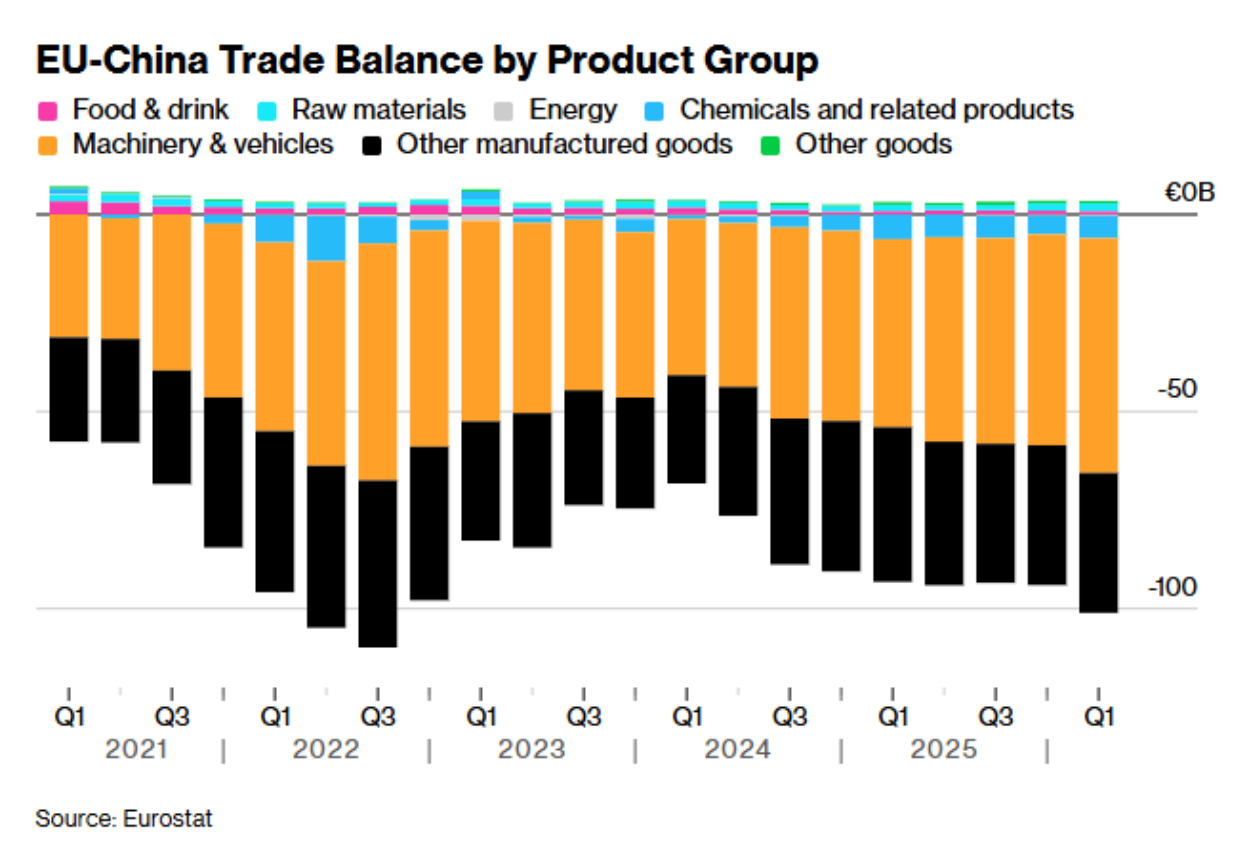
“We are fully aware of our dependencies on China, but we are equally aware that those dependencies are mutual,” Germany Chancellor Friedrich Merz said on Thursday. “We want to prevent the trade balance differences of the magnitude we are currently experiencing from growing.”
The EU followed a move by the US to strip Chinese imports of small-parcel tax exemptions. Despite political differences, Western nations are tightening coordination on trade security, drawing sharp pushback from Beijing.
Strategic Diversification Push
The EU wants to expand trade ties as part of its effort to diversify its supply chain away from China. An EU-Canadian delegation held talks on Monday in Montreal.
The goal was to strengthen resilient and diversified clean energy supply chains, a sector in which China dominates. Their talks focused on electricity grids, critical components, and the conditions needed to unlock private sector investment, the EC said in a statement.
“The EU-Canada partnership is not just a friendship of values,” Dan Jørgensen, European Commissioner for Energy and Housing, said. It is also a strategic asset — especially at a time when we face turbulent geopolitics and volatile energy markets.
China manufactured 92% of the world’s solar modules as of 2024, according to the Brookings Institution. That lead has persisted and, if anything, deepened. China also produces more than 80% of the world’s wind turbines, solar panels, and energy storage batteries.
Joining Pax Silica
Europe’s strategy extends beyond bilateral agreements. Brussels is also joining broader international initiatives designed to reshape critical supply chains.
The EU has joined the US-led Pax Silica. The decision is another part of the bloc’s latest push to reduce its economic dependency on China.
The EU joins a growing coalition of nations seeking to secure supply chains for semiconductors, critical minerals and artificial intelligence. The US State Department launched Pax Silica in December last year to strengthen trusted supply chains for semiconductors, critical minerals, energy infrastructure and AI.
“The future of AI will not be determined by who regulates first,” the State Department’s Under Secretary for Economic Affairs Jacob Helberg said on X. “It will be determined by who builds first and builds the most capacity. More energy. More compute.”
Rare Earth Dependency
Both the EU and the US want to reduce dependence on Chinese critical minerals while expanding domestic and allied supply chains. Rare earth elements are essential for semiconductor manufacturing, advanced electronics, batteries, military systems, and AI infrastructure.
China exercises a near-monopoly over the rare earth supply chain, according to the International Energy Agency (IEA). It controls 91% of global rare earth refining production and roughly half of the world’s known reserves.
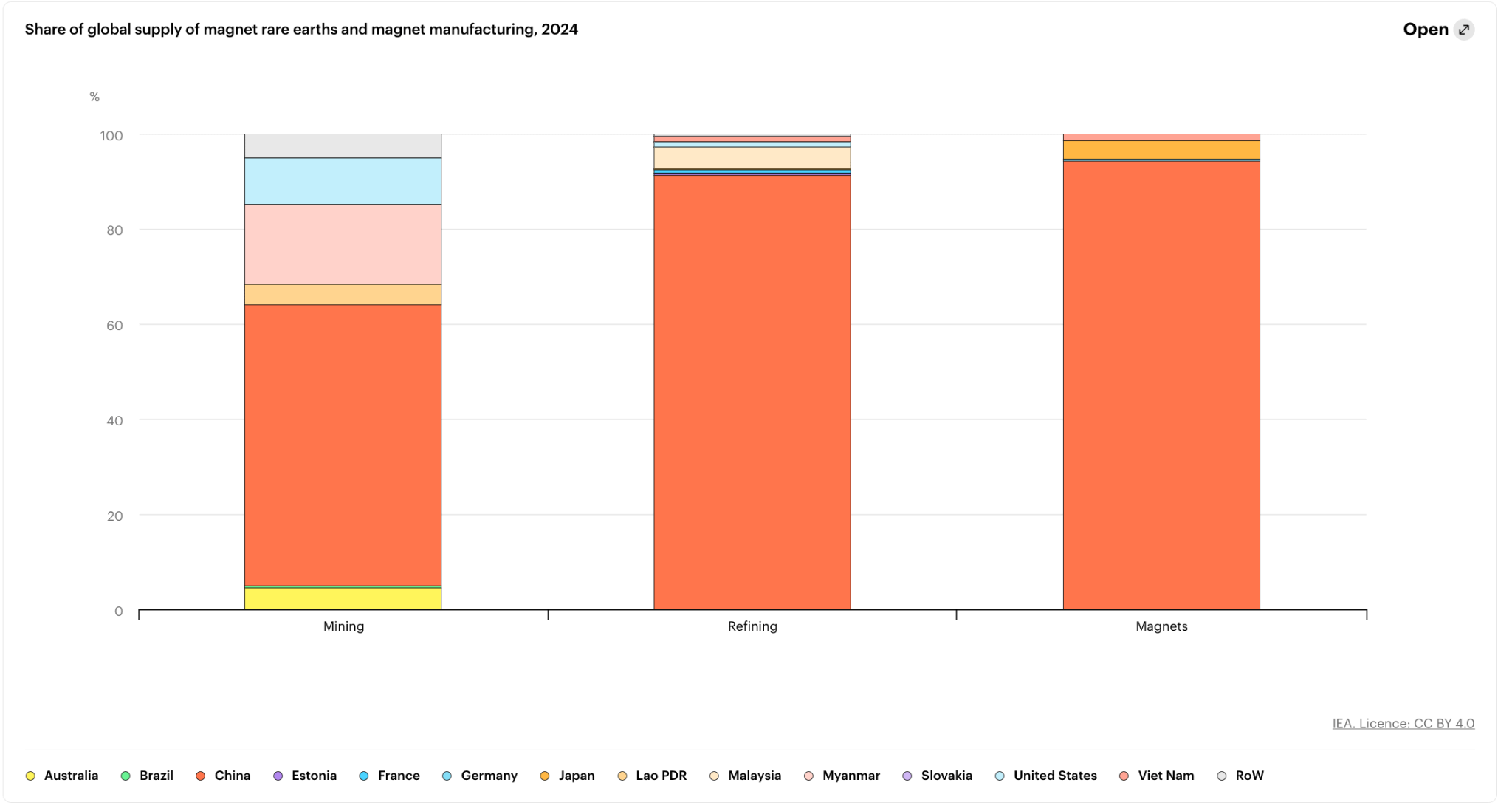
In 2025, the EU imported 47% of its rare earth elements and 98% of its rare-earth magnet supply from China.
“We cannot afford to depend on others for the technologies that keep our hospitals running, our energy grids stable, and our services secure,” von der Leyen said.
Europe’s Mining Challenge
Frameworks alone cannot solve Europe’s most acute vulnerability: rare earths. Reducing dependency also requires rebuilding Europe’s own upstream capacity.
Steps are being taken to do that. Sweden granted on Monday a 25-year exploitation concession for the Norra Karr project, one of Europe’s largest heavy rare-earth deposits.
The project, developed by the Canadian critical minerals explorer, Leading Edge Materials (LEMIF), contains dysprosium and terbium. These are used in permanent magnets for electric vehicles, wind turbines, and defense systems.
Chemical company Solvay SA (SVYSF) is increasing rare-earth processing capacity in France. Industrial manufacturer Neo Performance Materials (NOPMF) is expanding magnet production in Estonia.
A New Dependency Risk
Europe’s rare-earth ambitions have long been constrained by environmental permitting, local opposition and high production costs. The new projects aim to overcome these barriers.
But diversification away from China introduces a new dilemma. The EU is moving to cut its trade deficit and dependency on China for critical minerals and rare earths. In doing so, it risks opening itself to another problem.
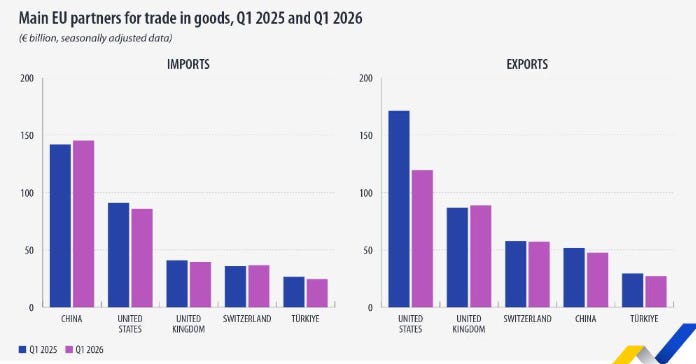
That is an overreliance on the US, which accounts for 13.7% of the EU’s imports. Those imports span technology, energy and critical inputs. In the first quarter of 2026, the US was Europe’s second-largest supplier of goods and services at €85.9 billion.
“It is certainly a real step change from ambition to delivery, but it’s still missing a couple of things,” Bernd Schaefer, CEO of EIT RawMaterials, said. “The US could become a second China, so to speak, in terms of another country for us to be import-dependent on for magnets.”
For Brussels, the challenge now is balancing diversification with resilience. It ensures that solving one dependency does not create another.
Disclaimer: Any opinions expressed in this article are not to be considered investment advice and are solely those of the authors. European Capital Insights is not responsible for any financial decisions made based on the contents of this article. Readers may use this article for information and educational purposes only.
Benzinga Disclaimer: This article is from an unpaid external contributor. It does not represent Benzinga’s reporting and has not been edited for content or accuracy.
Recent Comments