
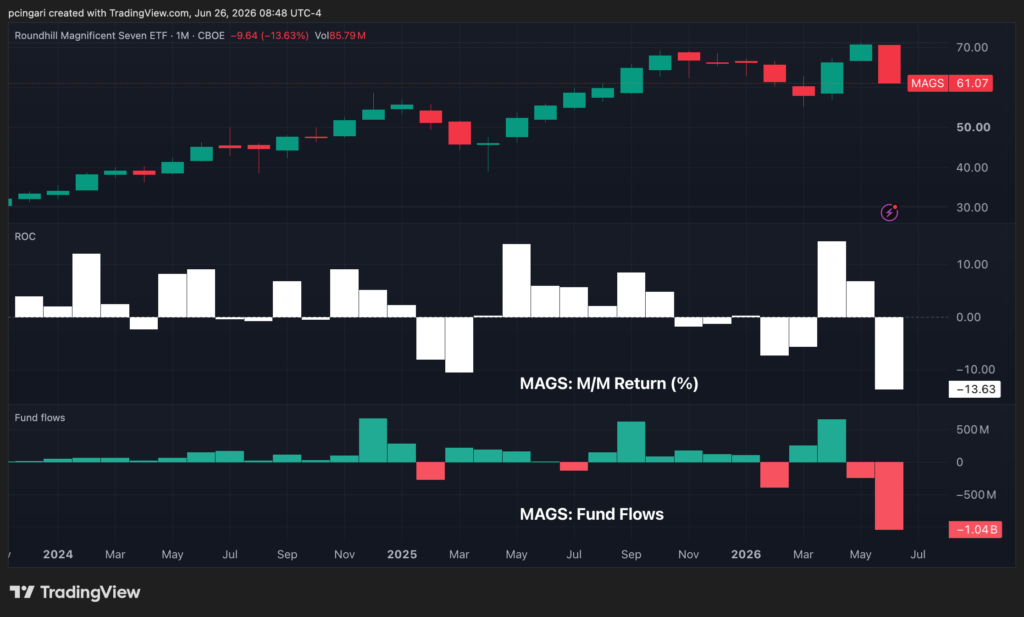
The trade that powered Wall Street for three years is having its worst month on record.
The Roundhill Magnificent Seven ETF (NYSE:MAGS) — the equal-weight basket that bundles the seven mega-cap technology leaders into a single ticker — is on track for its steepest monthly decline since it launched in April 2023, and investors are heading for the exits.
MAGS has fallen more than 13% in June and has bled over $1 billion in net outflows month-to-date, according to fund-flow data from Tradingview.
The slide dragged the fund into correction territory, down more than 14% from its May 14 record close of $70.94.
Is the market’s elite group merely showing cracks, or has it already crumbled?

All Seven In The Red
What makes June’s Magnificent seven selloff unusual is the breadth. In past wobbles, one or two names dragged while the rest held the line; this time the weakness is uniform.
Ranked by month-to-date performance, every member is down by high single digits or more:
- Microsoft Corp. (NASDAQ:MSFT) — down 21.64%
- Amazon.com Inc. (NASDAQ:AMZN) — down 16.12%
- Meta Platforms Inc. (NASDAQ:META) — down 14.17%
- Tesla Inc. (NASDAQ:TSLA) — down 13.92%
- Apple Inc. (NASDAQ:AAPL) — down 11.83%
- Alphabet Inc. (NASDAQ:GOOGL) — down 9.10%
- Nvidia Corp. (NASDAQ:NVDA) — down 7.29%
Microsoft is not only the group’s worst performer in June but is on pace for its steepest monthly drop since December 2000, as investors question the payoff on its ballooning data-center budget. Even Nvidia, the relative outperformer, sits firmly in the red.
Why The Money Is Leaving
The selloff is less about broken businesses than about a single question: when does the AI spending pay off?
The four big hyperscalers — Microsoft, Amazon, Alphabet and Meta — are set to spend more than $700 billion on AI infrastructure in 2026, a steep jump from a year earlier. Microsoft alone guided capital expenditure toward roughly $190 billion, about 61% above the prior year, even as it warned that operating margins would slip toward 44%.
With profit growth across the Magnificent Seven slowing to its weakest pace since 2022, investors are no longer willing to pay up for spending without visible returns.
A fresh catalyst arrived this week from the memory market. Micron Technology Inc. (NASDAQ:MU) delivered blowout earnings, up nearly tenfold from a year earlier, underscoring how far the price of the memory chips feeding AI data centers has climbed. Those higher costs land squarely on the Magnificent Seven, the largest buyers of that memory.
Apple has already signaled it will raise prices because of the memory crunch, and Nvidia sits awkwardly in the middle — selling the AI accelerators everyone wants while paying ever more for the high-bandwidth memory bolted onto them.
The mirror image of the Magnificent Seven’s pain is the rise of the companies they are paying.
As money leaves MAGS, it is rotating toward the suppliers — memory makers such as Micron, South Korea’s SK Hynix and Samsung, plus the networking, power and data-center names that monetize the buildout directly.
For now, the verdict is in the flows. After three years as the market’s undisputed engine, the Magnificent Seven spent June looking a lot more like dead weight.
Photo: Shutterstock
Recent Comments