
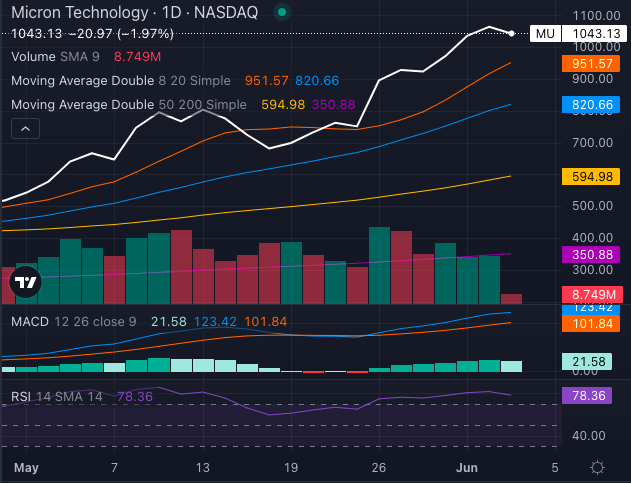
Micron Technology, Inc. (NASDAQ:MU) stock has climbed so far, so fast that it is flashing one of the market’s most dependable warning signs.

Chart created using Benzinga Pro
The memory-chip maker has surged roughly 190% year-to-date, pushing shares about 197% above their 200-day moving average, 75% above their 50-day moving average. Its Relative Strength Index, or RSI, has climbed to over 78, a level technical traders typically associate with overbought conditions and elevated pullback risk.
Yet Micron keeps making new highs.
The question for investors is simple: Why isn’t the market taking profits?
Technical Warning Signs Flash Red
Historically, semiconductor stocks trading this far above long-term trend lines tend to cool off. Momentum indicators such as RSI are designed to identify exactly these kinds of stretched conditions.
Micron’s chart checks many of those boxes.
The stock is trading over 75% above its 50-day moving average and nearly 27% above its 20-day moving average. Meanwhile, the RSI remains firmly above the 70 threshold that many traders view as a potential sell signal.
Under normal circumstances, that setup would suggest a pause, consolidation or even a correction.
Instead, Micron has largely ignored the textbook script.
The AI Memory Bottleneck
The reason may have less to do with technical momentum and more to do with what investors believe Micron has become.
For decades, memory stocks were viewed as some of the most cyclical names in the semiconductor sector. Investors focused on DRAM pricing, inventory levels and the timing of the next downturn.
Today, the narrative is different.
The explosive buildout of artificial intelligence infrastructure has created unprecedented demand for high-bandwidth memory, or HBM, the advanced memory technology used alongside AI accelerators from companies such as Nvidia Corp.
Micron has repeatedly highlighted strong HBM demand, with much of its production capacity already committed well into future periods. Instead of debating where memory prices peak, investors are increasingly focused on whether the industry can produce enough advanced memory to satisfy AI demand.
That shift is changing how the market values memory companies.
Not A Memory Stock — An AI Infrastructure Play?
The biggest takeaway from Micron’s chart may not be that the stock is overbought.
It may be that investors no longer see Micron as a traditional memory stock.
The market appears willing to overlook stretched technical indicators because it views Micron as a critical bottleneck in the AI supply chain. As long as demand for AI servers, accelerators and advanced memory continues to outpace supply, traders seem comfortable paying a premium for exposure.
That doesn’t mean the stock is immune to a pullback. History suggests no rally moves higher forever.
But for now, Micron’s chart is sending an unusual message: one of Wall Street’s most reliable sell signals is flashing, and investors simply don’t seem to care.
Photo: Thrive Studios ID on Shutterstock.com
Recent Comments