
Over the weekend, investor Michael Burry questioned the financial plumbing behind the artificial intelligence boom, arguing that complex financing arrangements may be masking how billions of dollars worth of Nvidia Corp (NASDAQ:NVDA) GPUs are funded and held across balance sheets.
Michael Burry Calls Nvidia AI Boom ‘Fugazi’
Burry, known for predicting the 2008 housing crash, pushed back against optimism around Nvidia after CNBC’s Jim Cramer said the chipmaker remained a winner despite the stock feeling “heavy again.”
Responding to Cramer, Burry wrote, “There are good reasons for this Jim. It is all Fugazi. How to make tens of $billions worth of NVDA GPUs disappear from balance sheets in 8-12 byzantine stepspvs.”

Michael Burry Questions AI Financing Structures Behind Nvidia Demand
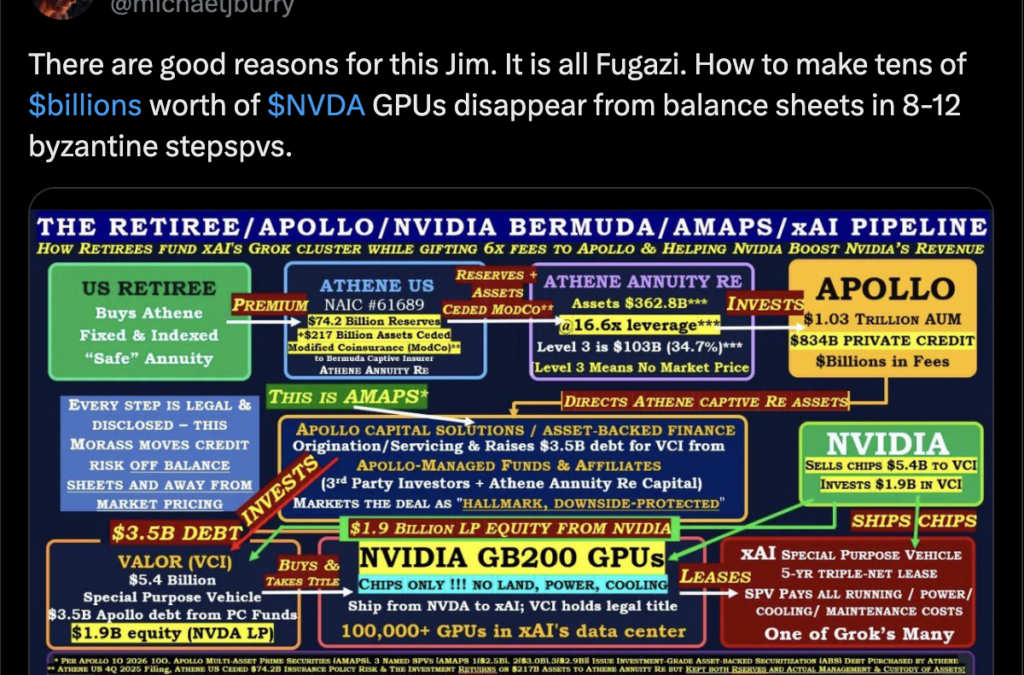
Burry also shared a detailed graphic outlining what he views as an increasingly complex chain connecting retirees, insurers, private credit firms, financing vehicles and AI infrastructure.
The diagram argues that retirement money flowing into annuities ultimately supports financing structures involving insurers, reinsurance entities, private credit firms and special purpose vehicles, or SPVs, which then help fund AI infrastructure purchases.
According to the chart, Nvidia sells GPUs into financing structures where ownership may sit with separate entities rather than the end users operating the hardware.
At the center of Burry’s criticism is the idea that AI infrastructure growth may rely more heavily on structured finance, leverage and off-balance-sheet arrangements than investors realize.
Nvidia did not immediately respond to Benzinga’s request for comments.
Burry Continues To Target Nvidia
In March, Burry alleged that Nvidia blocked Advanced Micro Devices, Inc. (NASDAQ:AMD) from a major AI infrastructure deal and said the U.S. Department of Justice has been probing the company for nearly two years.
He also accused Nvidia of operating in a “mafia-like” way in the AI chip market, warning it could face antitrust scrutiny.
Separately, researcher Shanaka Anslem Perera, in a November 2025 blog post, claimed a “$610 billion fraud” narrative, citing red flags in Nvidia’s finances, including rising receivables, longer payment cycles, higher inventory, and weaker cash conversion versus peers.
Price Action: Nvidia closed at $211.14, down 1.45% and then rose in pre-market trading to $214.50, up 1.59%, according to Benzinga Pro.
NVIDIA Corp ranks in the 98th percentile for growth in Benzinga Edge Stock Rankings, showing strong performance across short, medium and long-term time frames.

Disclaimer: This content was partially produced with the help of AI tools and was reviewed and published by Benzinga editors.
Photo courtesy: Mijansk786 / Shutterstock.com
Recent Comments