
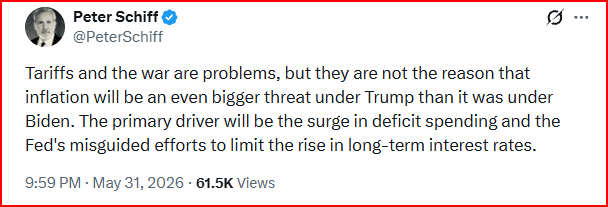
Economist Peter Schiff explains that the inflation threat under President Donald Trump is not just due to his tariff policies and the Iran War, but larger macro issues.
On Sunday, Schiff argued on X that tariffs and war are not the main reasons driving inflation more under Trump than under former President Joe Biden. Instead, he believes rising government deficits and the Federal Reserve’s efforts to suppress long-term interest rates will be the main triggers of higher inflation.
“The primary driver will be the surge in deficit spending and the Fed’s efforts to limit the rise in long-term interest rates,” wrote Schiff.

Rising Debt Fuels Economic Debate
This statement comes in the wake of Schiff’s previous criticism of Trump’s economic policies. He questioned the President’s intention to impose short-term financial burdens on Americans for war, while avoiding similar sacrifices to reduce government spending and the federal deficit.
The U.S. is currently grappling with billions in war spending amid a $2 trillion deficit. At the same time, the latest data indicates headline inflation is at 3.8% year-over-year, the highest since 2023.
Sen. Rand Paul (R-Ky.) argued that America’s greatest threat is not foreign adversaries but its growing debt and weakening dollar. He criticized the rising costs of entitlement programs such as Medicare and Social Security and warned that excessive debt is undermining the nation’s financial stability.
This situation is further exacerbated by the Treasury Department’s primary dealers, who estimate the U.S. will need about $2.04 trillion in net borrowing in fiscal 2026, with borrowing expected to stay above $2 trillion annually through 2028.
The Office of Management and Budget projects a $2.065 trillion deficit for 2026, higher than the Congressional Budget Office’s $1.853 trillion estimate. The projections come as U.S. national debt nears $39 trillion and borrowing costs remain elevated.
Disclaimer: This content was partially produced with the help of AI tools and was reviewed and published by Benzinga editors.
Photo courtesy: Shutterstock
Recent Comments