
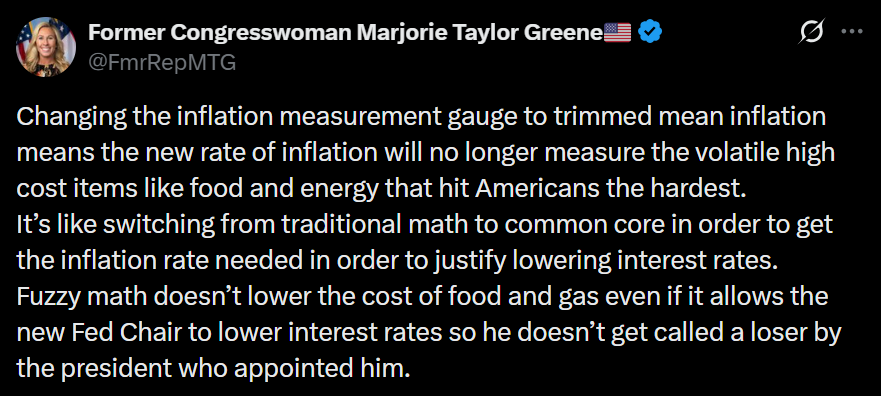
Marjorie Taylor Greene slammed the new Federal Reserve Chair, Kevin Warsh, in a social media post on Sunday.
The Former Georgia Congresswoman said that placing greater emphasis on “trimmed mean” inflation would downplay the impact of rising food and energy prices on American households.
“Fuzzy math doesn’t lower the cost of food and gas even if it allows the new Fed Chair to lower interest rates,” Greene said in a post on X.
Fed Chair’s Inflation View
Warsh, at his confirmation in April, urged policymakers to place greater emphasis on alternative inflation measures such as trimmed mean inflation, which excludes the largest monthly price increases and declines to better capture underlying price trends.
He suggested that conventional inflation measures can be overly influenced by short-term shocks, making trimmed mean inflation a more reliable guide for policymakers.

The Debate Over Inflation Metrics
Greene suggested that a greater reliance on trimmed mean inflation could make it easier for the Federal Reserve to justify lowering interest rates, a move that has drawn increased attention from politicians and investors alike.
In her post, Greene compared the potential shift to “switching from traditional math to common core,” arguing that changing how inflation is measured does little to address the higher costs Americans continue to face at grocery stores and gas pumps.
Economist and co-founder of Echelon Wealth Partners, Peter Schiff in response to Greene on X claimed that official inflation measures systematically understate the true pace of price increases because the government has repeatedly changed how inflation is calculated.
Inflation Remains Stubborn
Greene argued that shifting to trimmed mean inflation would exclude some of the most volatile costs, including food and energy prices, which she said have the greatest impact on American households.
American consumers paid more for goods and services in April than they had in nearly three years. Inflation rose 3.8% year-over-year—its highest level since 2023.
The central bank remains caught between signs of slowing growth and inflation that continues to run above its 2% target, complicating decisions on future interest-rate cuts.
Disclaimer: This content was partially produced with the help of AI tools and was reviewed and published by Benzinga editors.
Photo: Shutterstock/Consolidated News Photos
Recent Comments