
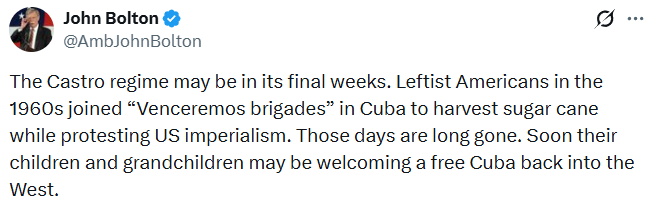
Former U.S. National Security Advisor John Bolton said Cuba’s communist government “may be in its final weeks,” citing economic pressure, U.S. legal action, and military signaling accelerating a crisis inside the Castro regime.
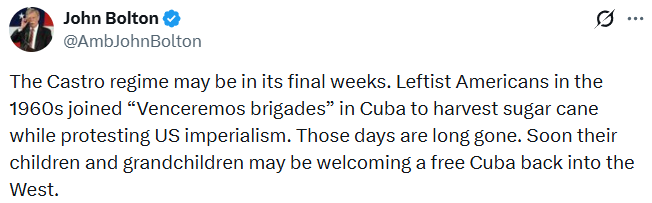
In an article written by Bolton in The Telegraph, published Saturday, he argued a combination of factors is shifting the balance against President Miguel Diaz-Canel, the Castro-family network, and the Communist Party.
Cuba’s Soviet Moment Returns
Bolton identifies Venezuela as the immediate catalyst. He argues that after the U.S. military captured Nicolas Maduro on Jan. 3, Washington cut off Caracas’s subsidized oil shipments to Havana.
According to Bolton, that move has effectively shut down Cuba’s already fragile economy. He draws a direct parallel to 1991, when the Soviet collapse ended similar subsidies, nearly toppling Fidel Castro. This time, no replacement patron is in sight. Nationwide blackouts have followed, sparking anti-regime protests.
Washington Closes In
On May 20, the Justice Department indicted former Cuban President Raul Castro for the 1996 downing of “Brothers to the Rescue” aircraft, killing three American citizens in international waters, and CIA Director John Ratcliffe‘s visit to Havana on May 14, as evidence that Washington is closing in on the regime.
According to Bolton, Cuban-Americans overwhelmingly want the entire Castro regime overthrown, not just a visible figure replaced.
President Donald Trump has for months hinted at taking control of Cuba, telling reporters in March that he could “do anything” with the island and calling a potential takeover “a big honor.” At a Miami summit later that month, Trump declared “Cuba’s next” before adding, “Please pretend I didn’t say that.”
After meeting with G7 counterparts in late March, Secretary of State Marco Rubio was asked directly whether the administration was pursuing regime change. He responded with a single word, “Yes.”
Under mounting pressure, Havana has also begun allowing Cubans living abroad to invest in and own businesses on the island. The move marks a significant policy shift for a system that has long restricted private ownership, as the government races to attract outside capital during the energy crisis.
Photo courtesy: paparazzza on Shutterstock.com
Disclaimer: This content was partially produced with the help of AI tools and was reviewed and published by Benzinga editors.
Recent Comments