
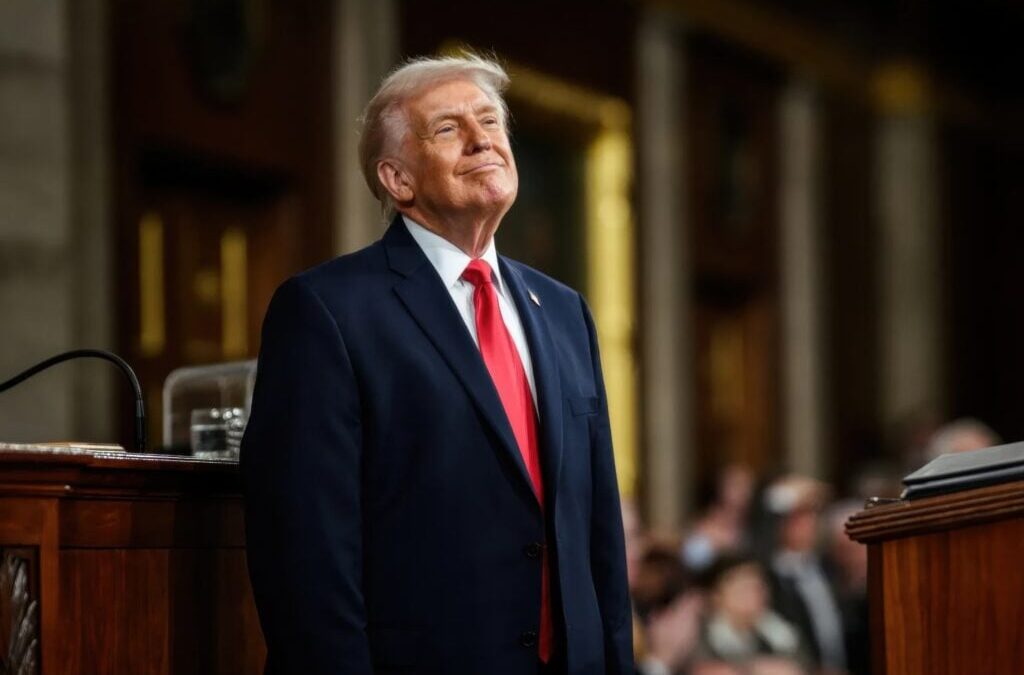
President Donald Trump‘s first-quarter 2026 ethics filing reads less like a disclosure form and more like a trading floor transcript.
A newly released Office of Government Ethics (OGE) filing shows Trump’s portfolio executed 3,642 securities transactions in Q1 — roughly 58 trades for every U.S. trading day in the quarter.
Trump certified the 113-page Form 278-T on May 8. The OGE received it on May 12. A handwritten notation on the cover page reads “Filer paid late fees,” indicating the disclosure window of 30 to 45 days set by 5 C.F.R. part 2634 was exceeded.
Benzinga contacted OGE to ask whether the transactions reflected direct trading activity by Trump or activity conducted through managed accounts or discretionary structures.
A spokesperson for the OGE declined to address the specifics: “OGE is committed to transparency and citizen oversight of government. However, OGE does not respond to questions about specific ethics disclosures.”
Trump’s Q1 2026 Trading Disclosure Explained: Which Stocks Were Bought And Sold
Across the 3,642 transactions, purchases outnumbered sales by roughly two to one.
The publicly-traded companies that surfaced most on the report were dominated by AI infrastructure, cloud, and consumer technology.
The most actively traded names by frequency and estimated notional range were:
| Stock / ETF | # of Purchases | Total Estimated Purchase Range | # of Sales | Total Estimated Sales Range |
|---|---|---|---|---|
| Microsoft Corp. (NASDAQ:MSFT) | 14 | ~$2.4M–$8.1M | 5 | ~$5.6M–$26.3M |
| Amazon.com Inc. (NASDAQ:AMZN) | 13 | ~$2.5M–$8.3M | 5 | ~$5.5M–$26.0M |
| Oracle Corp. (NYSE:ORCL) | 11 | ~$2.2M–$10.6M | 4 | ~$32K–$130K |
| Texas Instruments Inc. (NASDAQ:TXN) | 11 | ~$1.2M–$5.6M | 0 | $0 |
| Alphabet Inc. (NASDAQ:GOOGL) | 11 | ~$2.0M–$4.2M | 0 | $0 |
| Netflix Inc. (NASDAQ:NFLX) | 10 | ~$569K–$1.3M | 5 | ~$1.3M–$5.6M |
| Advanced Micro Devices Inc. (NASDAQ:AMD) | 10 | ~$635K–$1.4M | 4 | ~$18K–$95K |
| Uber Technologies Inc. (NYSE:UBER) | 10 | ~$1.2M–$5.5M | 4 | ~$602K–$1.3M |
| Meta Platforms Inc. (NASDAQ:META) | 10 | ~$1.0M–$2.2M | 3 | ~$751K–$1.5M |
| Walt Disney Co. (NYSE:DIS) | 10 | ~$363K–$995K | 1 | ~$100K–$250K |
| Nvidia Corp. (NASDAQ:NVDA) | 9 | ~$1.8M–$6.6M | 4 | ~$1.8M–$3.5M |
| Berkshire Hathaway Inc. (NYSE:BRK) | 9 | ~$347K–$880K | 3 | ~$66K–$165K |
| Home Depot Inc. (NYSE:HD) | 9 | ~$497K–$1.1M | 2 | ~$300K–$600K |
| Mastercard Inc. (NYSE:MA) | 9 | ~$213K–$595K | 2 | ~$251K–$515K |
| Costco Wholesale Corp. (NASDAQ:COST) | 9 | ~$1.5M–$6.2M | 1 | ~$15K–$50K |
| Motorola Solutions Inc. (NYSE:MSI) | 9 | ~$1.4M–$6.0M | 1 | ~$15K–$50K |
| AT&T Inc. (NYSE:T) | 9 | ~$397K–$1.0M | 0 | $0 |
| UnitedHealth Group Inc. (NYSE:UNH) | 9 | ~$234K–$610K | 0 | $0 |
| Verizon Communications Inc. (NYSE:VZ) | 8 | ~$333K–$895K | 6 | ~$317K–$830K |
| Adobe Inc. (NASDAQ:ADBE) | 8 | ~$1.3M–$5.8M | 5 | ~$103K–$295K |
| Workday Inc. (NASDAQ:WDAY) | 8 | ~$1.1M–$5.4M | 5 | ~$118K–$345K |
| Palantir Technologies Inc. (NASDAQ:PLTR) | 8 | ~$261K–$665K | 4 | ~$1.1M–$5.3M |
| Procter & Gamble Co. (NYSE:PG) | 8 | ~$1.2M–$5.6M | 3 | ~$66K–$165K |
| Apple Inc. (NASDAQ:AAPL) | 8 | ~$2.1M–$7.2M | 1 | ~$15K–$50K |
| Visa Inc. (NYSE:V) | 7 | ~$233K–$645K | 3 | ~$266K–$565K |
The dollar value of those purchases varied widely:
- Oracle alone accounted for an estimated $2.2 million to $10.6 million in purchases.
- Microsoft purchases totaled an estimated $2.4 million to $8.1 million.
- Amazon buys reached an estimated $2.5 million to $8.3 million.
- Nvidia purchases sat between $1.8 million and $6.6 million.
- Apple between $2.1 million and $7.2 million.
- AMD purchases, despite being frequent at 10 times, were sized smaller at an estimated $635,000 to $1.4 million combined.
A pattern worth flagging in the table: for Microsoft and Amazon, the number of purchases was much higher than the number of sales, but the dollar range of the sales was significantly larger than the dollar range of the purchases.
That means a smaller number of large-ticket sales offset a larger number of smaller buys.
The same pattern shows up for Palantir on the opposite side: 8 small purchases against 4 much larger sales.
The filing uses dollar ranges rather than exact figures, which is standard for the 278-T format.
Aggregate notional value across the entire filing falls in a wide band between roughly $220 million and $730 million, with a central estimate near $475 million.
Broad-market ETFs also appeared repeatedly throughout the filing, particularly the Vanguard S&P 500 ETF (NYSE:VOO) and SPDR S&P 500 ETF Trust (NYSE:SPY).
Trump’s Foreign Diversification Trade
Trump’s trading activity extended well beyond U.S. large-caps and major ETF tracking the U.S. stock market.
The filing records 19 transactions across nine different ETFs that provide exposure outside the United States, with the entire foreign push concentrated in roughly seven trading days between January 29 and March 10.
The largest single foreign-linked position is the iShares Core MSCI Emerging Markets ETF (NYSE:IEMG), which appears three times on the buy side.
- Row 31 of the report records a $1 million to $5 million purchase of the IEMG ETF on January 29.
- Row 54 adds a $500,000 to $1 million top-up on the same fund on March 4.
- Row 63 adds another $500,000 to $1 million purchase on March 10.
- The combined IEMG buying lands in an estimated range of $2 million to $7 million.
The same window captured purchases of iShares MSCI Canada ETF (NYSE:EWC), iShares MSCI Japan ETF (NYSE:EWJ), iShares Core MSCI Pacific ETF (NASDAQ:IPAC), iShares Core MSCI International Developed Markets ETF (NASDAQ:IDEV), iShares Currency Hedged MSCI Eurozone ETF (NYSE:HEZU), Vanguard FTSE Europe ETF (NYSE:VGK), iShares International Treasury Bond ETF (NASDAQ:IGOV), and iShares Gold Trust (NYSE:IAU).
Two things stand out from this cluster. First, there are no corresponding sales of any foreign-linked ETF anywhere in the 113-page filing.
The entire international book moved one direction — buying.
Second, the buying is unusually concentrated in time. Twelve of the 19 international purchases occurred on just two trading days: March 4 and March 10.
Combined estimated value of foreign-linked ETF purchases lands between roughly $5 million and $13.1 million.
| Foreign-Linked ETF | # of Purchases | Total Estimated Range | Dates |
|---|---|---|---|
| iShares Core MSCI Emerging Markets ETF | 3 | ~$2.0M–$7.0M | Jan 29, Mar 4, Mar 10 |
| iShares International Treasury Bond ETF | 2 | ~$750K–$1.5M | Mar 4, Mar 10 |
| iShares Gold Trust | 2 | ~$600K–$1.25M | Mar 5, Mar 10 |
| Vanguard FTSE Europe ETF | 2 | ~$500K–$1.0M | Mar 4, Mar 10 |
| iShares MSCI Canada ETF | 2 | ~$550K–$1.1M | Mar 5 + Mar 10 |
| iShares Core MSCI Intl Developed Markets ETF | 2 | ~$200K–$500K | Mar 4 + Mar 10 |
| iShares Core MSCI Pacific ETF | 2 | ~$150K–$350K | Mar 4 + Mar 10 |
| iShares Currency Hedged MSCI Eurozone ETF | 1 | ~$100K–$250K | Mar 10 |
| iShares MSCI Japan ETF | 2 | ~$100K–$200K | Mar 4, Mar 10 |
The Buying Accelerated During The Iran War, The Pace Of Trading Tripled In March
The most telling pattern in the filing is the cadence of the trading itself. Quarter activity divides cleanly into two halves: the period before Operation ‘Epic Fury’ and the period of the Iran war.
January recorded 380 transactions, split 242 purchases against 138 sales. February recorded 479 transactions, split 237 purchases against 242 sales.
The combined pre-war book — January and February together — captured 859 transactions with a buy-to-sell ratio of 1.26, essentially balanced.
On February 23 there were 49 sales, on February 26 there were 43, ahead of the geopolitical event that initially sent the S&P 500 sharply lower before it rebounded to record highs through March.
Operation ‘Epic Fury’ began over the February 28 weekend.
March alone recorded 1,319 transactions, split 983 purchases against 336 sales. That is more activity than January and February combined, and a buy-to-sell ratio of 2.93.
| Month | Total Transactions | # Purchases | # Sales | Buy/Sell Ratio |
|---|---|---|---|---|
| January 2026 | 380 | 242 | 138 | 1.75x |
| February 2026 | 479 | 237 | 242 | 0.98x |
| March 2026 (post-war) | 1,319 | 983 | 336 | 2.93x |
What Was Sold Before The War
In the five sessions before Operation Fury (Feb 23–27), the portfolio recorded 95 sales against 69 purchases.
The single largest pre-war sale was Walmart Inc. (NYSE:WMT), with a $250,000 to $500,000 ticket on Feb. 24 paired with a $100,000 to $250,000 sale the prior session — combined Walmart selling in the last week before the war landed in an estimated $350,000 to $750,000 range.
Other notable exits included Cincinnati Financial Corp. (NYSE:CINF) and Verizon Communications Inc. (NYSE:VZ), each in the $100,000 to $250,000 range.
Pre-Ceasefire, Pattern Inverts
The week starting on March 23 captured the most aggressive buying session of the entire quarter.
Monday March 23, saw 188 purchases against just 11 sales – the most active day on the quarter.
That day’s buying spread across nearly 190 distinct names, mostly sized between $1,000 and $50,000. The five largest tickets, each in the $100,000 to $250,000 range, were Molina Healthcare Inc. (NYSE:MOH), Match Group Inc. (NASDAQ:MTCH), Paycom Software Inc (NYSE:PAYC), Lamb Weston Holdings Inc (NYSE:LW) and Argan Inc (NYSE:AGX).
Across the four sessions from March 23 to March 27, the portfolio recorded 280 purchases against 93 sales.
The largest pre-ceasefire tickets were a $1 million to $5 million iShares Russell 1000 ETF (NYSE:IWB) buy on Mar. 27 and a $500,000 to $1 million top-up of Vanguard S&P 500 ETF (NYSE:VOO) on March 25.
The March 25 session also layered in single-name buys of Apple, Microsoft, Vertiv Holdings Co. (NYSE:VRT), AMD, Intel, Arista Networks Inc (NASDAQ:ANET), Lam Research Corp (NASDAQ:LRCX) and Qualcomm Inc (NASDAQ:QCOM).
Whether that timing reflects discretionary calls by the President, by a trust manager, or by a managed account is not specified anywhere in the filing.
The 278-T does not disclose the reporting structure beyond noting the filer.
What is documented is the pattern.
This report is based on the author’s review of the 113-page OGE Form 278-T. The filing was published as a scanned document, and a small subset of transactions could not be machine-classified due to scan quality. Aggregate figures cited reflect the classified subset and may carry small margins of error.
Image: Shutterstock
Recent Comments