
A colossal divergence is unfolding between Wall Street and Main Street.
While champagne flows on the trading floor and President Donald Trump celebrates the stock market at record highs, pessimism is spreading like wildfire outside Wall Street doors and straight into the kitchens of the average American family.
S&P 500, Nasdaq 100 Break Record Highs – Consumer Sentiment Hits Record Lows
On Friday, the S&P 500 Index – as tracked by the SPDR S&P 500 ETF Trust (NYSE:SPY) – rose to 7,400 points, while the Nasdaq 100 – mirrored by the Invesco QQQ Trust (NASDAQ:QQQ) – soared to a record of 29,000 points.
Both are on track to notch their sixth straight week of gains, the longest streak since October 2024.
A day earlier Trump wasted no time taking a victory lap, posting on Truth Social: “Trump’s Stock Market All-Time High.”
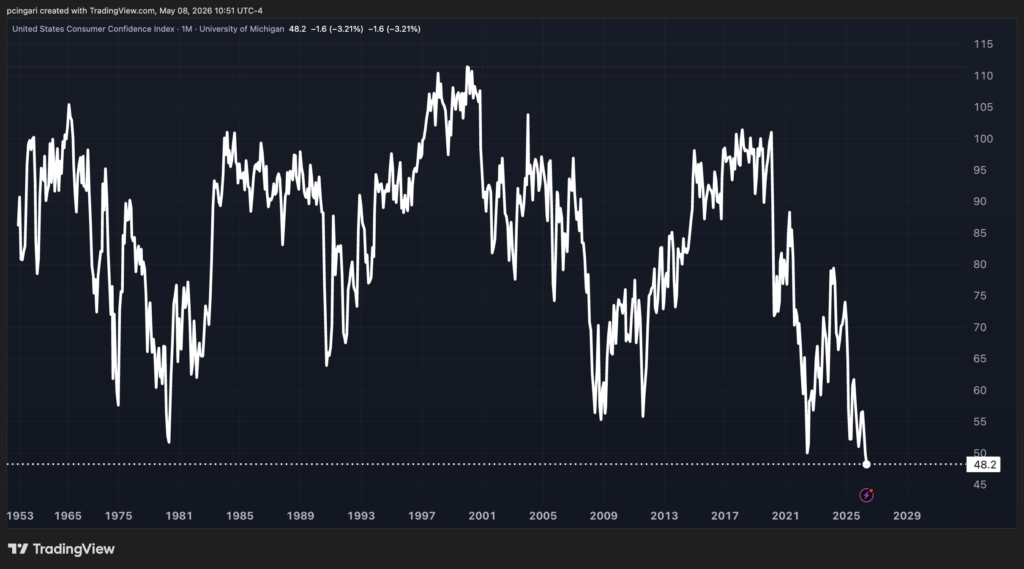
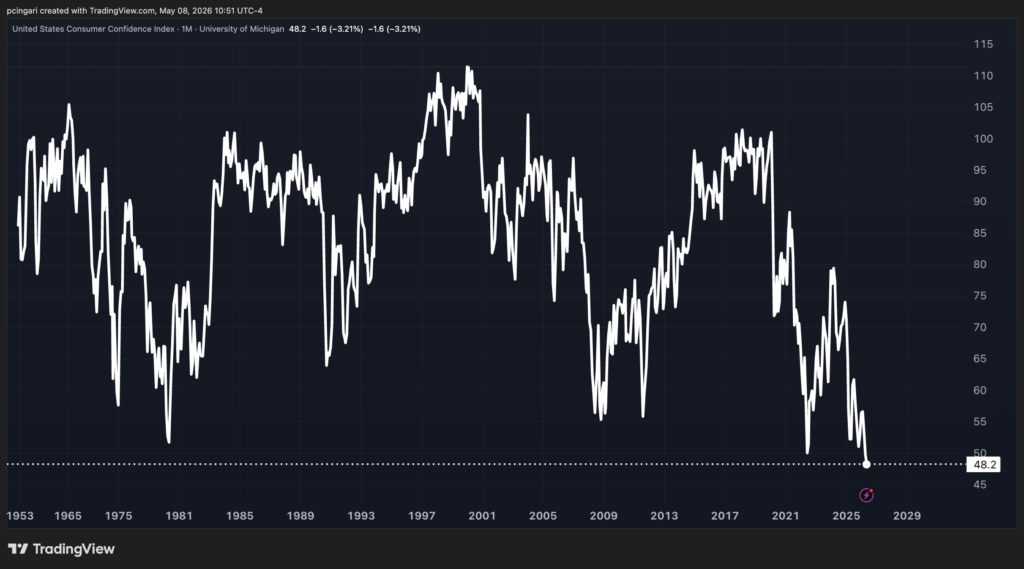
But just hours later, University of Michigan delivered a brutal counterpoint: U.S. consumer sentiment collapsed to 48.2 in May 2026 — the lowest reading ever recorded in the survey’s nearly 80-year history.
Let that sink in. Consumer mood is now worse than during the depths of the 2008 financial crisis, worse than the COVID lockdowns of 2020, and worse than the inflation panic of June 2022.
Chart: UMich Consumer Sentiment Drops To Lowest Levels Ever
The Real Driver: Gasoline And Tariffs
Survey director Joanne Hsu identified the culprits explicitly. About one-third of consumers spontaneously mentioned gasoline prices, and roughly 30% mentioned tariffs.
Real income expectations have been declining since March.
The Iran war that began in February 2026 sent crude oil prices surging 40%, pushing average U.S. gasoline prices to $4.55 per gallon.
Even with the recent ceasefire framework, the Strait of Hormuz remains effectively closed — keeping fuel costs elevated despite the headline peace rally on Wall Street.
“Middle East developments are unlikely to meaningfully boost sentiment until supply disruptions have been fully resolved and energy prices fall,” Hsu said.
Year-ahead inflation expectations sit at 4.5%, far above the 2.3-3.0% pre-pandemic range and well above the 3.4% reading from February 2026, before the Iran conflict began. Long-run inflation expectations remain at 3.4%, signaling that consumers struggle to believe the Federal Reserve can deliver on its 2% target.
The K-Shaped Reality
Here’s what the data really exposes: the share of consumers citing high prices as a drag on personal finances has reached 52% among households that don’t own equities, versus just 40% in the top income bracket — and even that latter figure is rising.
The wealth effect from record stock prices is concentrated at the top.
The Fed’s own data show that the top 10% of households own roughly 87% of all individually held equities.
For the bottom 50%, the S&P 500 hitting 7,400 is an abstraction. The price at the gas pump is not.
This is the textbook definition of a K-shaped economy: the asset-rich celebrate while the wage-earners struggle to fill their tanks.
Photo: Shutterstock
Recent Comments