
Crude is falling, gasoline prices keep climbing and refiners are cashing in.
The national average price of gasoline rose 25 cents for a second straight week to $4.56 a gallon, the highest level since the summer of 2022. Meanwhile, crude oil fell more than $7 on Wednesday, settling below $96 a barrel as ceasefire talks aimed at reopening the Strait of Hormuz advanced.
The Pump Tells One Story. The Barrel Tells The Other.
“Gasoline prices continue to face upward pressure from global supply concerns,” the AAA stated.
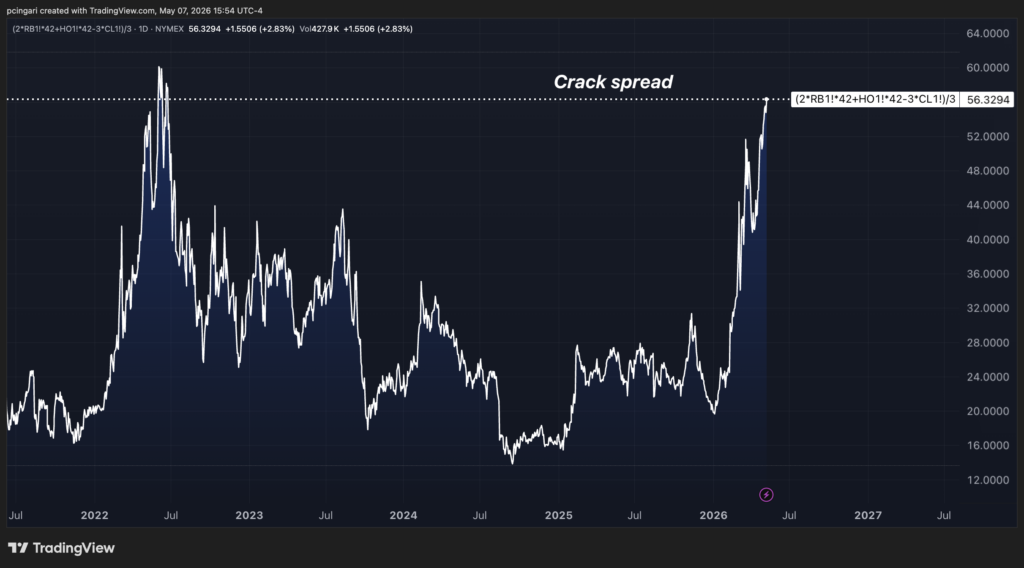
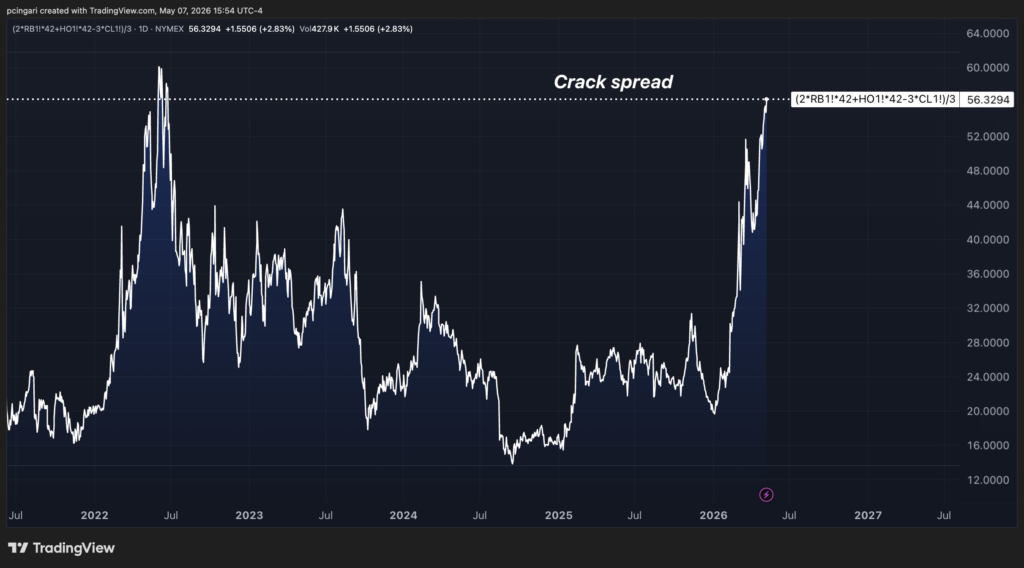
The 3-2-1 crack spread, the standard proxy for refining profit margins, just printed $56.22 a barrel on Thursday — its highest level since the post-Ukraine energy shock of June 2022.
When crude falls and pump prices keep climbing, refiners pocket the difference on every barrel they process.
According to U.S. Energy Information Administration data, U.S. crude inventories fell by 2.3 million barrels last week to 457.2 million, while gasoline demand softened from 9.1 million barrels per day to 8.81 million.
Demand cooled. Crude eased, but pump prices kept climbing.
What The Crack Spread Is — And Why It Matters Now
The crack spread is the gross margin a refinery captures for converting crude oil into gasoline and diesel.
The industry-standard 3-2-1 formula assumes that three barrels of crude are refined into two barrels of gasoline and one barrel of distillate, then subtracts the cost of crude from the value of the products.
Think of it as a coffee shop’s margin. Beans are the input cost — crude oil. The latte is the output — gasoline and diesel. The crack spread is what the barista keeps after paying for beans.
When wholesale coffee falls, and the price of a latte keeps climbing, the shop is having a very good morning.
That is exactly what is happening now. The chart of the 3-2-1 spread shows a near-vertical climb from roughly $20 a barrel last summer to $56.22 on Thursday — a 180% jump that puts the metric within reach of the all-time peak set during the post-Ukraine fuel shortage of June 2022.
The Stocks Capturing The Margin
- Marathon Petroleum Corp. (NYSE:MPC) reported first-quarter adjusted earnings of $1.65 per share on Tuesday, more than double the 75-cent consensus estimate, on adjusted EBITDA of $2.76 billion — up from $2 billion a year ago. The company also expanded its share buyback authorization by $5 billion, bringing total available repurchase capacity to $8.6 billion.
- Valero Energy Corp. (NYSE:VLO) set the tone the week before. The San Antonio refiner reported first-quarter adjusted earnings of $4.22 per share on April 30, blowing past the $3.16 consensus by 33% and reversing a $1.90 loss a year earlier. Refining segment operating income surged to $1.8 billion from a $530 million loss, on throughput of 2.9 million barrels per day. Valero raised its quarterly dividend 6% to $1.20 per share and returned $938 million to shareholders. Chief executive Lane Riggs cited constrained global refining capacity and low product inventories as the durable supports under margins.
- Phillips 66 (NYSE:PSX) surprised the market a day earlier on April 29, posting adjusted earnings of 49 cents per share against a 39-cent consensus loss — an 88-cent swing that lifted the stock 6.7% the same session. Realized refining margin jumped to $10.11 per barrel from $6.81 a year ago, with crude utilization climbing to 95% from 80%. The result came despite $839 million in mark-to-market hedging losses on short derivative positions. Phillips 66 raised its dividend 7% and ended the quarter with $6 billion in liquidity.
- HF Sinclair Corp. (NYSE:DINO) delivered the most asymmetric beat in the group on May 1. The Dallas-based refiner reported adjusted earnings of 69 cents per share against a 7-cent consensus, and reversed a 27-cent loss from the prior year. Adjusted refinery gross margin rose 9% to $9.95 per barrel, with West Coast strength offsetting weaker Mid-Continent capture. Net income reached $648 million. The exchange-traded fund tracking the performance of refiners is the VanEck Oil Refiners ETF (NYSE:CRAK), which closed at $49.15 on May 7 — within 5% of its all-time high of $53 set the same week and roughly 75% above its 52-week low.
Image: Shutterstock
Recent Comments