
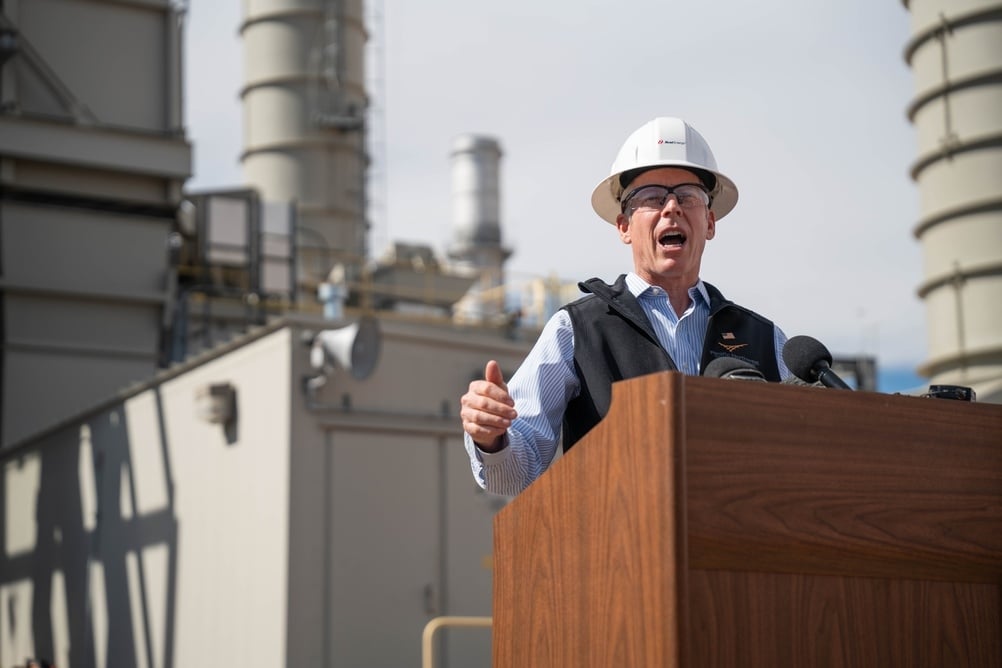
President Donald Trump has contradicted Energy Secretary Chris Wright‘s prediction on gas prices amid the ongoing Iran war.
During a phone interview with The Hill on Monday, Trump expressed his disagreement with Wright’s forecast that gas prices may not drop below $3 per gallon until next year.
“No, I think he’s wrong on that. Totally wrong,” Trump stated.
When asked about his expectation for a drop in gas prices, Trump responded, “as soon as this ends,” referring to the ongoing war with Iran. The U.S. currently maintains a blockade on all Iranian ports.
On the same day, Reuters reported that Pakistan’s army chief Asim Munir suggested to Trump that the U.S. blockade on Iranian ports poses a challenge to negotiations. Trump, however, refuted this claim in his conversation with The Hill, stating that Munir “didn’t recommend anything on the blockade.”
Trump further emphasized the strength of the blockade, saying, “The blockade is very powerful, very strong. They lose $500 million a day with the blockade up,” referring to Iran. “We control it. They don’t control it.”
Wright Predicts High Gas Prices
The ongoing tensions in the Strait of Hormuz have raised concerns over prolonged high gasoline prices.
Wright, in a conversation with CNN a day before, defended the pressure tactics and suggested that the passage through Hormuz is not safe, thereby justifying the U.S. blockade.
However, he also stated that gas prices might have peaked, but they would stay above $3 per gallon until next year.
According to AAA, the average gasoline price in the U.S. is at $4.042 per gallon.
Economists Say Relief Not in Sight
Economist Justin Wolfers warned that uncertainty around the Strait of Hormuz is not only driving current gas prices higher but also pushing up long-term price expectations through 2027 and beyond. He suggested Energy Secretary Chris Wright’s optimism may already be “outdated,” adding that without a resolution, high gas prices are likely to persist.
Meanwhile, economist Mark Zandi estimated that the war with Iran has already pushed U.S. gasoline costs up by an estimated $21.3 billion over the past six weeks, adding to the economic pressure on consumers.
Disclaimer: This content was partially produced with the help of AI tools and was reviewed and published by Benzinga editors.
Image via Shutterstock
Recent Comments