
A dire warning was just issued by the man at the center of the US Government through the GFC. What’s the warning now?
A Dire Warning
Henry Paulson just broke years of radio silence with a serious warning. The man who managed the U.S. Treasury through the 2008 financial crisis is now saying the Treasury market itself is heading toward a vicious emergency.
“We need an emergency break-the-glass plan, which is targeted and short-term, on the shelf, so it’s ready to go when we hit the wall.”
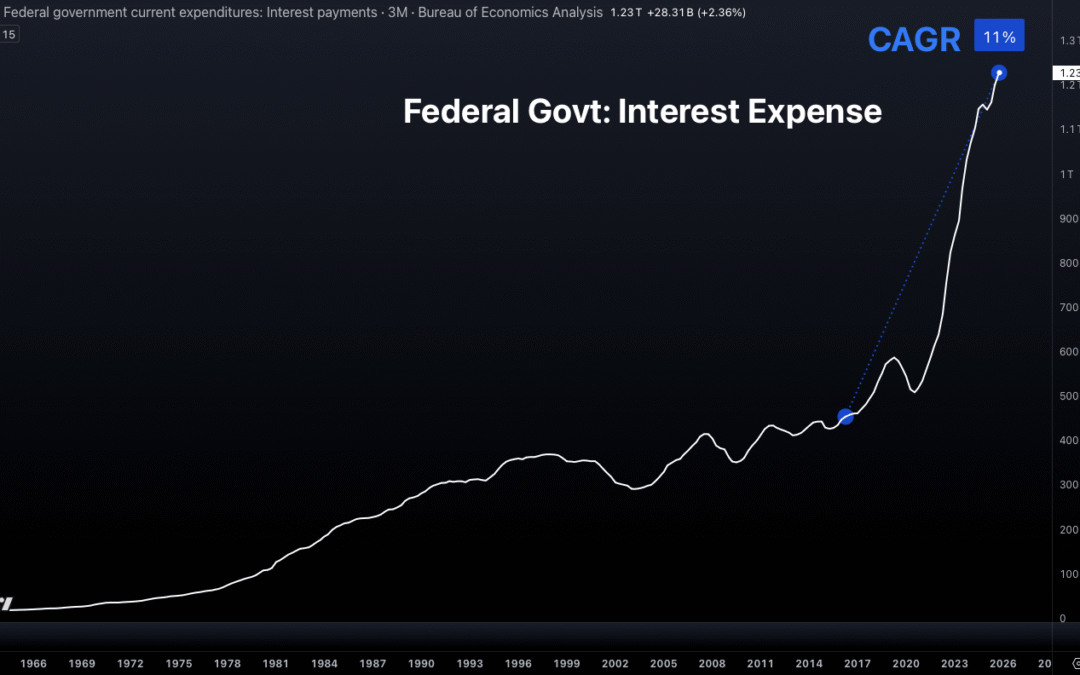
We’re sitting on $39 trillion in federal debt, with interest expense now over $1.2 trillion per year and growing at a terrifying 17% compound annual growth rate over the past six years. That works out to about $3.5 billion per day.

Annual interest expense, with CAGR since 2020.
As interest costs soar, we do not raise taxes- instead, we just issue even more debt (increasing the federal fiscal deficit, or the gap between federal spending and revenue). As more debt supply is issued, if demand does not rise at a commensurate rate, the price must decline.
And according to Paulson, foreign demand for Treasuries is no longer something we can count on.
In fact, the share of government debt that’s held by foreign and international investors has been declining for 14 years:

Foreign held debt, as share of total government debt
If buyers start to step back, even a little, it could trigger falling prices and therefore, Treasury yields to spike (yields and bond prices are inverse to one another. A rapid loss of confidence could come to what the world had long supposed to be the ultimate safe asset.
In an interview with Bloomberg this week, Paulson didn’t sugarcoat it:
“That’s a dangerous thing.” He went on, noting that should enough investors pull away, the Federal Reserve would be forced to step in as buyer of last resort.
In other words, the Fed would be forced to print money to buy our own debt.
A much larger problem
US Treasury debt is the collateral that underpins repo markets, derivatives, bank balance sheets, and the dollar’s reserve status worldwide. Remember that when most folks talk about the “dollar” as a reserve currency, US Treasuries are a core part of what they’re actually talking about (UST’s being interest-bearing dollars).
Concerns about US debt are not new, though they have started to rapidly increase, as seen in gold’s recent performance:

Concerns with US debt have been growing over recent years, helping push gold prices +161% over the past four years alone
When Treasuries wobble, the feedback loop across the entire financial system can turn very ugly, very fast.
We’ve seen pieces of this movie before- the Treasury flash crash in 2020 and the banking stress in March 2023 both required emergency Fed intervention. Each time it only accelerates the same structural shift: global capital moves away from unlimited, centralized, and permission-based fiat collateral and toward assets that have opposite attributes.
Historically, gold was the only option for such an alternative. Now, however, we have Bitcoin, which offers all of the same attributes as gold, but with several advantages:
-Bitcoin is more verifiable, more fungible, easier to transport, easier to store, cheaper to transact and much faster.
“People say, ‘When are you going to hit the wall?’ I obviously don’t know — it’s impossible to know. When we hit it, it will be vicious, so we have to prepare for that eventuality.”
While the Treasury market edges closer to this breaking point, Bitcoin continues to quietly do what it has done through every recent episode of monetary and fiscal stress: crushing outperformance.
No reliance on foreign buyers. No debt ceiling drama. No need for emergency backstops. Just fixed supply meeting growing demand in a world waking up to the fragility of traditional safe havens.
WANT MORE WOLF? Follow us on YouTube
Benzinga Disclaimer: This article is from an unpaid external contributor. It does not represent Benzinga’s reporting and has not been edited for content or accuracy.
Recent Comments