
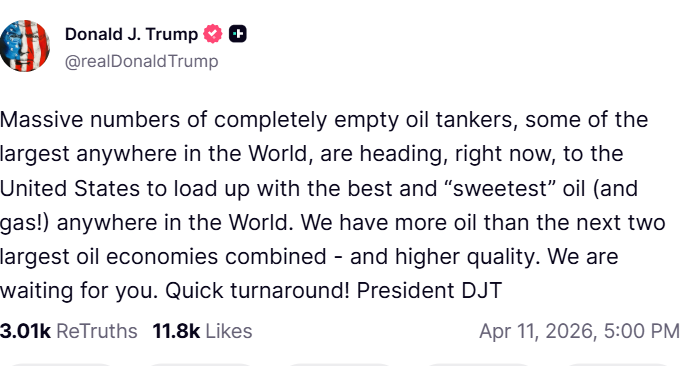
On Saturday, President Donald Trump said large, empty oil tankers are sailing to the U.S. to take on what he called the nation’s top-grade “sweetest” crude and gas, arguing domestic supply and quality outmatch rivals. His comments landed as oil markets remain on edge over the Hormuz shutdown, with Hormuz reopening timeline in focus while WTI traded around $95 a barrel.
In his Truth Social post, Trump wrote that some of the world’s biggest tankers are arriving empty for what he described as a quick load-and-go process, framing it as evidence of U.S. energy depth. Trump also claimed the U.S. holds more oil than the next two major oil economies combined.
Trumps Bold Claims About U.S. Oil Supremacy
Trump tied the surge of inbound vessels to demand for higher-quality barrels, saying the U.S. is “waiting for you” and promising “quick turnaround.” He also described U.S. output as both abundant and superior, positioning American crude as a substitute when other routes are disrupted.
That pitch comes as global buyers watch the Persian Gulf chokepoint that moves about 20% of worldwide oil and liquefied natural gas supply. With that corridor effectively frozen, tankers rerouting toward U.S. ports has become a tangible workaround for refiners and traders needing reliable cargoes.

In another post, Trump attacked media coverage of the Iran conflict and argued Tehran’s military capacity has been severely degraded, including naval and air assets. He also said mine-laying boats are no longer a threat and claimed the U.S. has begun clearing the Strait of Hormuz.
Market pricing reflected the tension: WTI was down 2.29% to $95.63 per barrel as of 6:18:50 p.m. EDT, while RBOB gasoline futures were up 0.63% to $3.0197 per gallon. ULSD heating oil futures fell 4.95% to $3.7421 per gallon, and natural gas futures slipped 0.64% to $2.653 per MMBtu around the same time.

Will Diplomatic Talks Reshape Energy Markets?
Separately, Trump told reporters, “It wont be easy … we will have that open fairly soon,” while discussing the effort to restore traffic through Hormuz. He also said other countries that depend on the route could pitch in, adding, “Other countries use the strait … and they’ll help out.”
The current stoppage followed Tehran’s move to block the passage after war broke out, cutting off one of the most important channels for seaborne energy. Tensions climbed after U.S. and Israeli strikes on Iran on Feb. 28 were followed by retaliation aimed at U.S. bases and Israeli targets.
Trump announced a ceasefire earlier this week, but commercial flows through the strait have not resumed, keeping supply chains strained. That backdrop helps explain why empty tankers would be repositioning toward U.S. loading points, where cargoes can be sourced without transiting Hormuz.
Talks between the U.S. and Iran are scheduled for Saturday in Islamabad, aimed at ending a six-week conflict, though Tehran signaled the meeting could be in doubt without commitments tied to Lebanon and sanctions relief. The U.S. team is led by Vice President JD Vance and includes special envoy Steve Witkoff and Trump’s son-in-law Jared Kushner, traveling after a refueling stop in Paris.
Escalating Tensions Impacting Oil Supply Dynamics
This situation unfolds as tensions between the U.S. and Iran remain high, with Trump stating that Iran is doing a “very poor job” of allowing oil through the Strait of Hormuz, which is critical for global oil supply. Predictions regarding a permanent peace deal between the two nations show skepticism, with a recent prediction market indicating only a 13% probability for an agreement by April 22, rising slightly to 20% by April 30 and peaking at 36% by May 31, reflecting uncertainty in diplomatic efforts.
The backdrop of these diplomatic challenges has substantial implications for oil markets, particularly as Trump emphasizes the importance of U.S. oil exports amidst these tensions. As negotiations evolve, the impact on oil supply routes and prices may intensify, further complicating the global energy landscape, especially in light of Trump’s claims regarding U.S. energy dominance amidst ongoing conflicts.
Recent Comments