
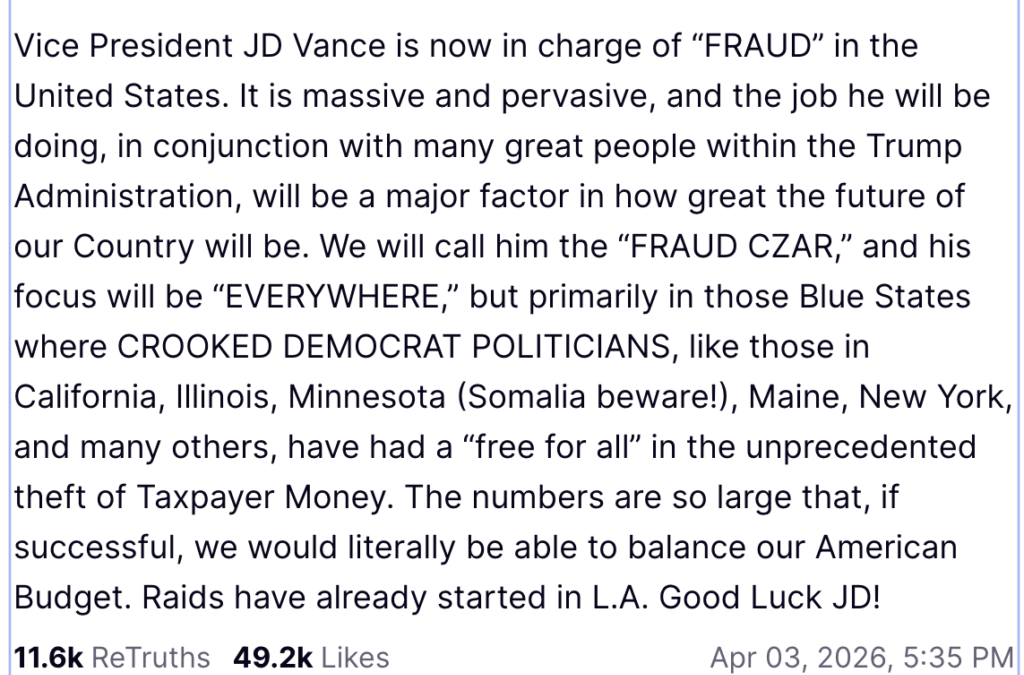
President Donald Trump appointed Vice President J.D. Vance “Fraud Czar” to head a federal anti-fraud initiative on Friday, offering no evidence for his claim that fraud is “massive and pervasive” across the U.S.
Trump made the announcement on Truth Social, emphasizing Vance’s role in the country’s future and directing focus primarily at Democrat-led states, including California, Illinois, Minnesota, Maine and New York, where he alleged “unprecedented theft of taxpayer money” without providing evidence.
“The numbers are so large that, if successful, we would literally be able to balance our American Budget. Raids have already started in L.A.,” Trump said.
The announcement follows Trump’s March 16 Executive Order establishing an anti-fraud task force.

Democrat-Led States In The Crosshairs
Citing fraud, Trump has repeatedly targeted Democrat‑led states such as Minnesota and California during his second term. The administration has taken actions, including freezing federal childcare funding and suspending Medicaid funding in Minnesota, as well as conducting raids in Los Angeles.
Both Minnesota Governor Tim Walz and California Governor Gavin Newsom have defended their states’ efforts to combat fraud, pointing to previous pardons issued by Trump to individuals convicted of fraud.
Vance’s 2028 Prospects Gain Momentum
The appointment follows Vance’s late March victory in the Conservative Political Action Conference’s (CPAC) 2028 presidential straw poll, where he secured 53% of the vote against Secretary of State Marco Rubio‘s 35%. However, at an early March Mar-a-Lago donor event, Trump reportedly asked attendees to choose between the two for the 2028 presidential nomination, with the crowd applauding louder for Rubio.
The designation represents the most formal consolidation of anti-fraud authority in Trump’s second term, placing J.D. Vance at the helm of a multi-agency crackdown — a move that increases pressure on Democrat-led states ahead of the 2026 midterms and raises Vance’s profile as an early frontrunner for the 2028 Republican presidential nomination.
Photo Courtesy: Shutterstock
Disclaimer: This content was partially produced with the help of AI tools and was reviewed and published by Benzinga editors.
Recent Comments