
On Thursday, speaking on the All-In podcast, Nvidia Corp (NASDAQ:NVDA) CEO Jensen Huang acknowledged the long-term potential of orbital computing.
AI Data Centers In Space: Big Vision, Bigger Challenges
“We should definitely work on the ground first because we’re already here,” Huang said, while noting that preparing for space-based infrastructure is still important.
The idea has gained traction as AI workloads surge, pushing tech companies to explore alternatives beyond traditional, power-hungry data centers.
Cooling In Space Remains A Major Technical Barrier
Huang pointed to cooling as one of the biggest obstacles to building data centers in orbit.
On Earth, systems rely on conduction and convection to dissipate heat. In space, however, those methods don’t work.
“You can only use radiation,” Huang said, adding that it requires “very large surfaces” to release heat — making systems complex and expensive.
While not impossible, he suggested the challenge will take years to solve.
While space offers abundant solar energy and virtually unlimited room, the cost of launching hardware and building infrastructure remains a major barrier.
Nvidia Already Running AI Workloads In Space
Despite the hurdles, Huang said Nvidia has already taken early steps toward space-based computing.
“We’re already there,” he said, noting that the company has deployed CUDA-powered systems on satellites performing imaging and AI processing tasks.
Nvidia CUDA is a system that lets developers use Nvidia graphics cards to do more than just graphics — they can also handle complex computing tasks much faster than regular processors.
He added that processing data directly in space — instead of sending it back to Earth — is a logical next step. “That kind of stuff ought to be done in space,” Huang said.
“It’ll take years,” Huang said. “It’s OK. I got plenty of time.”
Economics Still A Key Constraint
During Nvidia’s fourth-quarter earnings call, CEO Huang offered additional perspective on space-based data centers.
“The economics are poor today, but it is going to improve over time,” he said.
While cautious in the near term, Huang noted that space offers an “abundance of energy” and “plenty of space” for solar-powered AI satellites.
Nvidia Pushes Space AI And Orbital Data Centers
At the GPU Technology Conference, Huang highlighted the potential of orbital data centers as Nvidia unveiled its Space-1 Vera Rubin Module.
Huang added that the company’s THOR chip is “radiation approved” and noted that Nvidia is already using satellites for image processing.
Elon Musk and companies like Alphabet Inc.’s (NASDAQ:GOOG) (NASDAQ:GOOGL) Google are among those exploring space as a potential location for data centers to meet surging AI demand.
Price Action: Nvidia closed at $178.56, down 1.02% on Thursday and was trading at $179.17, up 0.34% in after-hours trading, according to Benzinga Pro.
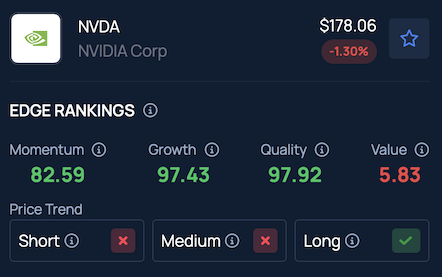
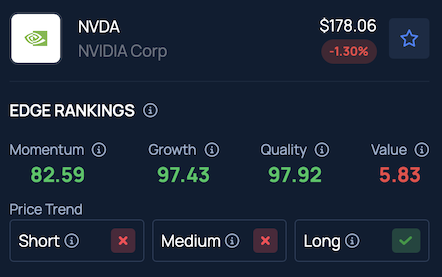
Benzinga Edge Stock Rankings show that while the stock is lagging in the short and medium term, it demonstrates a strong long-term upward potential, supported by a Quality score in the 97th percentile.
Disclaimer: This content was partially produced with the help of AI tools and was reviewed and published by Benzinga editors.
Photo Courtesy: glen photo on Shutterstock.com
Recent Comments