
Rising gasoline prices threaten to erode the benefit of larger tax refunds expected under President Donald Trump’s Big, Beautiful Bill Act, analysts and economists warn.
Brent crude futures surged to nearly $112 per barrel on Thursday, while WTI crude oil futures were trading 3.23% higher at $99.52 per barrel as of 12.25 PM ET, with the national average at $3.88 per gallon, per AAA.
John Mercer, Head of Global Research at Coresight Research, told Benzinga that while refunds offer a temporary cushion, they won’t fully absorb higher fuel costs.
Total tax refunds for 2026 are expected to rise by $31–33 billion (9.4–10% year-over-year) — roughly equal to one month’s typical national gasoline spending, according to Mercer.
With gas prices already up 21.2% year-over-year as of March 16 per the EIA, consumers are spending $6.3 billion more per month, meaning refunds could cover just over five months of that burden. A sharper price spike — like the ~44% year-over-year surge seen during the first eight weeks of Russia’s Ukraine invasion — would shrink that window to about 2.3 months.
Non-Drivers, EV Owners Insulated
Stanford economists Neale Mahoney, Jared Bernstein, Caleb Brobst, and Ryan Cummings reached a similar conclusion. Using Goldman Sachs’ projection that a three-week Strait of Hormuz closure could push crude to $110 per barrel, they applied a Bayesian vector error correction model estimating U.S. retail gas prices peaking at $4.36 per gallon in May before easing — with a longer closure pushing prices even higher.
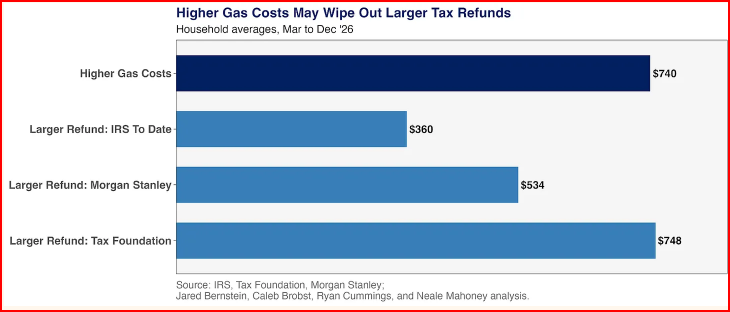
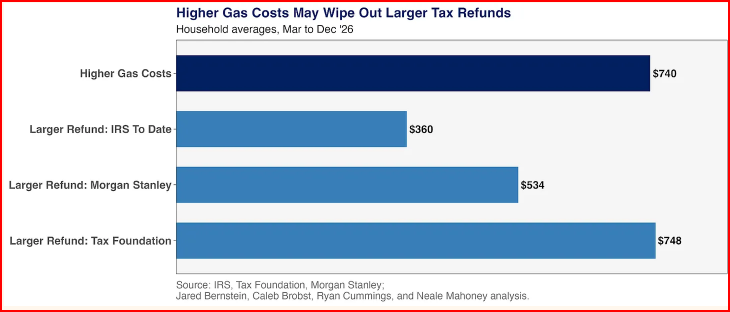
Their estimate: the average household could pay $740 extra in gas costs this year, wiping out — and in some cases exceeding — per-household tax refund estimates of $360 (IRS), $534 (Morgan Stanley), and $748 (Tax Foundation). Non-drivers and EV owners would be unaffected.
Could Gas Fall Below $3 By Summer?
GasBuddy’s Patrick De Haan cautioned Monday that prices could hit $3.80–$3.85 per gallon, with $4 possible but not imminent, citing the summer fuel blend switchover and Iran tensions driving sharp Midwest spikes — with Americans already spending $307 million more on gas than last month.
Energy Secretary Chris Wright offered a more optimistic outlook on Sunday, while speaking on NBC’s Meet the Press, suggesting prices could fall below $3 per gallon by summer.
Disclaimer: This content was partially produced with the help of AI tools and was reviewed and published by a Benzinga editor.
Image via Shutterstock
Recent Comments