

Retail investors talked up five hot stocks this week (March 9 to March 13) on X and Reddit’s r/WallStreetBets, driven by retail hype, earnings, AI buzz, and corporate news flow.
Oracle Corp. (NYSE:ORCL), Hims & Hers Health Inc. (NYSE:HIMS), Blue Owl Capital Inc. (NYSE:OWL), Strategy Inc. (NASDAQ:MSTR), Tesla Inc. (NASDAQ:TSLA), spanning software, online retail, pharma, private credit, cryptocurrency, and automotive, reflected diverse investor interests.
Oracle
- ORCL’s fiscal third-quarter earnings delivered strong beats with total revenue of $17.2 billion up 22% YoY, cloud revenue surging 44% to $8.9 billion, non-GAAP EPS of $1.79, up 21%, and remaining performance obligations exploding 325% to $553 billion, driven by massive AI infrastructure demand. The company raised its fiscal 2027 revenue guidance to $90 billion, easing concerns over heavy AI capex and debt.
- Some retail investors were questioning other traders about buying ORCL after its post-earnings jump.

- The stock had a 52-week range of $118.86 to $345.72, trading around $159 to $162 per share, as of the publication of this article. It rose 5.48% over the year and fell 45.53% over the last six months.
- ORCL had a weaker price trend in the short, medium, and long term, with a poor value ranking, as per Benzinga’s Edge Stock Rankings.
Hims & Hers
- HIMS news stories from March 9 to March 13, 2026, were dominated by the company’s blockbuster partnership announcement with Novo Nordisk A/S (NYSE:NVO), which sent the stock soaring. Under the deal, Hims & Hers will offer Novo Nordisk’s branded GLP-1 weight-loss drugs like Ozempic and Wegovy on its telehealth platform starting later in March, while ceasing promotion of compounded versions—resolving a prior patent infringement lawsuit from Novo and eliminating a major legal overhang amid regulatory scrutiny on compounded GLP-1s.
- Some retail investors were mocking the short sellers on HIMS after the resolution of the feud with NVO.

- The stock had a 52-week range of $13.74 to $70.43, trading around $23 to $25 per share, as of the publication of this article. It declined by 29.47% over the year and 57.05% in the last six months.
- HIMS had a weaker price trend in the medium and long terms but a strong trend in the short term, with a moderate growth ranking as per Benzinga’s Edge Stock Rankings.
Blue Owl Capital
- OWL stock was in focus amid the ongoing pressure in the private credit sector, with the stock continuing its sharp decline. Key developments included the Financial Times reports on Glendon Capital Management criticizing Blue Owl and peers for potentially obscuring portfolio weaknesses through inflated loan valuations in funds like Blue Owl Capital Corporation, raising fears of an impending sharp correction in debt markets—prompting OWL to reassure investors in a private conference that its recent $1.4 billion loan sale across three funds had no hidden incentives, backstops, or special terms.
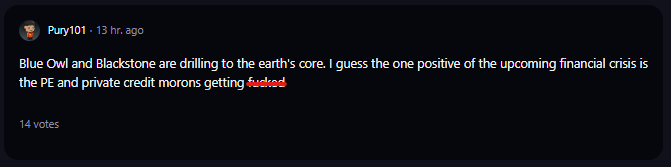
- Some retail investors were rejoicing that some private credit companies would stumble if a financial crisis occurred.
- The stock had a 52-week range of $8.60 to $21.88, trading around $8 to $10 per share, as of the publication of this article. It declined 54.61% over the year and 54.08% in the last six months.
- Benzinga’s Edge Stock Rankings showed that OWL had a weak price trend in the short, medium, and long terms, with a poor value ranking.
Strategy
- MSTR latest massive Bitcoin (CRYPTO: BTC) acquisition announced on March 9 was in focus as Strategy purchased 17,994 BTC for approximately $1.28 billion, at an average price of $70,946 per coin), funded largely through common stock sales and at-the-market offerings of its STRC preferred shares, boosting total holdings to 738,731 BTC, representing about 3.5% of Bitcoin’s supply and acquired for about $56 billion overall. This move, teased by Executive Chairman Michael Saylor with “The Second Century Begins,” reinforced the firm’s relentless BTC treasury strategy amid a challenging macro environment where Bitcoin traded around $69,000–$71,000.
- Some retail investors were nervous ahead of MSTR’s call options expiry.

- The stock had a 52-week range of $104.17 to $457.22, trading around $137 to $142 per share, as of the publication of this article. It was down 47.69% over the year and 58.56% over the last six months.
- MSTR maintains a weaker price trend over the short, medium, and long terms, as per Benzinga’s Edge Stock Rankings.
Tesla
- TSLA had a March 9 deadline for submitting detailed Full Self-Driving (FSD) crash and traffic violation data to the NHTSA, part of an ongoing investigation into ~58 incidents across millions of vehicles and 14 reported robotaxi crashes since mid-2025—creating regulatory overhang and scrutiny on Tesla’s autonomy narrative, though no immediate negative fallout or new disclosures emerged post-deadline, with sentiment mixed on whether the data submission bolstered or pressured the stock’s AI/robotaxi valuation premium. Broader bearish pressure came from a Reuters report on March 11 highlighting analysts slashing 2026 delivery growth forecasts to about 3.8%.
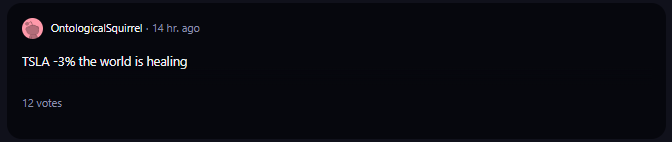
- An investor praised TSLA’s Thursday decline, saying the world was “healing.”
- The stock had a 52-week range of $214.25 to $498.83, trading around $395 to $400 per share, as of the publication of this article. It advanced by 59.22% over the year and down 0.23% over the last six months.
- According to Benzinga’s Edge Stock Rankings, TSLA was maintaining a weak price trend over the short and medium terms but a strong trend in the long term, with a moderate quality ranking.
Retail focus blended meme-driven narrative with earnings outlook and corporate news flow, as the S&P 500, Dow Jones, and Nasdaq witnessed mixed market action during the week.
Image via Shutterstock
Recent Comments