
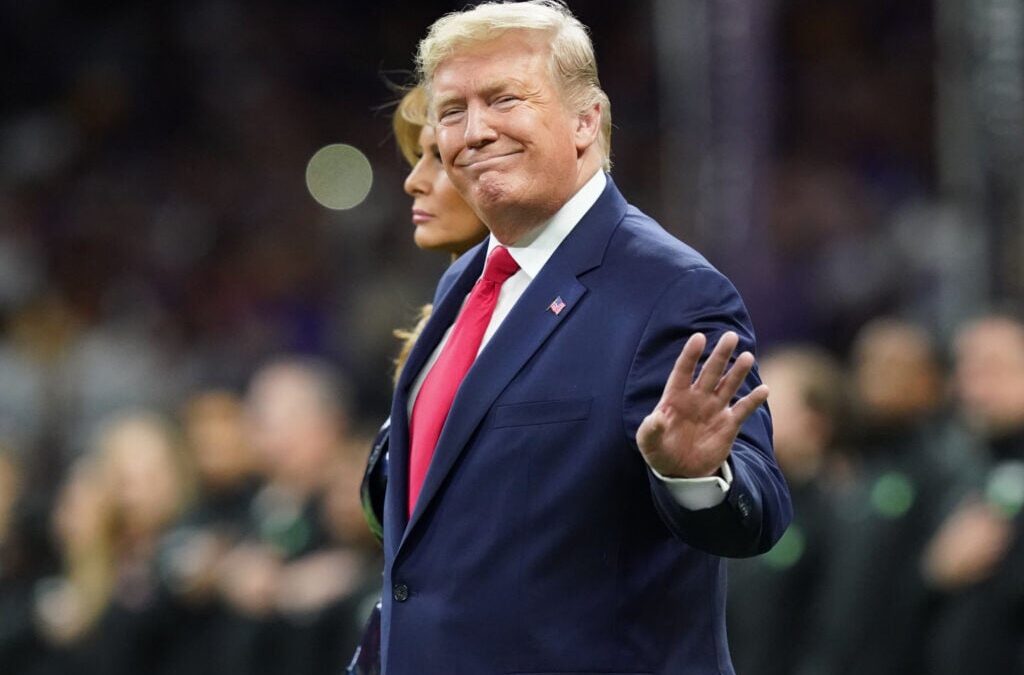
President Donald Trump offered a strikingly optimistic read on soaring crude prices — framing higher oil as a revenue source for the United States. But with equity markets tumbling, the VIX spiking above 26, and Goldman Sachs warning of $110 Brent in a disruption scenario, financial markets delivered a sharply different verdict.
West Texas Intermediate crude topped again $94 per barrel on Thursday morning, jumping roughly 8% from Wednesday’s close, as escalating tensions around the Strait of Hormuz reinforced market fears of a more prolonged supply shock.
“The United States is the largest Oil Producer in the World, by far, so when oil prices go up, we make a lot of money,” Trump wrote Thursday morning on social media.
Wall Street’s response was clear: higher oil isn’t a windfall — it’s a tax
The S&P 500 – as tracked by the SPDR S&P 500 ETF Trust (NYSE:SPY) – fell about 1.1% by mid-morning, while the Nasdaq-100 dropped 1.2% and the Dow Jones Industrial Average slid roughly 1.3%.
The Energy Select Sector SPDR Fund (NYSE:XLE) was the sole S&P sector in positive territory, rising 0.5%.
Iran Signals Escalation
The new catalyst for Thursday’s crude rally came directly from Tehran.
Iran’s new Supreme Leader Mojtaba Khamenei , in a statement broadcast on state television, issued a series of declarations that hardened the conflict’s economic dimension and complicated any diplomatic exit.
“Strait of Hormuz should stay closed…” and “should be continued as a tool to pressure the enemy.”
The language reframed the Hormuz blockade from a tactical military move into a deliberate, stated instrument of economic coercion.
“The thing with this war is that there’s no easy off-ramp for Trump. Simply declaring ‘mission accomplished’ won’t cut it if Iran keeps attacking ships in the Strait of Hormuz. Iran has leverage Venezuela and others didn’t have and it’s using it. A problem,” Robin Brooks, senior fellow at the Brookings Institution said on social media X.
The Wall Street Journal reported that reopening the Strait may ultimately require a ground operation to seize the Iranian coastline along the waterway — a step that military analysts described as potentially open-ended and carrying significantly higher casualty risks for U.S. and Allied forces.
Goldman’s New Oil Price Trajectory
Goldman Sachs’ commodity strategists moved their Brent forecasts sharply higher on Thursday. In their base case, Brent is expected to average $98 in March and April — up roughly 40% from the 2025 average — before declining to $71 by the fourth quarter of 2026.
In a more upside scenario, if Hormuz flows are disrupted for a total of one month, Brent averages $110 in March and April before gradually falling to $76 by late 2026.
Photo: © Kirby Lee-Imagn Images
Recent Comments