
Lightwave Logic Inc. (NASDAQ:LWLG) shares are trending on Wednesday night.
Shares of the technology platform company jumped 29.89% in after-hours trading on Wednesday to $6.52.
LWLG closed the regular session at $5.02, up 15.14%, according to Benzinga Pro data.
What’s Behind the Rally
The surge in extended trading followed Lightwave’s announcement of a development agreement with Israeli integrated circuit manufacturer Tower Semiconductor to integrate its electro-optic polymer-based modulator reference designs into Tower’s PH18 silicon photonics process design kit (PDK).
Tower’s PH18 is a 200mm SiPho foundry platform developed in Newport Beach, California. It is designed to support the growing demand for data center interconnects operating in both the O-band and C-band optical ranges.
According to Lightwave, under the agreement, the companies will target bandwidths of 110GHz and beyond within Tower’s PDK, enabling 400G per-lane photonic integrated circuit applications.
The company also stated that Tower and Lightwave will give customers the opportunity to take part in 2026 engineering tapeout runs on the PH18 platform.
Yves LeMaitre, CEO of Lightwave, said, “This collaboration allows us to bring the performance advantages of our electro-optic polymer modulators into a widely accessible foundry PDK.”
Trading Metrics, Technical Analysis
Lightwave Logic has a market capitalization of $730.06 million, with a 52-week high of $6.26 and a 52-week low of $0.79.
The Relative Strength Index (RSI) of LWLG stands at 61.42.
Over the past 12 months, the Colorado-based small-cap company’s stock has gained 258.57%.
The stock is currently trading at about 77.33% of its 52-week range.
Lightwave’s long-term trend and strong positioning suggest continued upside potential.
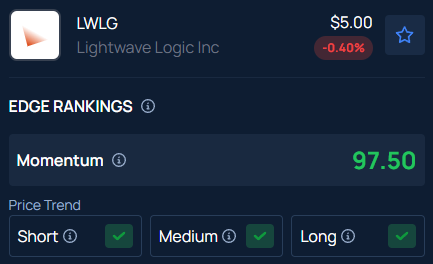
According to Benzinga’s Edge Stock Rankings, LWLG shows a positive price trend across all time frames, supported by strong Momentum in the 97th percentile.

Photo Courtesy: FabrikaSimf on Shutterstock.com
Disclaimer: This content was partially produced with the help of AI tools and was reviewed and published by Benzinga editors.
Recent Comments