
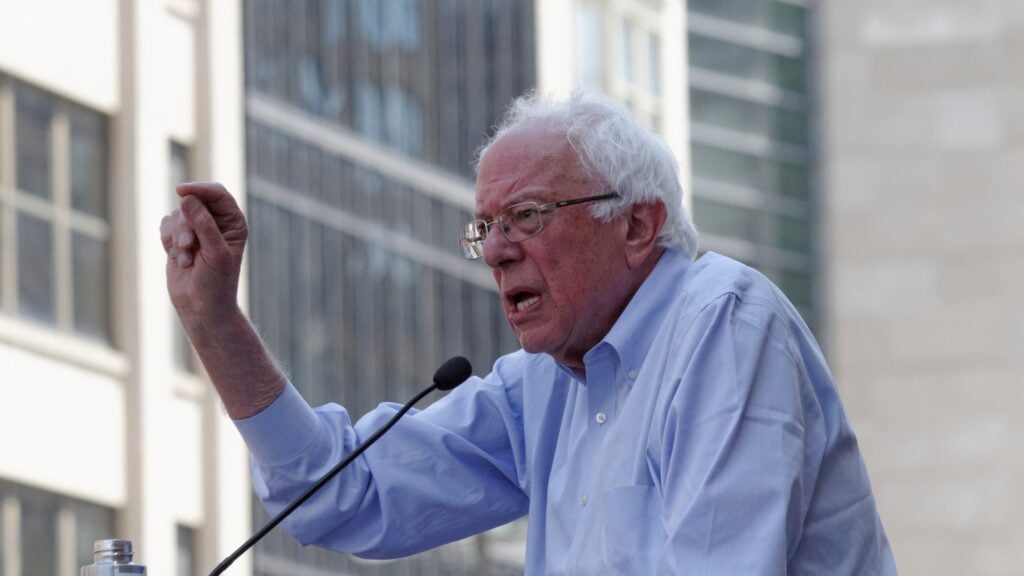
Several Democratic lawmakers criticized federal spending priorities, arguing that billions directed toward military action related to Iran should instead support health care, housing and lower costs for families.
Lawmakers Slam Iran War Funding
On Saturday, Sen. Bernie Sanders (I-Vt.) posted on X, saying, “We’re told there’s not enough money for health care, affordable housing or education. But somehow there are billions for an illegal & unconstitutional war.”
He called for a government that prioritizes working families over military spending.
Rep. Adam Schiff (D-Calif.) wrote that President Donald Trump claims budgets are too tight to lower costs but that Republicans are “already talking about seeking billions more in taxpayer dollars for war with Iran,” arguing priorities are misplaced.
Sen. Kirsten Gillibrand (D-N.Y.) said, “He found billions for bombs and tax cuts for billionaires. But he can’t find money for your family’s groceries or your kids’ doctor,” accusing the administration of breaking promises.
House Democratic leader Hakeem Jeffries (D-N.Y.) stated, “Taxpayer dollars should be used to lower the high cost of living… Republicans are instead spending billions to drop bombs,” criticizing defense-focused spending.
Sen. Mazie Hirono (D-Hawaii) said Trump “gutted health care, slashed food assistance… and now he’s launching a multi-billion-dollar war,” arguing policies increase costs for Americans.
US-Iran War Costs Could Have Toppled $1 Trillion
Last week, Estimates showed the U.S. military campaign against Iran, Operation Epic Fury, could have cost taxpayers between $40 billion and $210 billion, with direct military spending likely around $65 billion and rising if the conflict had lasted longer than two months.
Analysts also projected about $115 billion in additional economic losses from trade disruptions, energy market volatility, and financial strain.
Economists, including Peter Schiff, warned that the broader impact could have exceeded $1 trillion when including reconstruction costs.
They said the conflict may have pushed oil prices higher, disrupted supply chains, and increased inflation pressures.
While U.S. inflation had eased to 2.4% in January 2026, experts cautioned that prolonged military spending, government borrowing, and money creation to finance the war could have reversed that progress.
Some analysts also said investors likely would have turned to safe-haven assets such as gold amid uncertainty.
Report Questions The Accuracy Of The DOGE Budget Savings
Last month, Reports found that the Department of Government Efficiency (DOGE), led by Elon Musk, overstated its claimed $55 billion in federal spending cuts.
Analysts said actual savings were likely closer to $2.6 billion because many targeted contracts had already been paid or accounted for.
The cuts mainly affected research agencies, including the Education Department and the Department of Health and Human Services, where over $900 million in contracts were canceled.
Experts noted that more than a quarter of the listed contracts had already been paid, limiting the real impact on federal spending.
Disclaimer: This content was partially produced with the help of AI tools and was reviewed and published by Benzinga editors.
Photo courtesy: ana Shea / Shutterstock.com
Recent Comments