
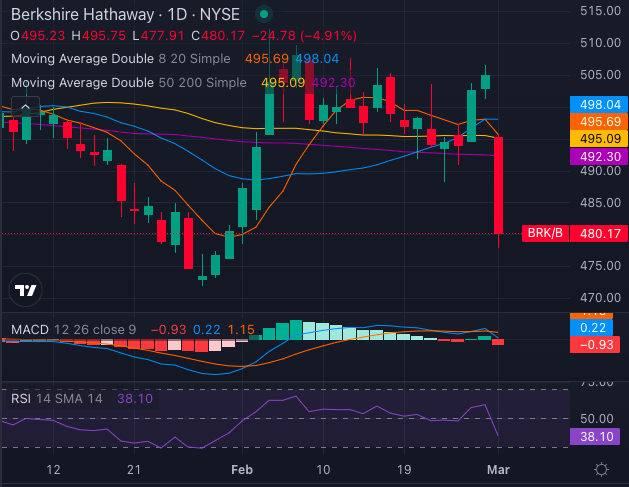
A nearly 5% drop isn’t normal for Berkshire Hathaway Inc (NYSE:BRK) (NYSE:BRK). Berkshire stock tumbled about 4.9% following the company’s first earnings report of the CEO Greg Abel era, marking its largest post-earnings decline in more than a decade.
For a stock synonymous with stability, that kind of reaction stands out.
$500 Rejection Triggers Technical Damage
The selloff came after a clear rejection near the $500 level, an area that had acted as recent resistance. In one session, the stock sliced below its short-term moving averages, including the eight-day and 20-day, and closed decisively lower around $480.
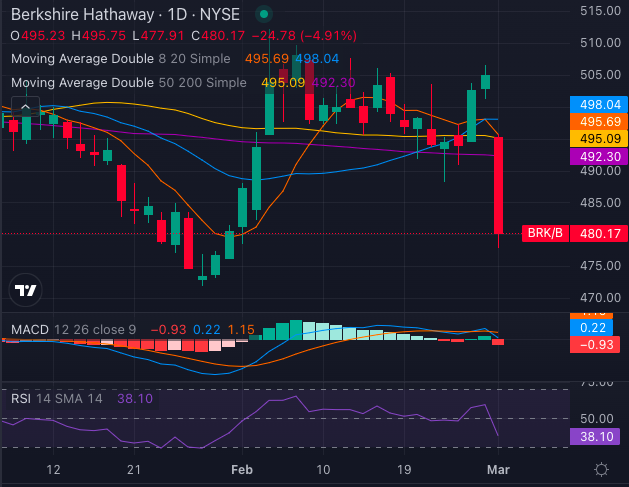
Chart created using Benzinga Pro
Technically, the damage is notable.
The RSI (relative strength index) dropped toward 38, reflecting weakening momentum but not yet deeply oversold conditions. Meanwhile, the MACD (moving average convergence/divergence) indicator flipped negative, with the histogram rolling over after a brief recovery attempt.
The sharp red candle also pushed shares back toward the 200-day moving average zone near the low-$490s — a level now lost on a closing basis.
For a low-volatility giant, this type of breakdown is rare.
The First Real Test Of The Abel Era
This was the first earnings report since Abel formally took over leadership from Warren Buffett. Whether the selloff reflects quarter-specific concerns or simply heightened sensitivity during a transition period, the optics matter.
Berkshire has long traded with a “Buffett premium” — a perception of disciplined capital allocation and downside protection.
The question now isn’t whether the business is broken. It’s whether investors are recalibrating that premium in a post-Buffett leadership structure.
When even Berkshire breaks support, markets pay attention.
Photo: Shutterstock
Recent Comments