
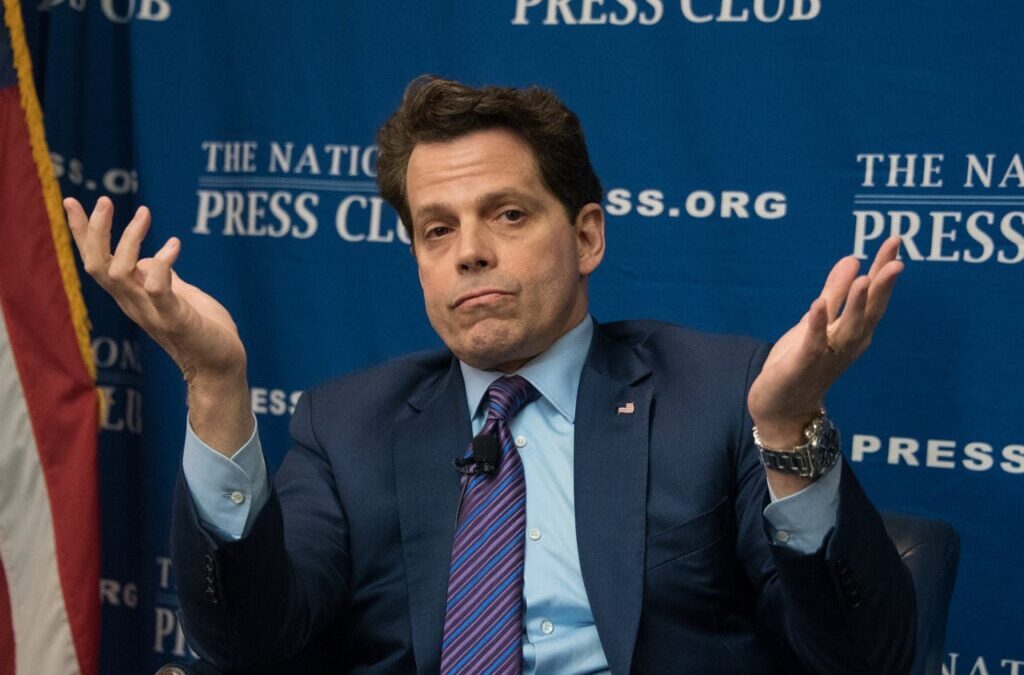
On Saturday, Anthony Scaramucci shared an anecdote he says captures what he views as President Donald Trump‘s core leadership weakness, describing a moment after the 2016 election when Trump rejected the idea of hiring people more capable than he is.
The criticism lands as Scaramucci has also attacked Trump’s tariff push and the market shock that followed tariff strategy backlash, including a steep global selloff after Trump’s “Liberation Day” rollout.
In a post on X, Scaramucci recalled how Bloomberg calling Trump after the election with advice to staff up with people who would challenge him. Scaramucci wrote that Trump replied, “That’s impossible. There’s nobody smarter than me,” and said he witnessed the exchange.
Scaramuccis Stark Warning About Leadership
Scaramucci argued that the comment points to a management style built around certainty rather than debate. He framed effective leadership as building teams that test assumptions, warning that a leader who insists on being the top mind in every meeting eventually narrows the talent around him.
In the same post, Scaramucci said journalist Maggie Haberman later corroborated the line in “The Confidence Man.” He added that the remark, in his view, explains how decision-making can become more about ego than outcomes.
That critique has also shown up in Scaramucci’s response to Trump’s trade actions, where he has argued the president’s inner circle isn’t built to push back.
After Trump moved to slap new tariffs on most major U.S. trading partners, Scaramucci posted on X, “There is stupid and then there is Donald Trump Stupid: DTS. A new global low.”
Scaramucci also took aim at Trump’s advisers, saying the administration was operating inside an “echo chamber of stupidity” on trade. The comments followed China’s decision to answer U.S. tariffs with its own measures on Thursday.
Consequences of Aggressive Foreign Policy
Scaramucci has previously discussed the potential repercussions of aggressive U.S. foreign policy, notably labeling a hypothetical U.S. invasion of Greenland as “one of the most self-destructive foreign policy moves imaginable.” He emphasized that such an action could not only be viewed as an illegal war of aggression against a NATO ally but also threaten the core trust within U.S. alliances and negatively impact financial conditions.
This perspective on leadership and decision-making aligns with Scaramucci’s critique of Trump’s tariff strategy, highlighting the broader implications of policies shaped by a lack of dissent within advisory circles. The potential fallout from aggressive actions, whether in trade or foreign policy, underscores the delicate balance leaders must maintain, particularly as geopolitical tensions rise.
Market Reactions Reflect Growing Tariff Concerns
Critics of the tariff campaign have argued that higher import costs and retaliation can boomerang onto U.S. growth. The size of the Dow’s one-day slide after the “Liberation Day” announcement signaled how quickly investors repriced the economic risk.
Scaramucci’s leadership critique and his tariff attacks both hinge on the same claim: that Trump resists dissent and surrounds himself with reinforcement instead of challenge. In the leadership post, as X noted, Scaramucci warned that when a leader believes he’s always the smartest in the room, the room gets smaller over time.
Recent Comments