
German Chancellor Friedrich Merz arrived in Beijing on Wednesday to address trade and economic imbalances with the European Union (EU).
His two-day trip follows visits by Emmanuel Macron in December and Keir Starmer in January. Their Beijing overtures underscore renewed European engagement with Beijing amid tense transatlantic relations with the Trump administration.
“It’s very important to me to keep and deepen this relationship wherever that is possible,” Merz said before meeting Premier Li Qiang in Beijing. “But we also have some issues that must be addressed.”
EU‑China relations remain strained by widening trade imbalances and concerns about industrial overcapacity, according to China Briefing. European capitals are also increasingly uneasy about economic coercion and China’s close alignment with Russia.
The January removal of senior military figures close to Xi Jinping has added another level of uncertainty to China. This could further complicate relations with Europe, StoneX Group said.
A day after Merz arrived, the National People’s Congress removed at least nine senior military deputies. This reduced the combined People’s Liberation Army (PLA) and People’s Armed Police delegation to 243, the South China Morning Post reported.
Widening Trade Deficit
The trade imbalance has emerged as a major sticking point in EU-China relations. The bloc’s trade deficit with China widened to €359.3 billion in 2025, from €304.5 billion in 2024, POLITICO reported, citing Eurostat data.
Germany recorded an €8.2 billion deficit with China in December, importing €15.5 billion, the Federal Statistical Office said. China regained its position as Germany’s largest trading partner last year, with total trade pf €251.8 billion, a status it had held from 2016 through 2023.
In comparison, Germany’s trade with the United States fell 5% to €240.5 billion.
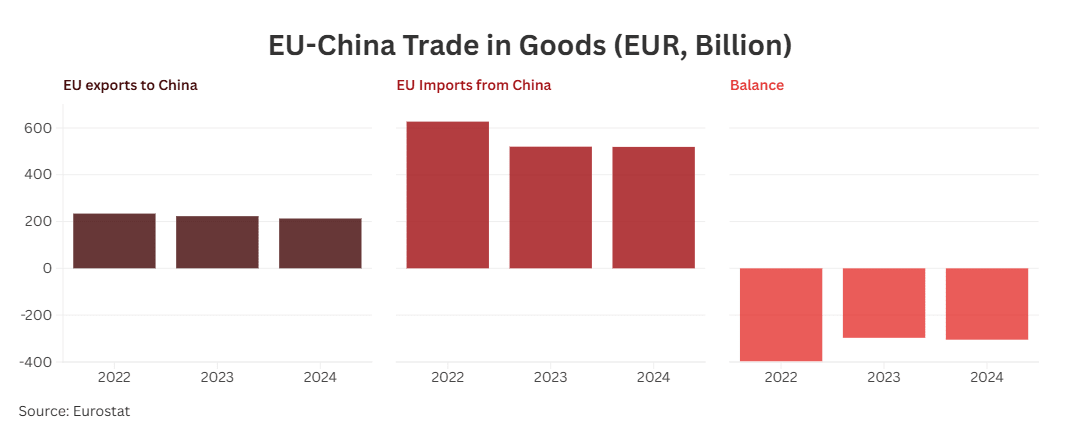
The deficit between Germany and China “has quadrupled since 2020, i.e. within five years,” Merz said. “This dynamic is not healthy. We are therefore addressing it and want to find ways to reduce this trade deficit at our expense.’
China Imposes Trade Restrictions
In October, China expanded its export controls on several rare-earth elements and related processing equipment. This occurred amid rising trade tensions following the US’s announcement of new tariffs.
“China is systematically exploiting the dependencies of others, reinterpreting the international order on its own terms,” Merz said at the Munich Security Conference on February 13. “Great power politics operates according to its own rules.”
European companies are highly exposed to such restrictions on rare‑earth elements. The EU’s current mining, refining, and recycling capacity remains insufficient for its green and digital transition.
Jens Eskelund, the head of the EU Chamber of Commerce in China, stated that European companies in China are increasingly affected by supply chain uncertainty. This has slowed production and caused shutdowns.
Brussels, Beijing Diverge on Ukraine
Germany and its EU partners have diverged from China over the war in Ukraine. Beijing’s political and economic backing of Russia has remained a central source of tension.
Russia’s war effort “would not be sustainable without ongoing Chinese support,” particularly through exports of dual-use components and critical minerals used in Russian drone production, Bloomberg News reported, citing Western officials. They described Beijing as a key facilitator of Moscow’s military campaign.
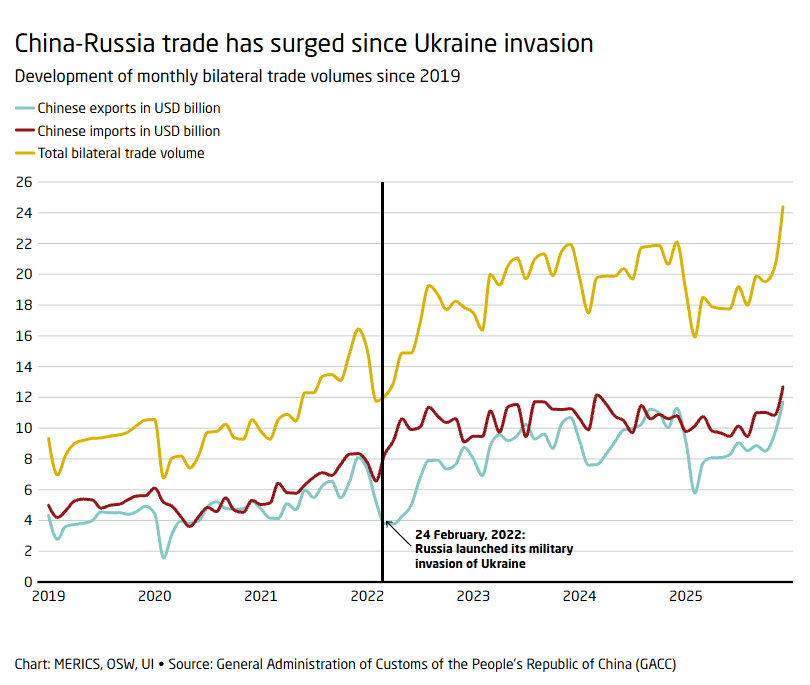
China now accounts for more than 40% of Russia’s oil exports. Beijing supplies the majority of high-priority dual-use goods needed for Russia’s war effort, Eva Seiwert, a senior analyst at the Mercator Institute for China Studies, wrote on February 11.
Beijing provided “Russia with an economic lifeline, cushioning the impact of Western dollar-centered sanctions, and allowing the Kremlin to sustain its war,” she said.
China’s Opaque Political Landscape
China’s increasingly opaque political environment is another challenge that Merz and his European counterparts will have to navigate. His visit comes soon after Xi tightened his grip over the armed forces through a sweeping shake-up.
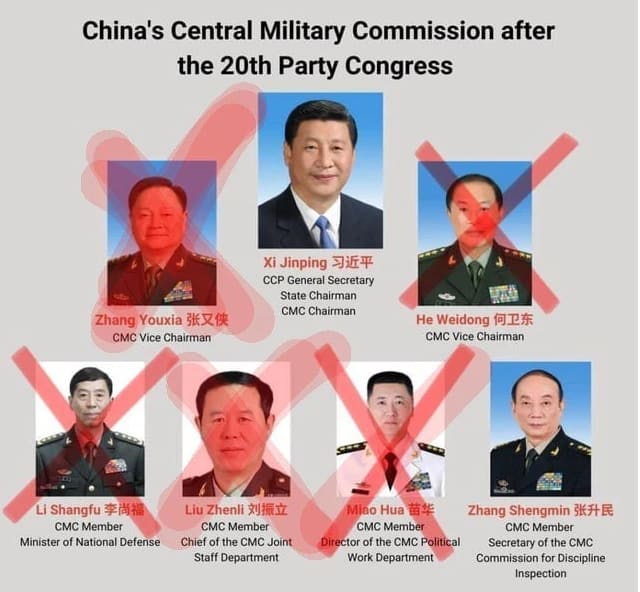
In January, the Defense Ministry announced investigations into General Zhang Youxia, the first-ranked vice chairman of the Central Military Commission (CMC), and Liu Zhenli, chief of staff of the CMC’s Joint Staff Department.
They were accused of serious violations of discipline and the law, including alleged corruption, obstructing military modernization, and undermining command authority within the CMC, according to the Defense Ministry. The ministry spokesman didn’t provide additional details on the accusations.
“China’s leadership shakeup is no longer a contained political issue and is increasingly shaping how risk is priced across geopolitics and trade,” Arlan Suderman, Chief Commodities Economist at StoneX, wrote on January 29.
‘Nobody Is Safe’
General Zhang Youxia hails from a prominent military family. He is considered a “princeling,” a term for descendants of influential Chinese Communist Party (CCP) officials. His father, Zhang Zongxun, was a Communist general during the Chinese Civil War.
“Zhang’s removal means that truly nobody in the leadership is safe now,” Jonathan Czin, a research fellow at Brookings Institution, said.
The latest military purge has left the CMC with only Zhang Shengmin, the newly appointed anti-corruption chief, alongside Xi himself. This has created a power vacuum in the world’s largest army, Mei Shanshan at the US-based RAND Corp., said.
Markets largely shrugged it off. The CSI 300 index approached a four-year high in January, gaining about 3% over the prior four weeks.
Uncertain Future in the Asia-Pacific
This leadership vacuum reverberates across the region, particularly affecting China’s readiness for a potential Taiwan invasion, experts say.
“Their simultaneous removal leaves a gap near the top of the chain of command that would direct how and to what extent the military will train, equip, and fight,” said Joshua Arostegui, research director of the China Landpower Studies Center at the US Army War College.
Zhang’s removal represents a significant loss of operational expertise, given his combat experience in the 1979 Sino-Vietnamese War. The Eastern Theater Command has lost critical institutional knowledge in joint amphibious landings and Taiwan blockade simulations.
“Gutting the PLA high command suggests that Xi is not contemplating a major military escalation against Taiwan in the near term,” Neil Thomas, a research fellow at the Asia Society Policy Institute, said.
Yet younger, Xi-loyal commanders may prove more nationalistic and aggressive, analyst Tang said. This will have rivals in Asia on edge, including Japan. Tokyo has enhanced its Defense capabilities under the National Security Strategy.
European Implications
Xi’s purge will complicate relations with the EU as Merz and other leaders try to improve economic ties with Beijing. Before the latest purge, European investors have said that China’s economic policies had slowed trade.
The EU Chamber of Commerce in China published a flash survey on December 1 showing increasing complications regarding trade. A lack of transparency in the process was reported by 39% of respondents. Just over one in five noted that application requirements lack clarity.
A similar proportion expects “significant” disruptions to supply chains, or production stoppages, if all of China’s export controls are implemented.
“These dynamics suggest that policy outcomes are becoming harder to anticipate precisely when global exposure to China remains high,” Suderman said. Yet following his meetings, Merz remained optimistic: “This marks a promising direction for German-Chinese relations.”
Disclaimer: Any opinions expressed in this article are not to be considered investment advice and are solely those of the authors. European Capital Insights is not responsible for any financial decisions made based on the contents of this article. Readers may use this article for information and educational purposes only.
Benzinga Disclaimer: This article is from an unpaid external contributor. It does not represent Benzinga’s reporting and has not been edited for content or accuracy.
Recent Comments