
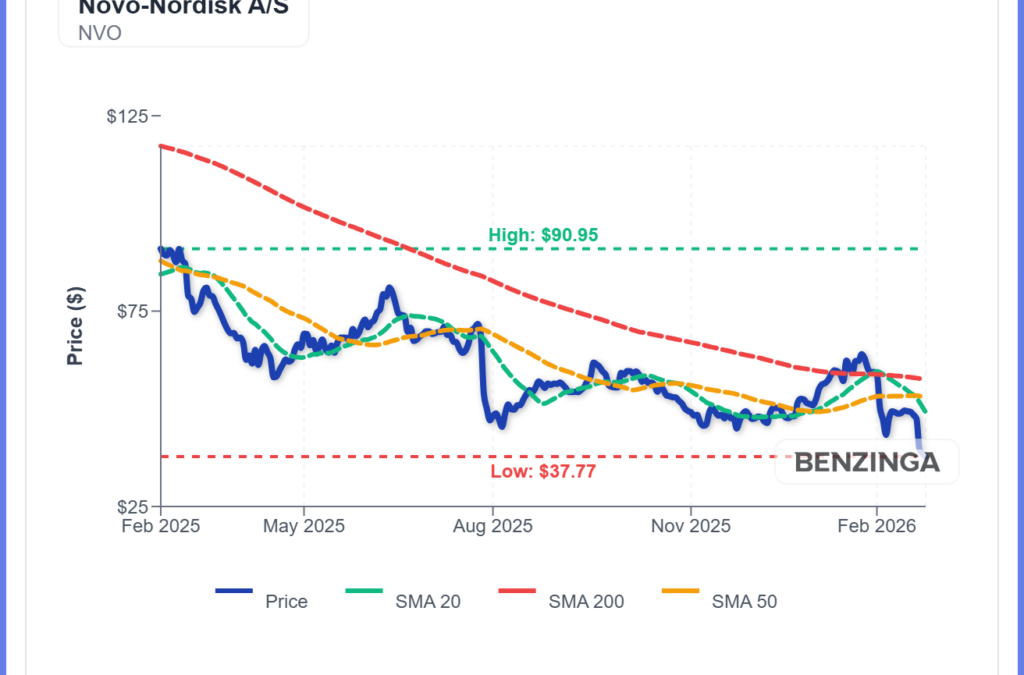
Novo Nordisk A/S (NYSE:NVO) has lost more than half its value from its peak. NVO stock is down 58% over the past year and more than 40% in just the past month, collapsing from a 52-week high of $91.90 to near $38.

But beneath the selloff, something unusual has emerged.
Novo Nordisk is no longer priced like a hypergrowth AI-era healthcare leader. It’s priced like a slow-growth legacy pharma stock.
NVO Stock Now Trades At A Fraction Of Peer Valuations
At just 10.6x earnings, NVO stock trades at a dramatic discount to both obesity-drug rival Eli Lilly and Company and broader pharma peers.
| Company | P/E Ratio (TTM) | Earnings Yield |
|---|---|---|
| Novo Nordisk | 10.6x | 9.42% |
| Eli Lilly | 45.4x | 2.20% |
| Vertex Pharmaceuticals | 31.8x | 3.14% |
| Pfizer | 20.0x | 5.01% |
This gap is striking.
Eli Lilly And Co (NYSE:LLY) trades at more than four times Novo Nordisk’s earnings multiple, while even specialized biotech leaders like Vertex Pharmaceuticals Inc (NASDAQ:VRTX) — with narrower product portfolios — command valuations nearly three times higher.
Even slower-growth companies like Pfizer Inc (NYSE:PFE) command nearly double Novo’s valuation, per Benzinga Pro data.
The market is no longer pricing Novo Nordisk as the creator of the GLP-1 obesity drug category. It’s pricing it as if its leadership has already peaked.
Expectations Have Reset — But The Opportunity Hasn’t Disappeared
The selloff reflects concerns over competition, pricing pressure, and slowing growth expectations. But valuation compression of this magnitude often signals a shift in expectations rather than a collapse in long-term relevance.
Novo Nordisk still controls one of the most important drug platforms in modern healthcare. The global obesity drug market is expected to expand dramatically over the next decade.
At a 9.4% earnings yield, the stock now reflects far more pessimism than optimism.
From Hypergrowth Premium To Deep-Value Setup
Novo Nordisk’s collapse has erased its growth premium and replaced it with a valuation typically reserved for declining businesses.
That reset may prove to be the real story.
Because when market leaders fall this far, the opportunity often isn’t in what they’ve lost — but in how little investors are now willing to pay for what they still control.
The opinions and views expressed in this content are those of the individual author and do not necessarily reflect the views of Benzinga. Benzinga is not responsible for the accuracy or reliability of any information provided herein. This content is for informational purposes only and should not be misconstrued as investment advice or a recommendation to buy or sell any security. Readers are asked not to rely on the opinions or information herein, and encouraged to do their own due diligence before making investing decisions.
Photo: Shutterstock
Recent Comments