
Apple Inc. (NASDAQ:AAPL) revealed its plans to shift a part of its Mac Mini production from Asia to the to a facility in Houston, Texas.
The move is part of Apple’s broader push to bring portions of its supply chain back to the U.S. Production is set to begin later this year at a Foxconn facility in north Houston, Sabih Khan, Apple’s chief operating officer, told the Wall Street Journal on Monday.
Despite the change, Mac Mini production will remain in Asia, Khan said, while the new U.S. assembly line will scale up to serve domestic demand. The move echoes Apple’s earlier effort to manufacture the Mac Pro in Texas, a program that has since seen production taper off significantly.
Khan said Apple is more confident about long-term demand for the Mac Mini, which is more popular than the higher-priced Mac Pro. The company is also expanding its Houston facility to add a new advanced manufacturing training center, set to open later this year, where students and supplier employees will be trained in Apple’s production techniques.
The Mac Mini accounted for under 5% of global Mac sales last year and less than 1% of the company’s total revenue, according to Consumer Intelligence Research Partners.
Apple did not immediately respond to Benzinga‘s request for comment.
Notably, the news comes in the wake of Apple’s announcement of a “special Apple Experience” event on March 4 in New York, London, and Shanghai. The event may feature multiple launches, including the new MacBook Pro models with M5 Pro and M5 Max chips and the budget MacBook.
Houston Move Amid Tariff Reset?
Following a pledge last August to invest $600 billion in the U.S. over four years, this is Apple’s latest domestic investment. The pledge was made after the Trump administration pressured several companies to increase domestic investment, promising tariff exemptions in return.
However, the Supreme Court’s recent ruling against President Donald Trump‘s IEEPA tariffs is likely to make things trickier for Apple. The company had previously navigated around tariffs by shifting some production to India from Vietnam and China, with CEO Tim Cook lobbying the president on global trade.
The new tariffs of 15% apply a universal rate across all countries and products, meaning Apple may face lower overall rates than before but will no longer benefit from previous category-specific exemptions.
This new move to Houston could be a strategic response to these changing conditions.

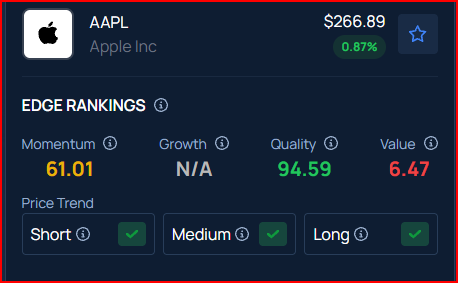
Benzinga’s Edge Rankings place Apple in the 94th percentile for quality and the 61st percentile for momentum, reflecting its strong performance in both areas. Benzinga’s screener allows you to compare Apple’s performance with its peers.
AAPL Price Action: On a year-to-date basis, Apple shares declined 1.78%, according to Benzinga Pro. On Monday, it climbed 0.60% to close at $266.18.
Disclaimer: This content was partially produced with the help of AI tools and was reviewed and published by Benzinga editors.
Image via Shutterstock
Recent Comments