
Gold’s rally just ran into its first real wave of selling pressure — and Peter Schiff is urging investors not to flinch. The pullback comes after a powerful surge pushed gold into overbought territory, but momentum has now clearly shifted into a cooling phase.
Schiff’s call to “buy the dips” lands at a critical technical moment, as charts show gold transitioning from a momentum-driven breakout to a support-level test.
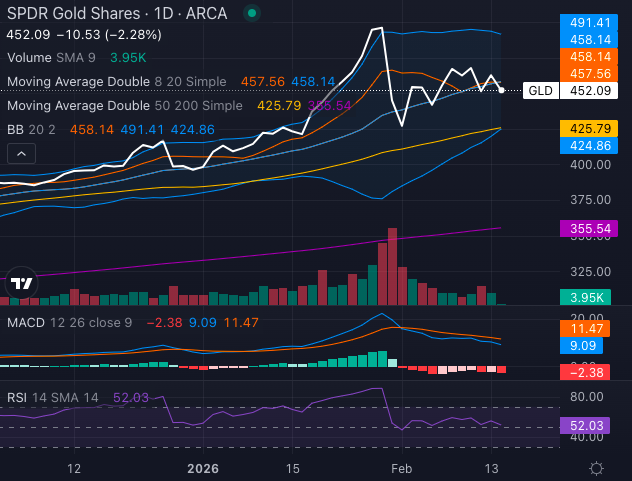
Chart created using Benzinga Pro
GLD Breaks Below 20-Day Average As Momentum Slows
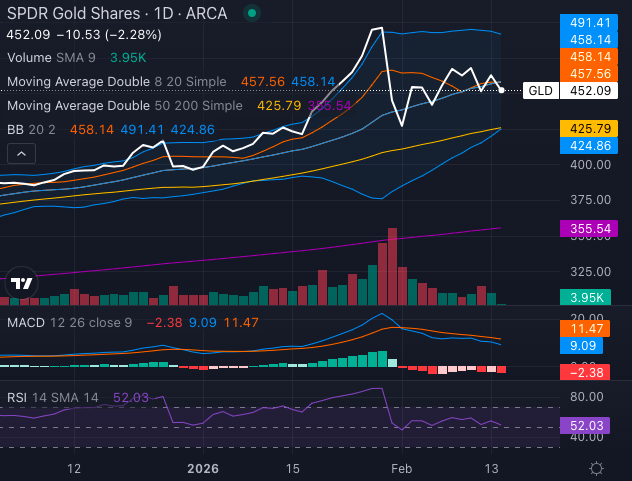
The physical gold-tracking SPDR Gold Shares (NYSE:GLD), the most widely traded gold ETF, is currently trading near $452, falling below its 20-day moving average of $457.56 — a key short-term momentum level. Losing this level signals that the aggressive upside momentum that fueled the recent rally has stalled.
Momentum indicators confirm the slowdown. The Relative Strength Index (RSI) has dropped to 52, down from near-overbought levels above 70 earlier this month. This places gold firmly in neutral territory, reflecting a balance between buyers and sellers rather than bullish dominance.
Meanwhile, the Moving Average Convergence/Divergence (MACD) indicator has turned negative, another sign that upside momentum has weakened in the near term.
Critical Support Levels Now Come Into Focus
Despite the pullback, gold’s broader uptrend remains intact.
GLD continues to hold well above its 50-day moving average at $425.79 and its 200-day moving average at $355.54 — both key structural support levels that define the long-term bull trend.
Additionally, GLD remains above its lower Bollinger Band near $424.86, a level that often acts as technical support during bull market consolidations.
Schiff’s dip-buying call reflects confidence that this is a temporary reset, not a trend reversal. But the technical setup makes one thing clear: gold is no longer being driven purely by momentum.
It’s now a conviction trade — and whether buyers step in near support levels will determine the next major move.
Photo: Shutterstock
Recent Comments