
Spain’s left-wing government has granted legal status to more than 500,000 illegal immigrants in the eurozone’s fastest-growing economy. The ruling has sparked political pushback and sharp criticism from Elon Musk.
The regularization decree on January 27 allows foreign nationals, equivalent to about 2% of the country’s current labor force, to apply for a one-year residence and work permit if they entered Spain before December 31. They must have been living in the country for at least five consecutive months.
“We did this for two reasons,” Socialist Prime Minister Pedro Sánchez wrote in The New York Times on February 4. “The first and most important is a moral one. The second reason that made us commit to regularization is purely pragmatic. The West needs people.”
The center-right opposition Popular Party and the far-right Vox party criticized the decision that bucks a wider trend of many European governments adopting tougher stances on migration. Vox leadership said it would appeal to Spain’s Supreme Court as soon as the decree was published, seeking precautionary measures to suspend its implementation.
Italian Prime Minister Giorgia Meloni on Wednesday highlighted her country’s fight against mass migration. She said her government had implemented measures to strengthen the “fight against mass illegal migration” and human trafficking.
Elon Musk Weighs in on Sanchez’s Policy
Tesla Inc. (NASDAQ:TSLA) CEO Elon Musk, who has been a critic of mass migration, weighed in. He called Sanchez a “tyrant and traitor to the people of Spain” on X and said that his true motivation was “electoral engineering.”
Sanchez’s Socialist party sustained its second major loss in two months in a snap regional election on Sunday, Bloomberg reported. The election campaigns in Aragon, a northeastern Spanish region of about 1.3 million people, focused largely on Sanchez’s plan to legalize half a million immigrants to boost social security revenue by more than €1 billion annually.
The Socialists had 18 seats, down from 23 in the snap election. The far-right nationalists of Vox doubled their seats to 14 to take third place, sustaining momentum from the election in December in Extremadura.
European anti-immigration parties, including Alternative for Germany (AfD) and France’s National Rally (RN), have pushed back against Spain’s immigration decision.
Tomasz Froelich, a German Member of the European Parliament (MEP) representing AfD, described the new policy as “a crime against Spain! That is a crime against Europe!” Jordan Bardella, leader of RN, has called on the EU to make the Schengen system exclusive to EU citizens after Spain moved to legalize more than half a million illegal migrants.
Majority of Spaniards Think Migration Is Too High
The election results come as Spanish polls show that the majority of people in the country oppose immigration.
Polling by Spain’s 40dB Institute for El País and Cadena SER in October 2024 found that 75% of Spaniards now link immigration to negative outcomes, including insecurity, crime, and strained public services—a 16% increase in concern over the past 18 months.
The Spanish have aligned with majorities across seven European Union (EU) countries who have said immigration over the past decade was “too high,” according to a February 2025 YouGov survey. For example, 54% of Spaniards felt that immigration levels were too high, with only 15% saying they were about right.
Housing is a source of frustration for the Spanish public, with residents and immigrants competing for around 80,000 new homes when approximately 140,000 new households are created each year.
Sanchez Delivers Strong Economic Growth
Sanchez’s party has delivered stronger economic growth than Germany and France. GDP grew by 2.6% year-on-year in the fourth quarter, according to the National Statistics Institute (INE). That was the slowest rate in two years.
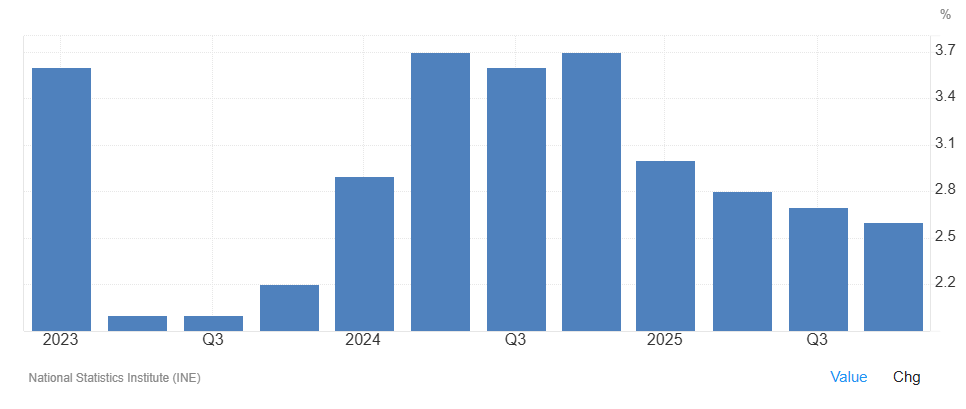
“For three years running, we have had the fastest-growing economy among Europe’s largest countries,” Sánchez wrote. “We have created nearly one in every three new jobs across the European Union.”
Since the end of 2019, Spain’s economy has grown 2.8 percentage points faster than the eurozone’s, according to ING Think. Germany’s GDP, the largest economy in Europe, grew 0.4% year-on-year in Q4, the most in three years. France’s GDP expanded by an annual 1.1% in Q4.
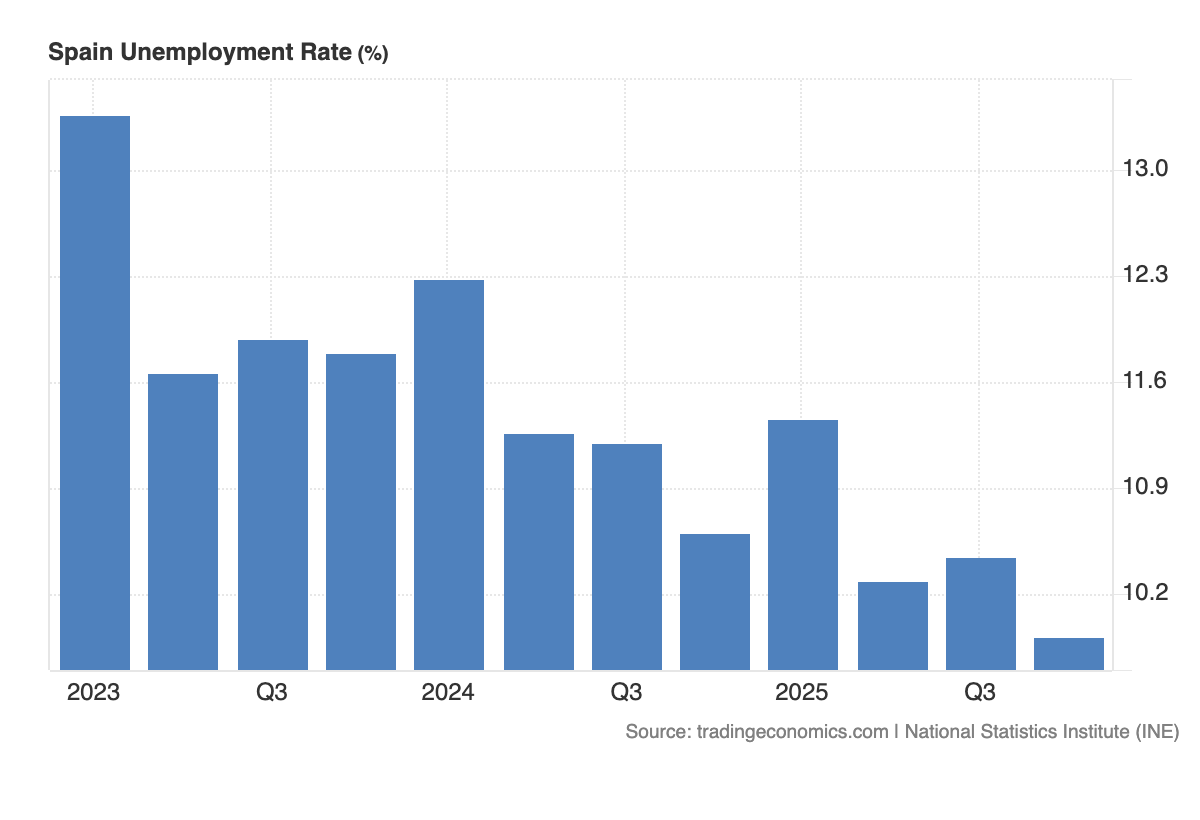
Spain’s unemployment rate dropped below 10% in Q4 for the first time in nearly two decades. However, chronic labor shortages have plagued agriculture, hospitality, logistics, and elder care.
Migration Supports Consumption, GDP
An aging population and low employment among older workers have threatened labor supply, growth, and public finances. Migration has driven consumption, boosting the country’s labor force by 6.4% since 2019, compared to 3.6% in the eurozone, according to ING Think.
“Much of Spain’s recent growth has been quantitative, driven by substantial migration inflows that expanded the labor force,” ING Think wrote on January 30. “The government’s recent regularization plan…suggests a continuation of this strategy.”
The country’s industrial production dropped significantly in December, marking the first decline in 10 months. It contracted 0.3% year-on-year, led by a decline in durable consumer goods, according to National Statistics Institute figures.
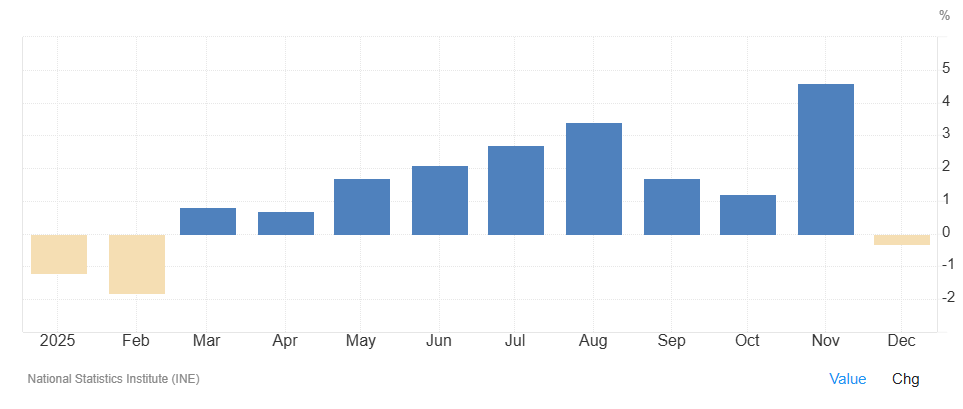
Spain Industrial Production Growth Over the Last 12 Months, Source: INE
Despite 1.3% average growth for 2025, the downturn raises questions about sustained economic strength.
“This demographic tailwind masks weaker productivity dynamics,” ING Think said. Spain must shift “from quantity-driven growth to a sustainable, productivity-led model,” it said.
Sanchez Could Face Political Pushback
Sanchez could also face strong political pushback. The conservative and far-right opposition lashed out at the regularization, saying it would only encourage more illegal immigration.
The “ludicrous” plan would “overwhelm our public services,” Alberto Núñez Feijóo, head of the Popular Party, the main right-wing opposition group, wrote on X. “In Socialist Spain, illegality is rewarded,” he said, vowing to change migration policy “from top to bottom” if he took power.
Sanchez also used a royal decree that doesn’t require parliamentary ratification, despite the original citizen-led proposal having received overwhelming congressional support in April 2024. The decree revived a citizen-led initiative backed by more than 700,000 signatures and endorsed by 310 members of Congress in April 2024.
“Parliamentary arithmetic has played an important role in this decision,” Asbel Bohigues, a Political Science Professor at the University of Valencia, said. “Since the 2023 elections, the combined votes of the PP, Vox, and Junts amount to a narrow right-wing majority, even though the government itself is led by the left.”
The recent snap elections in Aragón and Extremadura point to challenges to Sanchez’s socialist party.
Sanchez Wants to Tighten Social Media Rules
Sanchez has also taken a strong stance on social media, one that Musk responded to by labeling the Spanish leader as a “true fascist.”
He has proposed criminal liability for tech executives, penalties for algorithmic amplification of illegal content, and a “Hate and Polarization Footprint” to expose platforms enabling it.
The social media proposal grants Spanish authorities unprecedented power over foreign technology companies. It holds executives criminally liable and would investigate platforms like Grok, TikTok, and Instagram, representing a significant regulatory escalation.
Spain also joined Australia in implementing the world’s first under-16 social media ban in December 2025. Sánchez said Spain had joined five other European countries in a “Coalition of the Digitally Disposed” to advance coordinated regulation of social platforms.
“Vague definitions of ‘hate’ could label criticism of the government as divisive, leading to shutdowns or fines,” Pavel Durov, Telegram’s founder, said. “This can be a tool for suppressing opposition.”
Disclaimer: Any opinions expressed in this article are not to be considered investment advice and are solely those of the authors. European Capital Insights is not responsible for any financial decisions made based on the contents of this article. Readers may use this article for information and educational purposes only.
Benzinga Disclaimer: This article is from an unpaid external contributor. It does not represent Benzinga’s reporting and has not been edited for content or accuracy.
Recent Comments