
Vice President JD Vance’s visit brings GPU exports, nuclear co-operation into public view, positioning the small nation for capital influx
Vice President JD Vance became the first sitting US President or Vice President to visit Armenia on Monday, in a historic trip that marks a fundamental shift in US-Armenia relations.
Standing alongside Armenian Prime Minister Nikol Pashinyan, Vance publicly confirmed what I wrote in November: the US has approved exports of high-powered NVIDIA Corp (NASDAQ:NVDA) GPUs to Armenia, positioning the country alongside Saudi Arabia and the UAE as one of the few nations with access to America’s most advanced AI chips.
“These are chips that simply do not exist in most countries in the world,” Vance said. “They are now going to be developed and the data centers using those chips are going to be built and in fact are already being built.”
Vance announced a $9 billion civil nuclear cooperation deal, Armenia’s first-ever purchase of US military equipment ($11 million in surveillance drones), and infrastructure investment commitments that indicate Armenia has moved from regional player to strategic US partner.
For investors, these developments represent an inflection point. The numbers tell the story.
De-Risking an Entire Market
“The visit in its essence was full of milestone announcements. One of the major ones being authorization by the US of the NVIDIA and Firebird partnership with Armenia through investments of $500 million,” said Hovsep Patvakanian, PhD, Head of Armenia’s Investment Council and CEO of Invest in Armenia.
A $500 million AI factory being built by Firebird AI, using NVIDIA GPUs and Dell Technologies Inc (NASDAQ:DELL) servers, will bring large-scale AI computing infrastructure to the region.
The nuclear component is equally significant. The cooperation agreement positions US companies as front-runners to replace Armenia’s aging Soviet-built reactor, with $5 billion in initial exports plus $4 billion in long-term contracts.
“Access to advanced American AI chips and dual-use technologies is granted only to a limited number of countries and is regulated by the strict US export control system. This is not an open market or a one-time investment,” Patvakanian explained. “As of now, the authorization for the NVIDIA partnership was given only to Israel, Japan, South Korea, the UK, Australia, and as of yesterday, also to Armenia. This has put Armenia into the league of countries where institutional investors have confidence to invest in.”
A $9 billion US investment in a country with a GDP of roughly $29 billion represents nearly one-third of Armenia’s entire economy. That scale of commitment signals serious strategic intent.
“When the American Vice President visits and announces these commitments to a small Caucasus country like Armenia, the size of Connecticut, this boosts investment immediately,” said Peter Bilzerian, Managing Director at MPP Insights and Investor focused on Armenia’s tech ecosystem.
The impact is already visible. “American companies are suddenly flooding my inbox asking about our Armenia data engineering teams,” Bilzerian said.
Patvakanian confirmed the immediate response: “I have personally been contacted by several major conglomerates engaged in energy infrastructure development, AI data centers, and AI-driven startups based in Silicon Valley aiming to open their offices in Armenia. We see the first signals of the visit and negotiations are underway to have several tech giants enter Armenia, hopefully by the end of this year.”
Data Diplomacy and Infrastructure Security
NVIDIA’s relationship with Armenia is a result of positioning and foresight. Prime Minister Pashinyan visited NVIDIA headquarters in 2019, before it became the world’s most valuable company. CEO Jensen Huang made a reciprocal visit in 2023. The $500 million Firebird AI partnership represents years of relationship-building.
“Investing $9 billion into civil nuclear energy isn’t coincidental. It’s investment security for the data infrastructure that NVIDIA is building,” Bilzerian explained. “Armenia already has the NVIDIA chips and the data engineering talent. But now they are getting American nuclear technology to power it. This is data diplomacy at its finest.”
The GPU exports enable what Firebird AI calls “digital export of electricity.” With closed borders constraining physical trade, digital exports through computing power represent a viable economic model.
Beyond AI and data centers, Patvakanian identified semiconductors and logistics as key sectors. The logistics opportunity stems from the TRIPP agreement opening routes closed for decades. “A route from Gyumri to Kars, which previously was going through Georgia with over 28 hours, will now be a straight line covering 1 hour,” he explained. “This means cutting the transportation costs by 32%.”
The Investment Window
“The window to invest in Armenian tech companies is now,” said Bilzerian. “There are probably 10 to 14 months before institutional capital makes it more expensive. Regardless of political opinion, this is real power to move a country.”
Patvakanian offers a longer timeline: “Institutional capital can make Armenian tech more expensive, yet I would give much farther time horizon, around 3-4 years. We need all those projects to commence and be finalized for the ripple effect to kick in.”
Looking Forward
“Peace is not made by people who are too focused on the past,” Vance said during his press conference. “Peace is made by people who are focused on the future.”
For Armenia, that future increasingly involves American technology, capital, and validation. For investors, it represents one of the most overlooked opportunities in emerging tech markets, now thrust into the public spotlight by the highest levels of the US government.
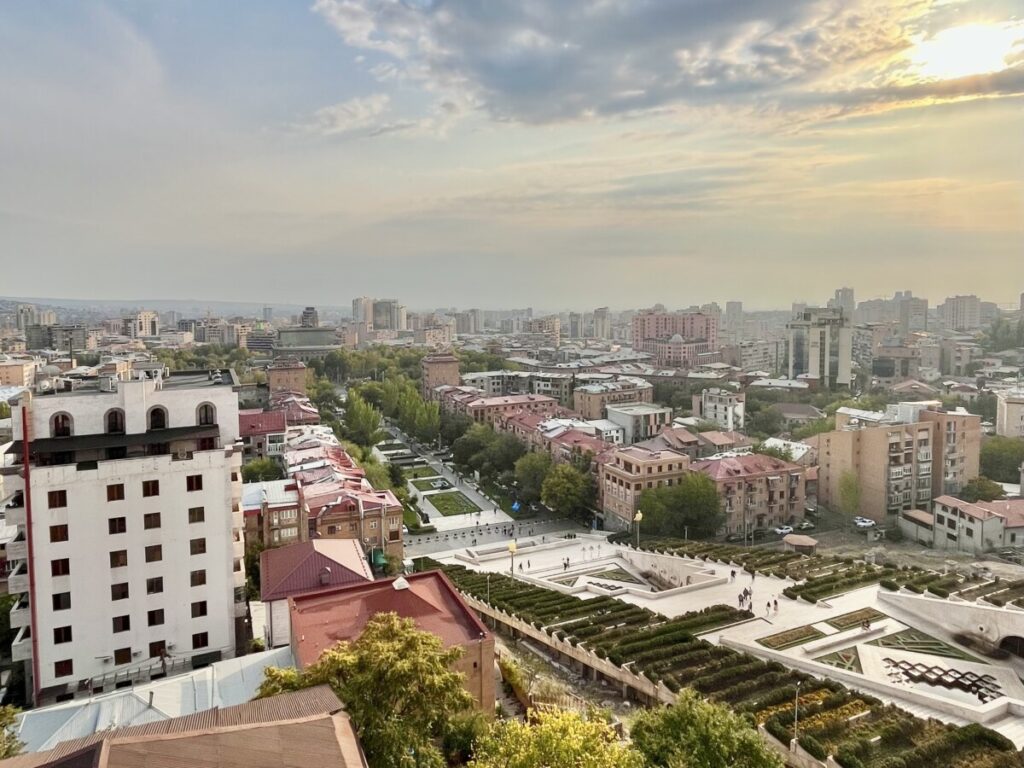
Photo courtesy of Brett Hershman
Disclaimer: The author has no affiliation or financial interest in any company, organization, or individual mentioned in this article, and derives no monetary gain from its publication.
Benzinga Disclaimer: This article is from an unpaid external contributor. It does not represent Benzinga’s reporting and has not been edited for content or accuracy.
Recent Comments