
On Monday, Sen. Bernie Sanders (I-Vt.) renewed his long-standing push to tax automation, arguing that companies like Amazon.com, Inc. (NASDAQ:AMZN) are replacing workers with robots to boost profits while avoiding the costs tied to human labor.
Sanders Targets Amazon Over Automation Push
Sanders took to X to criticize corporations such as Amazon for increasingly relying on robots instead of workers, saying the financial incentive is obvious.
Earlier this year, Amazon said it plans to cut roughly 500,000 jobs as it shifts more work to AI, automation, robots and other technologies—a major downsizing from its current workforce of about 1.56 million employees.
“Why would corporations like Amazon replace workers with robots? Pretty simple,” Sanders wrote. “Robots don’t need a wage, health care, time off, sick leave, Social Security, Medicare or unemployment benefits.”
Sanders argued that as automation spreads across warehouses, logistics and white-collar work, the tax system has failed to keep pace. “Maybe it’s time to tax robots & use the revenue generated to help working families,” he added.
Amazon did not immediately respond to Benzinga’s request for comments.
See Also: Amazon Is Lagging In 2025, Yet 200+ ETFs Still Can’t Let It Go
Tax The Robots Idea Gains Unlikely Support
While the proposal may sound progressive, Sanders is not alone.
Microsoft Corp (NASDAQ:MSFT) co-founder Bill Gates floated a similar idea as far back as 2017, years before generative AI tools like ChatGPT reshaped the workplace.
At the time, Gates suggested that companies using robots to replace human workers should be taxed in a way comparable to payroll taxes, with the funds directed toward worker retraining and social programs.
Despite often clashing politically, Sanders and Gates found rare alignment again in 2023, both warning that rapid automation could eliminate jobs faster than the economy can replace them.
Mark Cuban Says Robot Tax Talks Can’t Wait
Billionaire entrepreneur Mark Cuban has also backed the concept, arguing that policymakers need to start addressing automation now rather than after job losses accelerate.
“I like a straight amount per hour of use, per robot or cobot,” Cuban said, adding that the specific form of the technology should not matter.
Cuban has said a clear framework would help governments recoup lost revenue as machines take on roles once filled by humans.
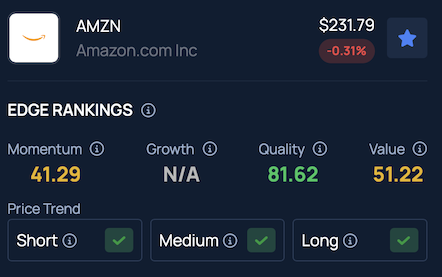
Price Action: Amazon shares are up 5.38% year-to-date. On Monday, it slipped by 0.19% and in after-hours trading, it was down by 0.16%, according to Benzinga Pro.
Benzinga Edge Stock Rankings show that AMZN has a strong price trend across the short, medium and long term. Click here for a closer look at the stock, as well as its peers and competitors.

Read Next:
Disclaimer: This content was partially produced with the help of AI tools and was reviewed and published by Benzinga editors.
Photo Courtesy: LiamMurphyPics on Shutterstock.com
Recent Comments