
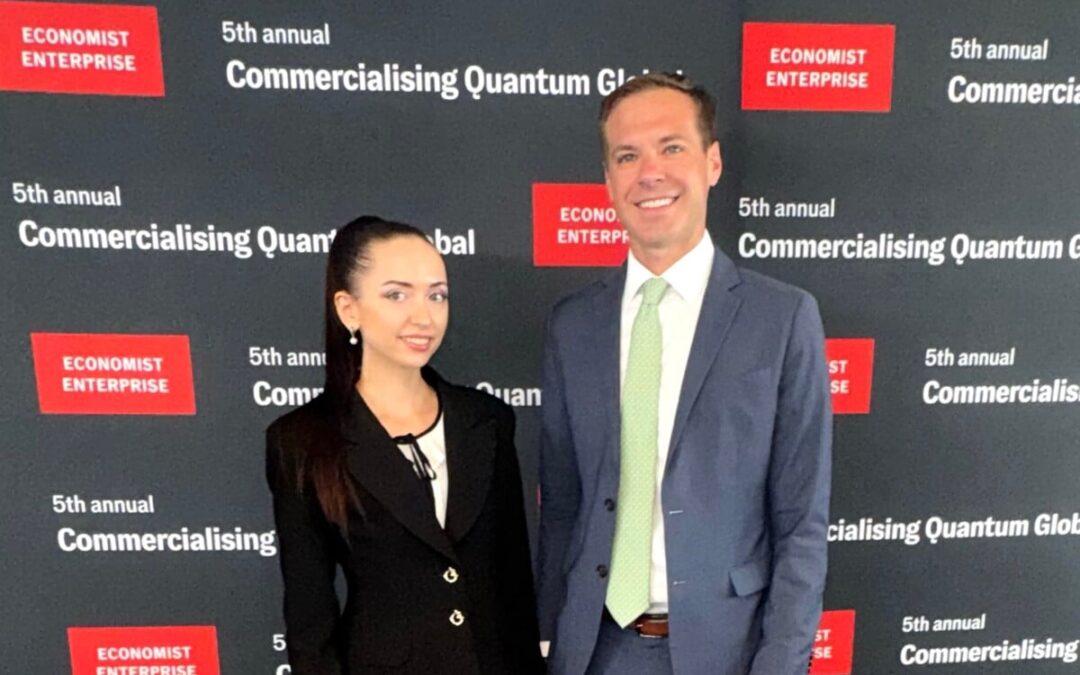
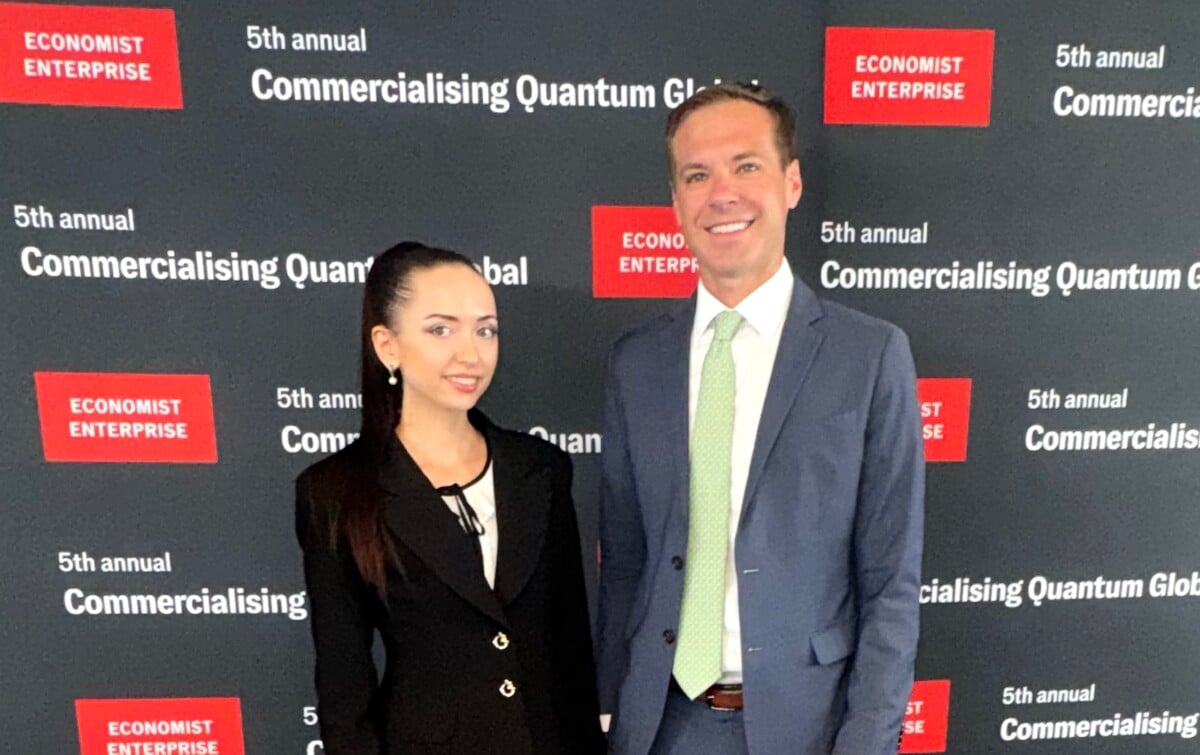
Credit: Anna Tutova(Founder AI Crypto Minds) with Matt Kinsella(CEO Infleqtion) at The Economist Commercializing Quantum Global conference in London.
How Matt Kinsella went from Silicon Valley venture investor to running the first publicly traded neutral-atom quantum company and why he thinks Google and Microsoft just validated his bet.
Matt Kinsella reaches into his pocket and pulls out a metal-and-glass cell no larger than a harmonica. It holds millions of atoms suspended in an ultra-high vacuum. “What we do is we build quantum cores, like this one I’m holding here,” he says in conversation with me at The Economist Commercializing Quantum Global conference in London. Those invisible particles are the logic gates of a machine that Kinsella believes will soon crack problems no classical computer can touch.
That conviction now trades on the New York Stock Exchange. Infleqtion (NYSE:INFQ), the first publicly listed pure-play neutral-atom quantum computing company, went public in February via a SPAC merger that injected $550 million onto its balance sheet. It posted $9.5 million in revenue in the first quarter of 2026, up 14% year-over-year, and is guiding to at least $40 million for the full year. The company has also signed a LOI for a $100 million program with the Department of Commerce. A month ago, Matt Kinsella stood in the White House as President Trump signed an Executive Order elevating quantum technology to a national priority. Yesterday, he testified before the House Committee on Natural Resources, advocating for quantum sensors to map critical mineral deposits.
Not bad for a former investor who walked away from an 18-year career because he couldn’t ignore what he was seeing. “Over the last three years, I’ve seen quantum computing shift from speculative and it’s happening, and now it’s just a question of when,” Matt Kinsella says. “The opportunity was just too big, and the importance of getting this technology out into the world was too big to not do it, honestly. So, what should have been a pretty hard choice to leave a great career at a firm for 18 years was ultimately a pretty easy one.”
From seed check to corner office
Matt Kinsella began his career in 2005 as a public equity analyst at Maverick, spending nine years picking technology stocks before moving to San Francisco in 2014 to build the firm’s venture-capital practice. Quantum caught his attention in 2017. “I got very curious about quantum, started going down the rabbit hole, and ultimately decided that really starting something from scratch might be the best risk-reward,” he says. He found Dana Anderson, a physicist at the University of Colorado Boulder, and wrote the first seed check to commercialize neutral-atom technology. He joined the board and stayed there for six years before becoming CEO in early 2024.
The physics, he insists, is now the easy part. “We have passed the physics challenges at this point in time, and now it’s really controlling the laser systems with more precision such that we control our atoms with more precision so that we can get to the number of logical qubits and the number of operations that we need to start to reach utility-scale quantum computing.” Utility-scale doing what classical computers cannot is the holy grail. Matt Kinsella aims for 30 logical qubits by the end of this year and 100 by 2028, enough, he believes, to start beating classical machines on specific algorithms. “I believe that we will start to do interesting things that classical computers can’t do. It might not be a wow ChatGPT moment, but it is, I think we’ll get there by the end of 2028 when we have 100 logical qubits.”
Why neutral atoms won the argument
When Matt Kinsella first backed Dana Anderson, neutral atoms were a dark horse. Google was pushing superconducting qubits; Microsoft chased topological qubits. That has changed dramatically. “Both have really shifted towards focusing on neutral atoms, and I think that’s hugely validating for the neutral atom market,” Matt Kinsella says. “When I first invested in Infleqtion(ColdQuanta previously), most people hadn’t even heard of neutral atoms, and they’ve really come from a dark horse to now leading in most of the metrics that matter.”
Inside Infleqtion’s vacuum cells, millions of neutral atoms float freely. Lasers interact with them, exploiting quantum mechanical properties to build clocks, inertial sensors, and quantum processors. “Think of each individual atom being a qubit, and then we put those qubits into superposition, we entangle those qubits, and then ultimately we use those qubits in that array as the fundamental logic gates for our computer,” Matt Kinsella explains.
The sensors are already generating revenue. Infleqtion’s atomic clocks currently the size of three stacked pizza boxes are shrinking toward a 1U rack-mount, and then to a chip-scale device within four to five years. “That’s not science, that’s engineering, and it’s been a very well-trodden path that we just need to invest the R&D in to follow,” Matt Kinsella says. The endgame is what the company’s founder calls “quantum in the kitchen”, a quantum positioning system that replaces GPS. “If you have better than GPS capabilities locally, you can start to wean off GPS,” Matt Kinsella says. Soldiers and autonomous vehicles will be the first adopters. Then everyone else.
The NVIDIA partnership and the AI flywheel
While some feared NVIDIA’s quantum workstation ambitions would make it a rival, Matt Kinsella describes a symbiotic loop. “They are very much not a competitor and very much a partner. The tact they’re taking … NVIDIA wants to sell more GPUs, and so they view quantum ultimately as a way to sell more GPUs.” NVIDIA’s Ising models, released recently, already help Infleqtion detect and correct quantum errors by turning root-cause analysis into an inference problem, something AI devours. “The detection of errors in a quantum computer is quantum mechanical in nature, but tracing those errors back to their root cause is an inference problem. And inference is something that AI is very, very good at. So, we are accelerating our time to error correction by using some of these AI tools.”
Once the qubits are error-corrected, QPUs and GPUs will work hand-in-hand. A joint experiment with NVIDIA solved a condensed-matter physics puzzle called the Anderson impurity model. “It is not commercially useful today, but it is a precursor and maybe a view into the future of how QPUs and GPUs will work together to solve problems like, how do you build a better battery, or how do you build better jet fuels, or how do you make new materials to build planes out of, etc.”
Capital is no longer the existential threat
For years, Matt Kinsella’s biggest fear was running out of money. “Historically, capital had been one of the things I would have viewed as an existential crisis or existential risk to the business, not because it was any kind of near-term thing, but we didn’t have enough capital in the bank historically to achieve the mission.” The public listing and the Department of Commerce program changed the math. “Capital is no longer the existential threat to the business, and so I intentionally took that threat off the table because I didn’t want to have to take the risk of three years from now the public markets being accommodative to technology, deep tech companies.”
Now the challenges are the mundane growing pains of a company heading from 200 to 300 people. “You have all the standard challenges that you experience when you’re taking a company from zero people to 50 people, to 100 people, to 200 people, and now we’re on our way to 300 people or so this year.” Matt Kinsella isn’t losing sleep over Google or Microsoft, either. “At one point in time, Google and Microsoft were very small companies who had big, big large incumbents that they were competing with, and they ran circles around their large incumbents and ultimately grew to be large companies. And I’m pretty convinced we’ll do the same thing, and that we’ll just be able to be much more nimble and move much faster.”
The Bitcoin paradox and the China race
Matt Kinsella has been a Bitcoin investor longer than he’s been a quantum investor. He knows the uncomfortable truth that a sufficiently powerful quantum computer could break the cryptography securing Bitcoin. “It is true, quantum will pose a problem for the underlying encryption that many of the blockchains run on, in particular Bitcoin. … In a few years, I don’t know exactly how many, but it’s going to happen, quantum computers will be powerful enough to break the underlying encryption of Bitcoin.” Yet he’s not selling. “I do believe that at this point in time, the large chains like Bitcoin or Ethereum are too big to fail. So, even though it will be challenging, I do think they’ll find a way to fork the networks with better quantum encryption methodologies that will make sure they don’t ultimately get broken.” He also sees a solution inside the problem: “You can use quantum to encrypt blockchains in a much more robust fashion. And so, it works both ways.”
On geopolitics, Matt Kinsella is direct. “It is a race with China, there’s no doubt about that. And I think it’s a very important race for the US, the UK, and our allies to win.” China is taking a “top-down directed investment model,” while the West relies on capital markets. “Historically, that capitalist method has been a much more successful method in getting technologies out to market faster. … I will bet on the way that the US and the UK are going about it every day.”
For now, Matt Kinsella is focused on two numbers: $40 million in revenue and 30 logical qubits by year-end. Then 100 logical qubits by 2028. Then chip-scale sensors that fit in your pocket. The prop on the table, the quantum core, is both a science experiment and a balance-sheet asset. And for the investor who couldn’t stay away, it’s proof that the hardest career choice was really no choice at all.
Benzinga Disclaimer: This article is from an unpaid external contributor. It does not represent Benzinga’s reporting and has not been edited for content or accuracy.
Recent Comments