
After months in which artificial-intelligence winners dominated investor attention, equity markets are broadening. Crowded trades are losing momentum while investors search for ways to participate in that trend.
With higher interest rates still looming under new Federal Reserve Chairman Kevin Warsh, financials are among the beneficiaries of the rotation. The largest U.S. banks set the tone in second-quarter earnings, with JPMorgan Chase, Goldman Sachs, Bank of America. and Morgan Stanley among the firms benefiting from stronger dealmaking, active trading desks and resilient consumers.
All six major U.S. banks beat Wall Street’s second-quarter profit expectations, with some analysts and investors describing the scale of the beats as extraordinary.
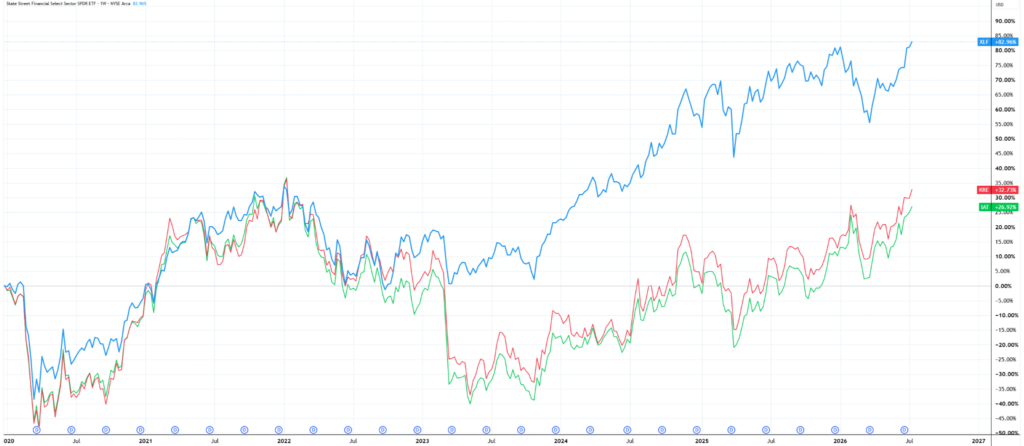
Yet that mega-cap strength has not lifted all boats. Regional-bank ETFs — the SPDR S&P Regional Banking ETF (NYSE:KRE) and the iShares U.S. Regional Banks ETF (NYSE:IAT) — still lag. Their discount is rooted in the 2023 crisis that brought down Silicon Valley Bank and rattled confidence across the industry.
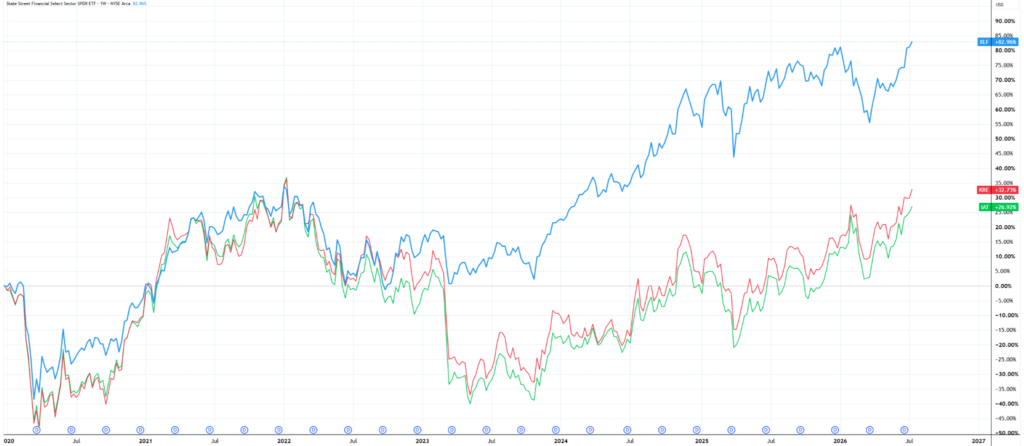
XLF vs KRE vs IAT weekly chart. 2020-Present; Source: TradingView
The result is a widening gap between regional-bank exposure and broader financial-sector vehicles such as the Financial Select Sector SPDR Fund (NYSE:XLF).
The Supporting Macro
Going forward, the discount may be increasingly hard to justify. Commercial real estate concerns remain an overhang, but improving macro data, stronger loan demand and better credit trends are beginning to offset fears that the sector is still trapped in a post-crisis balance-sheet shock.
Meanwhile, Morgan Stanley notes strengthening commercial and industrial loan growth and a business-cycle reacceleration.
“Regional Banks still benefit from the broader recovery, improving loan growth dynamics and our call for a re-steepening of the yield curve,” Mike Wilson, chief U.S. equity strategist at Morgan Stanley, said on the firm’s podcast.
That last point is central to the trade. A steeper yield curve typically allows banks to earn more on longer-term loans while funding themselves through shorter-term deposits, supporting net interest margins. With Morgan Stanley citing an ISM Composite Index reading of 54.5 and improving commercial and industrial loan growth, the sector’s earnings power could reaccelerate just as investors begin rotating away from crowded growth trades.
A Narrow Window For M&A
Yet another positive catalyst is consolidation. American Banker reported that bank merger activity is poised to accelerate under the second Trump administration, which has loosened certain merger standards and sped approvals at the Federal Deposit Insurance Corp.
After a spring lull tied to geopolitical volatility, dealmaking looks set to resume: there were 188 bank M&A deals in 2025, and 83 announced in the first half of 2026, per Seaport Research Partners analyst Laurie Havener Hunsicker, who expects the activity to “substantially accelerate” in the second half of 2026 and into 2027.
The clock is the catalyst. Lenders need scale to meet technology demands, and the regulatory window may narrow after 2028.
“The limited window of opportunity is the risk that we get another kind of administration in 2029, and they go back to the kind of behavior we were seeing during the early Biden era,” Meg Tahyar, a partner at Davis Polk, noted.
Recent Comments