
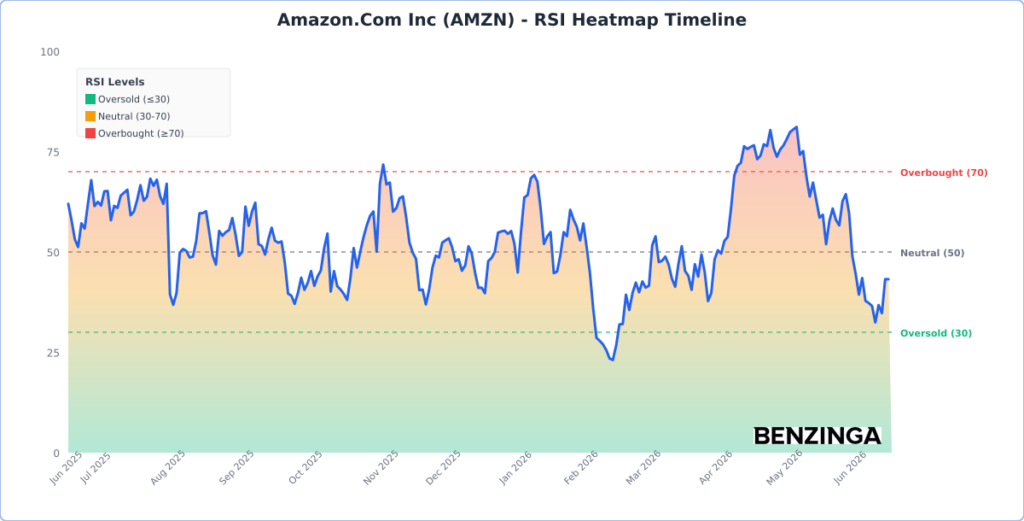
Amazon.com Inc. (NASDAQ:AMZN) shares are trading lower on Wednesday afternoon, reflecting broader market volatility as investors digest a more hawkish-than-expected policy stance from the Federal Reserve. Here’s what investors need to know.
- Amazon.com shares are experiencing downward pressure. What’s pulling AMZN shares down?
Growth Stocks Face Valuation Pressure
The central bank held the federal funds rate steady at 3.50%-3.75%, but the accompanying Summary of Economic Projections surprised traders by signaling one rate hike later this year, a pivot from previous expectations of a cut.
This hawkish shift serves as a significant headwind for high-growth equities like Amazon. Higher interest rates increase the discount rate applied to future cash flows, disproportionately compressing the valuation of growth-oriented companies that derive much of their worth from earnings projected far into the future.
Economic Outlook And Inflation Concerns
Furthermore, the Fed’s updated outlook projects higher inflation and a lower unemployment rate, suggesting that borrowing costs may remain elevated for longer than the market previously anticipated.
For a capital-intensive giant like Amazon, sustained high interest rates raise financing costs and may dampen consumer discretionary spending, a core pillar of its retail and cloud computing revenue streams. With all eyes now on Chair Kevin Warsh’s first press conference, the market is bracing for further clarity on the Fed’s inflation tolerance and the path for future rates.
Critical Moving Averages Levels To Watch For AMZN
Amazon is now trading 6.3% below its 20-day SMA ($255.40) and 6.6% below its 50-day SMA ($256.16), which keeps the near-term trend pointed down despite the stock still holding above the longer-term 200-day SMA ($232.67). The 20-day SMA sitting below the 50-day SMA reinforces that the recent downswing has had enough duration to tilt short-term trend signals bearish.

MACD is the cleaner momentum read right now: it’s below its signal line and the histogram is negative, which tells traders upside pressure is fading versus the prior upswing unless momentum can re-accelerate. In plain terms, MACD compares faster and slower trend momentum, and being below the signal line often shows buyers are losing control in the near term.
The bigger-picture trend is still trying to stabilize after the golden cross in May (50-day moving above the 200-day), but price action since the May swing high has been choppy and mean-reverting. If the stock can’t reclaim the 20-day/50-day area, traders often start focusing on whether the 200-day zone becomes the next “line in the sand.”
- Key Resistance: $275.00 — a round-number area near the upper end of the 52-week range where rebounds can stall
- Key Support: $226.50 — a nearby floor to watch ahead of the 200-day moving-average zone ($232.67)
How Amazon Makes Money and Its Revenue Breakdown
Amazon is the leading online retailer and marketplace for third-party sellers, and that retail engine still makes up about 74% of total revenue. The rest is driven by Amazon Web Services at roughly 17% and advertising services at about 9%, giving the company multiple levers that can matter depending on where the economy is in the cycle.
International segments account for about 22% of revenue, led by Germany, the United Kingdom, and Japan, which adds both growth opportunity and currency/macro sensitivity. For traders, that mix is why Amazon can trade like a consumer stock on some days and like an enterprise/cloud name on others.
Amazon.Com Benzinga Edge Rankings and Market Comparison
Below is the Benzinga Edge scorecard for Amazon.com, highlighting its strengths and weaknesses compared to the broader market:
- Momentum: Neutral (Score: 57.54) — The stock’s trend signals are mixed, with longer-term support holding but short-term pressure still evident.
- Quality: Neutral (Score: 53.66) — The fundamentals screen as middle-of-the-pack, suggesting neither a clear quality premium nor a red flag.
- Growth: Strong (Score: 95.63) — The profile still skews heavily toward growth expectations versus the broader market.
The Verdict: Amazon.com’s Benzinga Edge signal reveals a growth-heavy profile with neutral momentum and quality readings. For longer-term bulls, that often means the thesis leans on execution and growth delivery, while near-term traders may wait for momentum to turn back up before pressing new risk.
AMZN Stock Price Activity Update for Wednesday
AMZN Stock Price Activity: Amazon.com shares were down 3.17% at $238.19 at the time of publication on Wednesday, according to Benzinga Pro data.
Image: Shutterstock
Recent Comments