
In January 2007, Steve Jobs held up a glass rectangle and most of the tech industry shrugged. Eighteen months later, every phone maker on earth was scrambling to catch up. The ones who moved first won. The ones who waited spent years playing catch-up.
CrowdStrike CEO George Kurtz thinks cybersecurity may have just experienced a similar moment.
Speaking during the company’s first-quarter earnings call on Wednesday, Kurtz said a newly released AI model developed in collaboration with Anthropic changed the cybersecurity landscape in a matter of weeks.
“More happened in a matter of weeks in cybersecurity than in the whole year prior,” Kurtz said.
‘Any Human…Can Now Be A Cyberhacker’
The model can identify vulnerabilities and connect them into attack chains, effectively automating tasks that once required highly sophisticated hackers. According to Kurtz, the development marks a turning point for the industry.
“Any human or agent can now be a cyberhacker,” he said. “Or worse, wage serious cyber attacks that threaten enterprise survival, nation state continuity, and critical infrastructure.”
The CrowdStrike chief argued that companies are embracing artificial intelligence far faster than they are securing it.
As an example, Kurtz said CrowdStrike recently assessed a Fortune 100 company after the model’s release and discovered 45 million vulnerabilities.
Worldwide AI Spending
The warning comes as worldwide AI spending is projected to reach $2.5 trillion, as per Gartner, while only a small fraction of organizations have developed advanced AI security strategies.
Kurtz compared the moment to cybersecurity’s version of Y2K — a period when businesses were forced to rapidly rethink technology risk and invest heavily in protection measures.
Apple’s iPhone Moment Vs. AI Moment
The difference, he suggested, is speed.
The smartphone revolution took years to reshape entire industries after Apple’s breakthrough. AI-powered cyber threats may be compressing that timeline into months.
Crowdstrike Earnings
CrowdStrike reported first-quarter revenue of $1.39 billion, beating analyst estimates of $1.36 billion, while adjusted earnings came in at $1.10 per share, ahead of expectations of $1.07 per share, according to Benzinga Pro. Revenue rose 26% year-over-year, driven by a 26% increase in subscription revenue to $1.32 billion, while annual recurring revenue grew 24% to $5.51 billion after the company added $255.8 million in net new ARR during the quarter.
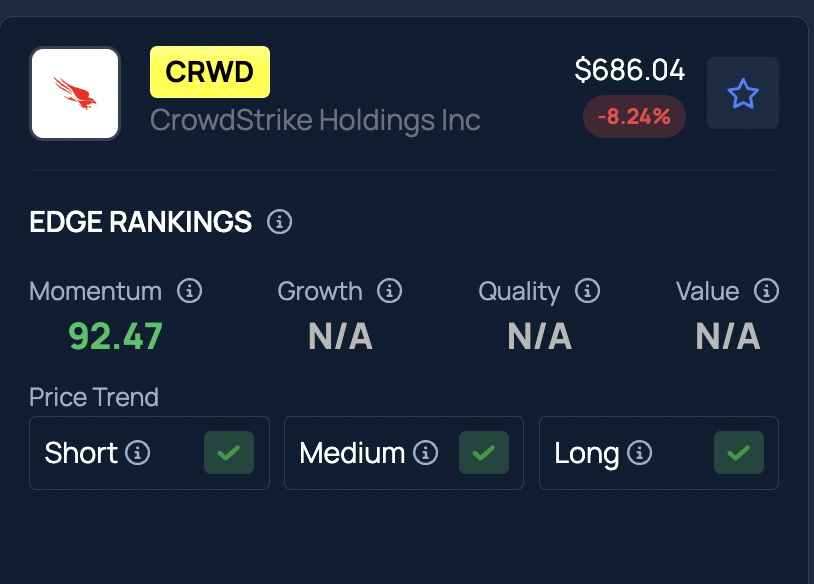
According to Benzinga Edge Stock Rankings, the stock continues to exhibit strong momentum across short-, medium- and long-term timeframes.
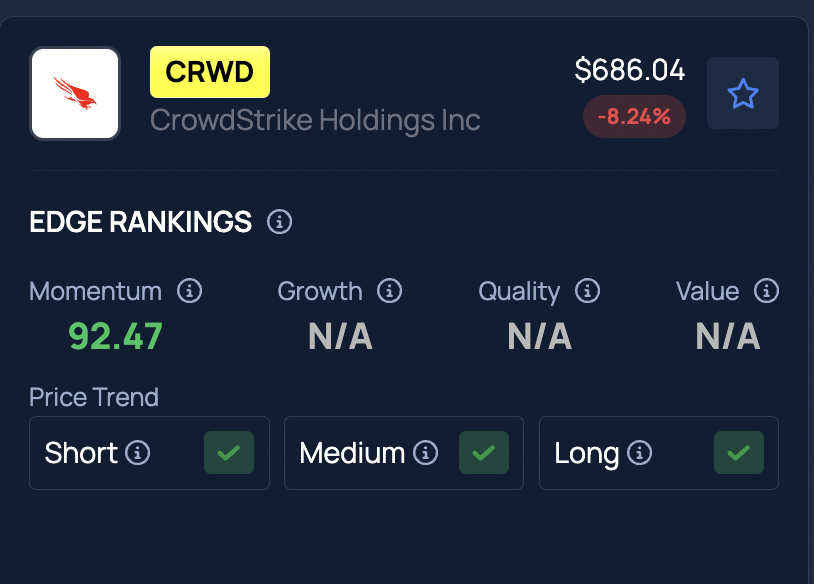
Image Via Shutterstock
Recent Comments