
When President Donald Trump returned to the White House, his administration wasted no time unwinding Biden-era clean energy subsidies under the “drill baby drill” mantra. For environmentalists and sustainability-focused companies, the outlook appeared bleak.
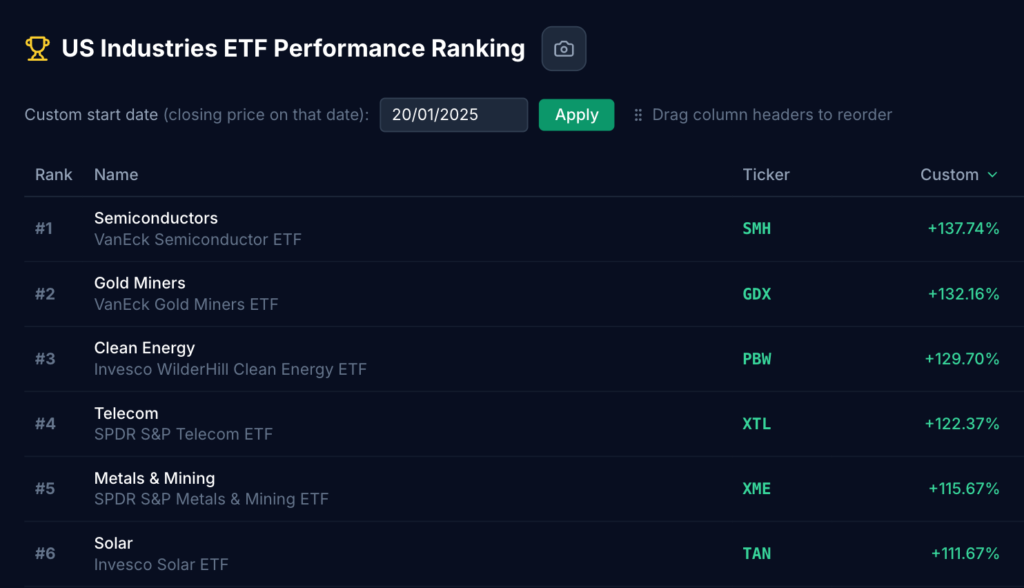
Fast-forward to today: Shares of clean energy companies — as tracked by the Invesco WilderHill Clean Energy ETF (NYSE:PBW) — have rallied 130% since Inauguration Day, almost mimicking the VanEck Semiconductor ETF (NASDAQ:SMH), the market’s purest proxy for the artificial intelligence boom.
Solar, the corner of the market Trump singled out most often, was not far behind. The Invesco Solar ETF (NYSE:TAN) returned 112%.


How Did A Sector That Trump Disparaged Keep Pace With AI Chips?
PBW’s largest industry exposure is electrical equipment, at 33.19% of the portfolio. Its second largest is semiconductors, at 14.31%.
The two trades have blurred into one.
Navitas Semiconductor Corp. (NASDAQ:NVTS), a maker of the power chips that manage electricity inside data centers and electric vehicles, sits inside the clean energy fund as a top-10 holding.
It has returned 387.45% over the past year.
The logic runs through the wall socket.
Data centers need staggering amounts of electricity, and the grid cannot deliver it fast enough.
That has turned fuel cells, grid-scale batteries and power-electronics makers into infrastructure for the AI build-out rather than bets on climate policy. The same demand that lifts Nvidia Corp. (NASDAQ:NVDA) lifts every company that generates, stores and converts the power its chips consume.
Bloom Energy Corp. (NYSE:BE), which builds fuel cells that can power data centers directly without waiting on the grid, is the clearest example.
The stock is up 1,380.83% over the past year.
Hormuz And High Oil Prices Quietly Rebuilt the Case For Renewables
There is a second engine, and it sits in the Strait of Hormuz.
Brent crude trades near $100 a barrel. That is down from a 2026 peak above $121, but still well above the mid-$70s level where oil sat before war broke out across the Gulf in late February.
When the cost of a barrel remains elevated for more than a year, every alternative starts to look cheaper.
The conflict Trump leaned on to justify more drilling has, at the same time, strengthened the economics of the power that never touches a barrel.
What Washington Did, And What the Market Shrugged Off
Trump’s One Big Beautiful Bill Act phased out investment tax credits that underpinned returns for solar and wind for a decade.
Projects that break ground after July 2026 lose those credits unless they are running by the end of 2027.
The law was written to slow the build-out. In the near term, it did the opposite, setting off a race to start projects before the window closes and pulling demand forward rather than erasing it.
The result is a leaderboard that looks nothing like a green-energy roster.
Inside the PBW ETF, the biggest winners of the past year trade more like leveraged bets on electricity itself.
| Company | 1-Year Return (as of June 2, 2026) |
|---|---|
| Bloom Energy Corp. | +1,380.83% |
| T1 Energy Inc. (NYSE:TE) | +855.05% |
| Energy Vault Holdings Inc. (NYSE:NRGV) | +547.62% |
| Lithium Argentina AG (NYSE:LAR) | +504.05% |
| Fluence Energy Inc. (NASDAQ:FLNC) | +477.66% |
| Ballard Power Systems Inc. (NASDAQ:BLDP) | +388.37% |
| Navitas Semiconductor Corp. | +387.45% |
| Plug Power Inc. (NASDAQ:PLUG) | +346.36% |
| FuelCell Energy Inc. (NASDAQ:FCEL) | +317.03% |
| Hyliion Holdings Corp. (NYSE:HYLN) | +305.84% |
January 2018: The Tariff That Backfired
None of this is new, and it has happened under this same president before.
In January 2018, Trump imposed Section 201 tariffs on imported solar panels. Wall Street read the move at the time as a death sentence for the industry’s cost structure.
Solar did the opposite. The Invesco Solar ETF returned 58% in 2019, the best showing of any unleveraged US ETF that year, as falling equipment costs and a record project pipeline overwhelmed the policy drag.
The setup rhymes in 2026.
What It Means for Investors
The takeaway is that energy demand has decoupled from energy politics.
A fund built to profit from the green transition is now, beneath the surface, a wager on the same power-hungry AI cycle that nearly caught the chips it nearly caught. That is the rotation hiding inside the numbers. The open question is 2027, when the credits actually expire, and the sector has to stand on its own.
Trump set out to drill. So far, the market has gone and electrified instead.
Image: Shutterstock
Recent Comments