
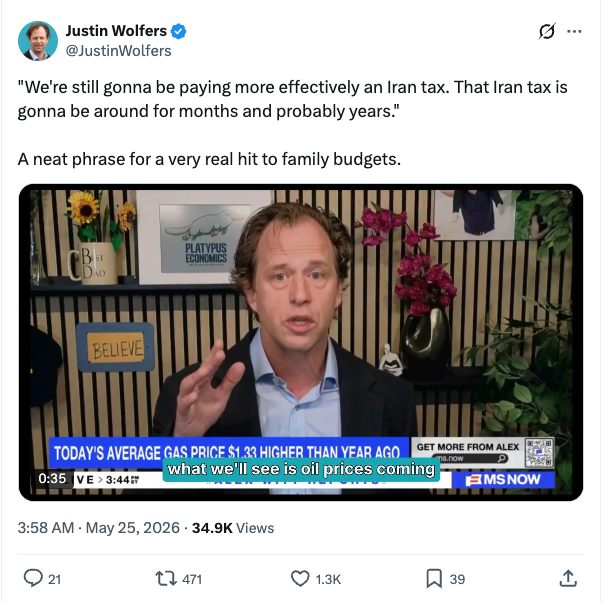
Economist Justin Wolfers on Sunday raised concerns that Americans will continue to face the pressure of higher energy prices linked to the conflict with Iran, which would hurt family budgets.
Higher Energy Prices To Persist
In a post on X, Wolfers said “We’re still gonna be paying more effectively an Iran tax. That Iran tax is gonna be around for months and probably years.” “A neat phrase for a very real hit to family budgets,” he added.

Screenshot from Justin Wolfer’s X account
The economist has used the ‘Iran tax’ as a phrase and not the real tax, saying that a prolonged increase in energy prices will continue to weigh on family budgets for months and years. He pointed out that the markets are pricing more expensive energy until the next general election in 2028.
If the tensions in the Middle East cool down, oil prices might fall quickly, but would remain high relative to what they would have been before the war, Wolfers said.
Higher Gas Price Ripples Through Economy
The average gas price stood at $4.51, up $1.33 from the year-ago period. Experts predict high gas prices to continue through 2026.
Americans have spent about $41.7 billion in additional gasoline and diesel costs since the Iran conflict began in late February. Jeff Colgan, a political-science professor at Brown University said “We are spending this huge amount of money as a country on extra fuel costs, which we could have used in a whole bunch of more constructive ways to improve America’s transportation infrastructure.”
This surge in fuel costs has not only prompted consumers to reduce spending but also fueled inflationary pressures across several sectors, including transportation and food markets.
“Think of an oil shock like a stone tossed in a pond.” “First splash: gasoline” Wolfers previously said, “Then the ripples: airfares, delivery costs, packaging, groceries, construction materials. The ripples are real. Just give them a moment to spread.”
Photo: QQMinh88 via Shutterstock
Recent Comments