
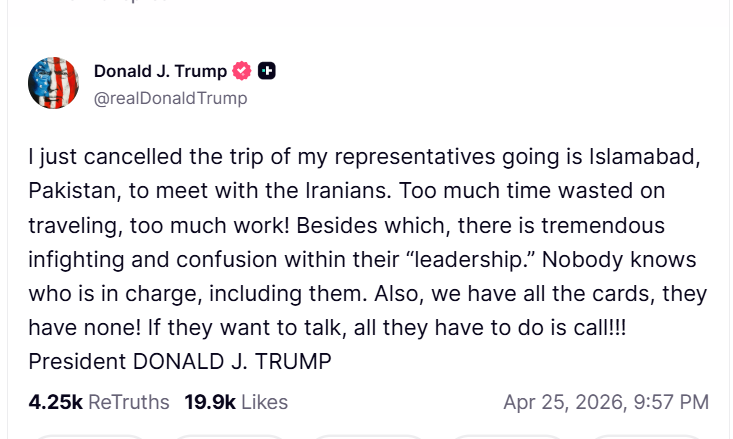
On Saturday, President Donald Trump said he called off a planned trip by his representatives to Islamabad, Pakistan, where they were set to meet with Iranian officials, arguing the travel would waste time and pointing to disarray inside Tehran’s leadership. The move comes as Sen. Lindsey Graham (R-S.C.) has backed the ongoing oil blockade against Iran, describing it as a key pressure point that could even broaden beyond current enforcement.
In a Truth Social post, Trump wrote that the delegation’s Islamabad stop was scrapped because Trump sees “tremendous infighting and confusion” among Iran’s leaders and believes Washington holds the upper hand if Tehran wants talks. In the same post, Trump said Iran could initiate contact directly if it wants to negotiate.

Trump’s Strategic Shift Signals New Tensions
Trump’s rationale centered on leverage, including his claim that the U.S. has “all the cards” while Iran has none, a posture that aligns with the economic squeeze described by Graham and other administration voices. Graham has argued the blockade is draining Tehran’s ability to fund activities the U.S. says are tied to militancy.
In comments this week, Graham called keeping the blockade in place “very smart” and said he expects it to remain until Iran shows meaningful behavioral change. He also said he anticipates enforcement will widen and warned countries that help Iran sell crude that they risk consequences, adding, “…you do so at your own peril,” he said.
Graham said he delivered those views after what he described as a “very good call” with Trump and Defense Secretary Pete Hegseth. He framed the moment as the strongest opening since 1979 to push for changes in Tehran’s conduct, preferably through diplomacy.
The administration has also pointed to concrete financial pressure from the oil restrictions, including Trump’s figure that Iran is losing $500 million per day because of the blockade. That claimed daily hit is part of the broader argument that sanctions-style tools can do more than another round of travel-heavy meetings.
Pressure Tactics Amid Diplomatic Negotiations
This strategic focus on negotiations follows Trump’s recent appeal to Iranian leaders to release eight women accused of crimes against the Islamic Republic, stating it would be a “great start” to upcoming negotiations. In a Truth Social post, Trump urged, “Please do them no harm!” as he emphasizes maintaining pressure on Tehran amidst ongoing tensions.
This context underscores the administration’s dual approach of engaging diplomatically while enforcing a strict blockade, which Trump has indicated will persist until there are significant changes in Iran’s behavior, aligning with Senator Lindsey Graham’s warning that the blockade could expand globally.
Could Iran’s Oil Crisis Escalate Globally?
Graham’s warning about a potentially global expansion dovetails with reports of stepped-up interdictions in key shipping lanes, including U.S. actions to intercept Iranian tankers and divert them away from destinations such as India, Malaysia and Sri Lanka. The senator has said the core goal is to deny Tehran revenue he says can be used as “resources for terrorism.”
Other officials have echoed the pressure narrative in operational terms, with Treasury Secretary Scott Bessent saying the naval effort is constricting Iran’s oil income and could soon strain storage capacity around Kharg Island. Bessent also said the U.S. plans to tighten economic measures aimed at disrupting Iran’s access to international financial channels.
Maritime reporting has added friction to the picture, after Lloyd’s List said earlier this week that 26 Iranian ships slipped past the blockade to move cargo, a claim the Pentagon rejected. The dispute over whether shipments are getting through underscores why U.S. officials and allies are talking about tougher, broader enforcement.
Key Insights From Recent Oil Market Movements
The Iran-focused standoff has also intersected with trading activity, with traders placing $430 million in oil wagers ahead of Trump’s ceasefire move that was described as the fourth well-timed trade linked to Iran war developments. Those bets highlight how quickly energy markets can react to shifts in the diplomatic and military backdrop.
Meanwhile, reports of Iran firing on ships as tensions rise have been cited alongside the widening blockade narrative. Against that backdrop, Trump’s decision to skip an Islamabad meeting track fits a strategy that leans on economic and maritime pressure rather than extended travel for talks.
Recent Comments