
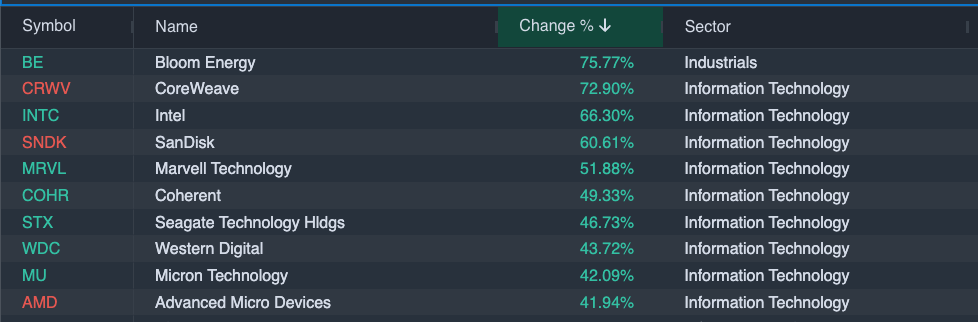
Twelve trading sessions after a U.S.-brokered ceasefire between Israel and Lebanon took effect — and with both the S&P 500 and the Nasdaq 100 trading at record highs — 10 large-cap stocks with market capitalizations exceeding $50 billion had each gained more than 40%, according to Benzinga Pro data screened on April 17.
None of them is an energy company. All 10 companies are technology or technology-adjacent names whose valuations had been compressed by a specific combination of forces: rising oil feeding into inflation expectations, supply-chain anxiety around Strait of Hormuz disruptions, and the general risk-off sentiment that had pushed high-multiple stocks lower through the conflict period.
The rotation is not uniform in its character. Some names broke historic records.
One delivered a streak not seen in over two decades.
A cluster of memory and storage stocks repriced a structural supply shortage that had been building since late 2025 but was obscured by geopolitical noise.

10. Advanced Micro Devices Corp. (NASDAQ:AMD) — +41.94%
Advanced Micro Devices closed higher for 12 consecutive sessions — its longest uninterrupted winning streak since 2005. Over that span the stock gained 41.94%, adding roughly $101 billion in market value.
The streak ranks among the rarest in AMD’s history: a chart of the company’s full price history since its 1972 IPO identifies only four instances of ten or more consecutive positive closes.
The current episode is the fourth, and arrives with the largest initial move of any in the series.
Wall Street began to reprice AMD’s server-CPU business as a structural beneficiary of the agent-based AI wave. Analysts at Bernstein SocGen raised their 2027 revenue forecast well above the Street consensus, citing AMD’s partnership with Meta and the upcoming MI400 AI accelerator launch. A
MD reports first-quarter results on May 5, with prior guidance calling for 32% year-over-year revenue growth.
9. Micron Technology, Inc. (NASDAQ:MU) — +42.09%
Micron Technology gained 42.09% in the 12-session window, recovering from war-period lows as the market repriced the memory leader at multiples more consistent with its fundamental supply-demand position.
Micron had already supplied the catalyst for the storage group’s broader rerate in March, reporting second-quarter fiscal 2026 earnings of $12.20 per share — roughly 33% above consensus — with revenue of $23.86 billion driven almost entirely by high-bandwidth memory demand.
Management confirmed that HBM capacity for the remainder of 2026 is completely sold out, with AI data centers consuming roughly 70% of high-end DRAM supply.
Memory chip stocks surged roughly 9% in a single premarket session on April 8 as ceasefire terms became clearer, with Micron leading the group alongside SanDisk, Seagate and Western Digital.
8. Western Digital Corporation (NASDAQ:WDC) — +43.72%
Western Digital surged 43.72% in the 12-session period, extending a move that had already pushed the stock to record highs in mid-March following Micron’s blowout earnings.
The ceasefire extended the trend rather than initiating it.
The company’s dual exposure to NAND flash and high-capacity hard drives gives it a broader AI storage surface than pure-play peers. Entire HDD manufacturing capacity for 2026 is reportedly committed, with some enterprise contracts extending into 2028.
Morgan Stanley described both Western Digital and Seagate as underappreciated AI infrastructure plays. Western Digital reports third-quarter fiscal results on April 30.
7. Seagate Technology Holdings PLC (NASDAQ:STX) — +46.73%
Seagate Technology Holdings PLC rallied 46.73% as the mass-capacity hard drive market repriced alongside the broader memory sector. Seagate’s high-capacity Mozaic platform has become the dominant solution for AI cold storage — the large data repositories that feed model refinement and are far more cost-effective on high-density HDDs than on enterprise SSDs.
As enterprise SSDs have reached price premiums of up to 16 times HDDs on a per-terabyte basis, Seagate’s position as the volume supplier in the HDD duopoly has taken on renewed strategic value.
JPMorgan upgraded the stock, citing strong demand trends and expanding margins.
6. Coherent Corp. (NYSE:COHR) — +49.33%
Coherent Corp. gained 49.33% in the window, extending a 12-month rally of roughly 448% driven by AI data centers migrating from copper to optical interconnects to sustain the bandwidth demands of next-generation compute clusters.
The company’s datacenter and communications revenue grew 34% year over year in its most recent quarter, now representing 72% of total revenue.
A strategic supply agreement with Nvidia Corp. (NASDAQ:NVDA), including a multi-billion dollar purchase commitment for advanced laser and optical networking products, reinforced investor confidence.
Management described the demand environment on the most recent earnings call as extraordinary, with a 4x book-to-bill ratio and customer forecasts extending into 2028.
5. Marvell Technology, Inc. (NASDAQ:MRVL) — +51.88%
Marvell Technology rallied 51.88% on a 12-day basis, with five consecutive weekly gains.
Marvell supplies custom silicon and high-speed networking ASICs to hyperscalers — products that benefit directly when AI infrastructure capital expenditure resumes after risk-aversion periods.
Bank of America recently named Marvell alongside AMD as one of its top AI compute picks. The ceasefire restored the macro conditions under which investors were willing to price Marvell’s AI content at a premium multiple.
4. SanDisk Corporation (NASDAQ:SNDK) — +60.61%
SanDisk soared 60.61% in 12 sessions, closing at $906.16 on April 16 and approaching its record high of $965, driven by a NAND flash supply crunch that has left its products fully allocated well into the year.
As a 2025 spin-off from Western Digital, SanDisk is now the pure-play NAND flash supplier in the group. A renewed manufacturing joint venture with Kioxia through 2034 locked in production cost certainty at precisely the moment the rest of the industry was scrambling for wafer capacity
Second-quarter fiscal 2026 revenue of $3 billion represented a 61% year-over-year increase, with non-GAAP EPS of $6.20 far above the prior year’s $1.23. Bernstein raised its price target to a then-Street-high of $1,250, citing memory prices rising faster than expected.
3. Intel Corporation (NASDAQ:INTC) — +66.30%
Intel Corporation closed at $68.50 on April 16, approaching its high near $69 last touched in 2020. A further above that level will push the chipmaker to levels last seen in September 2000, at the peak of the dot-com era.
Intel had already risen roughly 240% from its April 2025 low near $18 under CEO Lip-Bu Tan, supported by $8.9 billion in CHIPS Act funding and the successful ramp of its 18A process node to high-volume manufacturing in Arizona. An expanded AI infrastructure partnership with Alphabet Inc. (NASDAQ:GOOGL)‘s Google, focused on Xeon processors and custom Infrastructure Processing Units, added further tailwinds.
The ceasefire acted as an accelerant on an already moving stock. Intel reports first-quarter 2026 earnings on April 23.
2. CoreWeave, Inc. (NASDAQ:CRWV) — +72.90%
CoreWeave recovered from a low near $67 to $119.56, its highest level since November 2025, with eight consecutive sessions of gains and a 12-day rate of change of 72.90, the strongest momentum reading since its March 2025 IPO.
Two catalysts converged. The deal pipeline accelerated: CoreWeave secured a $21 billion extended agreement with Meta Platforms Inc. (NASDAQ:META) through 2032, expanded its OpenAI deal from $16 billion to $22.4 billion, and added Anthropic as a customer — bringing nine of the ten largest AI model providers onto its platform.
Financing followed, with a $3.5 billion convertible notes offering and $1.75 billion in senior notes both upsized on strong investor demand.
Macquarie upgraded the stock to Outperform, describing CoreWeave’s platform as increasingly structural to hyperscaler infrastructure rather than a commodity rental arrangement.
1. Bloom Energy Corporation (NYSE:BE) — +75.77%
Bloom Energy is the top performer in the screen, crossing $200 for the first time in its trading history on April 14.
The primary catalyst was a structural deal. On April 13, Oracle Corp. (NYSE:ORCL) announced an expansion of its partnership with Bloom to deploy up to 2.8 gigawatts of solid oxide fuel cell systems for U.S. AI data center development, with 1.2 gigawatts already under contract.
The deal positions Bloom as the leading on-site power supplier for hyperscale AI infrastructure — solving the most urgent constraint for data center operators: the inability to connect to the electrical grid fast enough to keep pace with AI investment.
JPMorgan raised its price target to $231, calling the expanded Oracle deal an additional stamp of approval for Bloom’s momentum. The company had previously guided for revenue above $3.1 billion in 2026, representing roughly 58% growth over the record 2025 revenue of $2.02 billion.
Jefferies upgraded the stock following the announcement, more than doubling its price target. The ceasefire provided the macro backdrop. Oracle provided the fundamental break.
What’s Next?
The rotation into AI infrastructure and memory storage across these 12 sessions is not a simple bounce from war-period lows.
It is a structural repricing of assets that were simultaneously discounted by geopolitical risk and by a narrative suggesting AI capital expenditure cycles were beginning to mature.
TSMC’s first-quarter 2026 earnings — reporting sharp demand growth for advanced nodes used in AI accelerators — provided the fundamental confirmation that AI infrastructure investment had not slowed; it had been only temporarily obscured by Hormuz.
The open question is sequencing:
- AMD reports May 5
- Intel reports April 23
- Western Digital and SanDisk both report April 30.
Whether earnings confirm the re-rating the tape has already delivered — or whether guidance disappoints at elevated multiples — is the tension that defines the second chapter of this rotation.
Image: Shutterstock
Recent Comments