
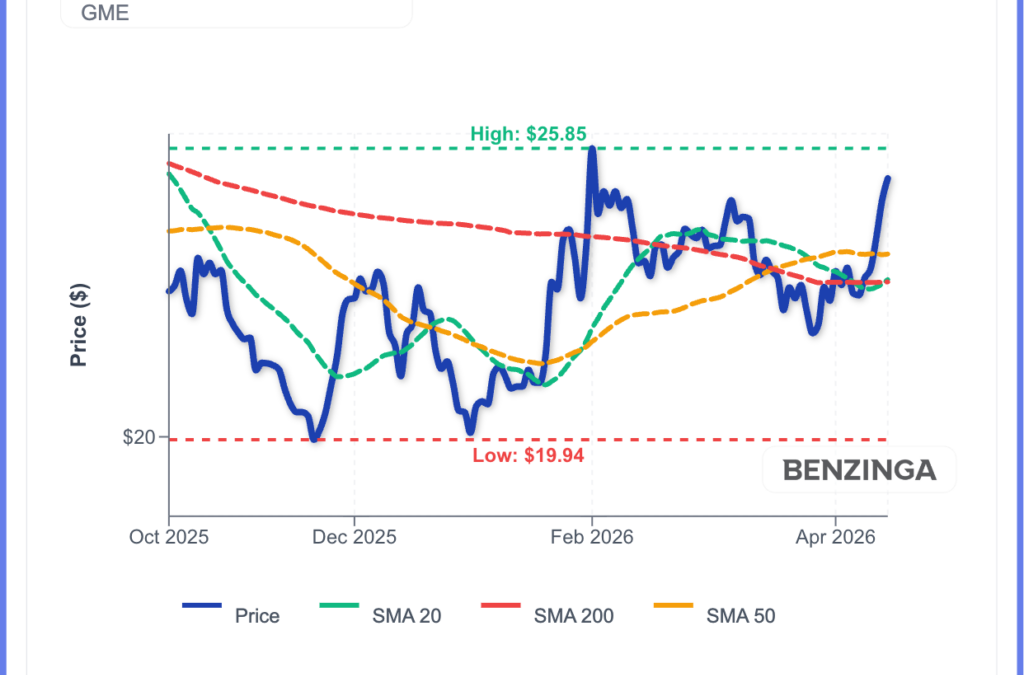
GameStop Corp (NYSE:GME) shares are climbing Thursday as traders react to the company’s “Power Packs” rollout and an elevated short-interest setup. Here’s what investors need to know.
- GameStop shares are advancing steadily. Why are GME shares climbing?
Power Packs Launch Opens A New Revenue Angle
GameStop’s latest catalyst is the public launch of “Power Packs,” a digital trading card platform that lets collectors buy digital packs that can unlock physical PSA-graded cards, including Pokémon and major sports categories.
Packs are priced from $25 to $2,500, and investors are framing it as a higher-margin collectibles expansion with potential recurring digital transaction revenue.
Short-interest data is also part of the setup, with short interest recently falling to 62.82 million shares from 64.23 million, or 15.34% of float, and about 10.36 days to cover at current volumes. That short-cover math matters for GME because a thinner short base can still create sharp squeezes when days-to-cover sits above 10 and volume spikes.
Traders Shrug Off Steve Eisman’s Criticism
Separately, investor Steve Eisman recently criticized the company’s acquisition strategy on April 4 as a “pipe dream,” pointing to a $9 billion cash pile and a “declining business” in physical retail. The stock’s upside reaction suggests traders are prioritizing the collectibles monetization angle over longer-term strategy skepticism.
Technical Setup Leans Bullish Despite Mixed Signals
GameStop is sitting in the middle of its 52-week range ($19.93 to $35.81), which indicates the stock is still trading within a wide, two-sided band rather than trending at an extreme. It’s trading 9.2% above its 20-day simple moving average (SMA) and 10.6% above its 100-day SMA (at $25.44), a setup that leans toward buyers controlling the short- and intermediate-term tape.
The moving average backdrop is mixed: the 20-day SMA remains below the 50-day SMA (a bearish short-term crossover), but the golden cross in March (50-day SMA above the 200-day SMA) keeps the longer trend from looking broken. That combination often shows up when a stock is rebounding but still needs time to “repair” the shorter-term structure.
The moving average convergence divergence (MACD), a trend/momentum measure, has the MACD line above the signal line with a positive histogram, which points to improving upside momentum versus the prior downswing. In everyday terms, MACD is saying the recent push higher has more force than the recent pullbacks, even if it can still chop around.
- Key Resistance: $28.00 — a level where rallies have recently stalled and sellers may reappear.
- Key Support: $22.50 — an area where buyers have tended to step in and defend pullbacks.

GME Shares Edge Higher Thursday Afternoon
GME Stock Price Activity: GameStop shares were up 1.98% at $25.28 at the time of publication on Thursday, according to Benzinga Pro data.
Image: Shutterstock
Recent Comments