
The Iran war was supposed to be a tech headwind. It became a chip boom.
Nine semiconductor stocks have surged between 19% and 61% since the conflict began on Feb. 27, making chipmakers the surprise outperformers of a war that has rattled oil markets, shaken consumer confidence and forced the Federal Reserve into wait-and-see mode.
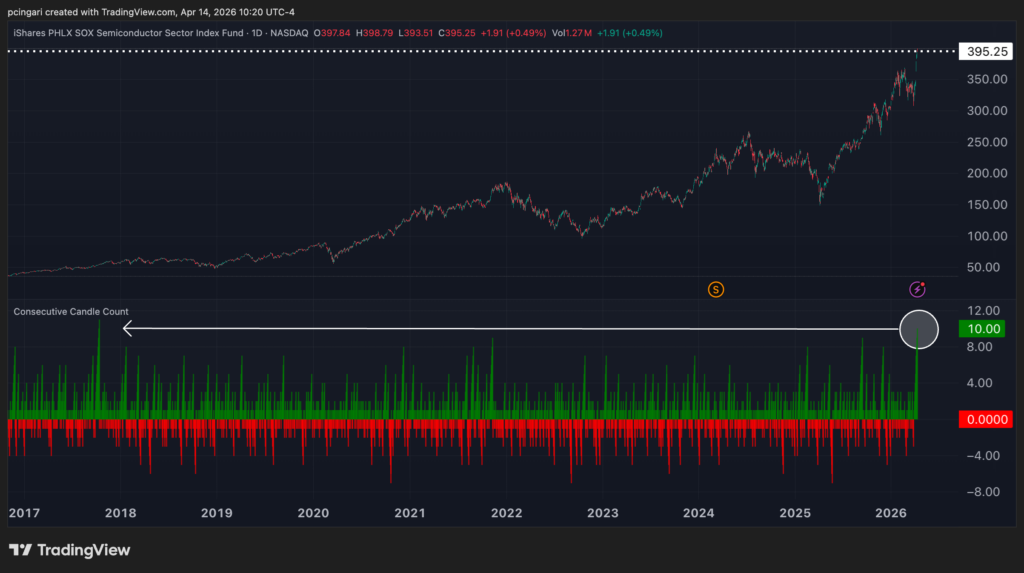
The iShares PHLX Semiconductor Sector Index Fund (NASDAQ:SOXX) is on track Tuesday for its tenth consecutive daily gain — the longest winning streak since 2017.
The ETF has surged 28% over that stretch, its biggest ten-session run since 2002, and is pressing against all-time highs at $395-396.
Moves of this magnitude in the semiconductor index have been extraordinarily rare. In the entire history of the SOXX, only three comparable episodes stand out — all clustered during the dot-com bust: a 32.4% surge in October 2001, a 35% rally in October 2002, and a 29.45% gain in November 2002.
Each marked a violent snapback from panic-driven lows. Today, the market is making the same bet on the Hormuz closure — that the disruption is temporary, the ceasefire holds, and the structural AI-driven demand cycle resumes where it left off.
Chart: SOXX — 10 Straight Sessions Of Gains, Longest Streak Since 2017

The Chipmaker Leaderboard Since The Ira War Started
Benzinga Pro data tracking regular-session moves from Feb. 27 through Apr. 14 shows the following chip and semiconductor-linked names among the top mega-cap gainers since the war began.
Notably, Nvidia Corp. (NASDAQ:NVDA) failed to join the broader chipmaker rally.
| Company | Price | Gain Since Feb. 27 (as of April 14) |
|---|---|---|
| Marvell Technology Inc. (NASDAQ:MRVL) | $131.30 | +60.73% |
| Intel Corp. (NASDAQ:INTC) | $65.18 | +42.91% |
| Seagate Technology Holdings PLC (NASDAQ:STX) | $513.28 | +25.85% |
| Western Digital Corp. (NASDAQ:WDC) | $350.16 | +25.19% |
| ARM Holdings PLC (NASDAQ:ARM) | $157.58 | +23.64% |
| Advanced Micro Devices Inc. (NASDAQ:AMD) | $246.83 | +23.29% |
| Broadcom Inc. (NASDAQ:AVGO) | $379.75 | +18.84% |
Why Have Semiconductor Stocks Rallied Since The Iran War?
The logic runs through the peace trade.
As markets increasingly price a Hormuz ceasefire and a return to lower oil prices, the rotation has moved sharply away from energy and into rate-sensitive, growth-oriented sectors.
Semiconductors — already in a structural upcycle driven by artificial intelligence demand — have absorbed the bulk of that rotation.
The SOXX chart tells the war’s full story in one frame. The ETF sold off from all-time highs in late February as the conflict erupted, bottomed near $310 in late March, then staged a near-vertical recovery through April as ceasefire talks gained traction.

What Comes Next?
The risk is binary. If peace talks in Islamabad produce a durable ceasefire and the Strait of Hormuz reopens, the chip rally has a fundamental case behind it: lower energy costs, easing financial conditions and a Fed that can resume its cutting cycle.
If talks collapse and oil returns to $100-plus, the rotation reverses just as fast as it arrived.
For now, 10 green candles say the market has made its choice.
Photo: Shutterstock
Recent Comments