
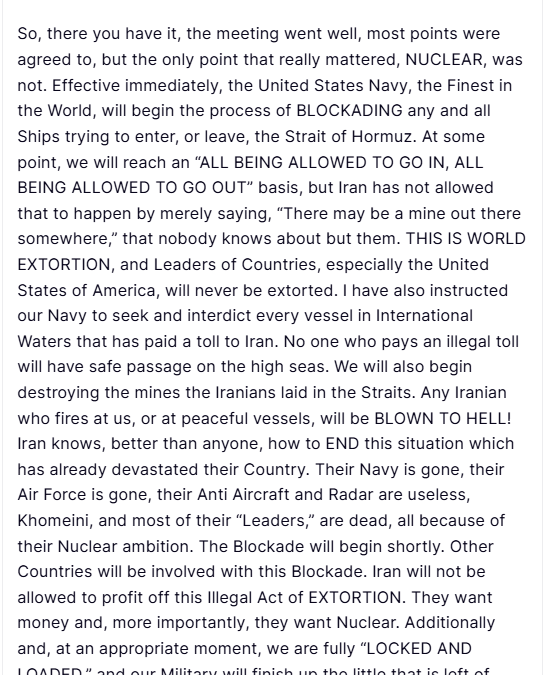
On Sunday, President Donald Trump said the U.S. will move to block ship traffic tied to Iran in and out of the Strait of Hormuz after Tehran failed to follow through on a pledge to open the waterway. The escalation follows Vice President JD Vance‘s warning to Iran, as U.S. negotiators departed Tehran without reaching a nuclear deal.
In a series of posts on Truth Social, Trump wrote that Iran’s failure to open the strait created global disruption and that ship operators may avoid the route amid claims mines were placed in the water. Trump also said he was briefed by Vance, Special Envoy Steve Witkoff, and Jared Kushner on a meeting hosted in Islamabad with Pakistan’s Field Marshal Asim Munir and Prime Minister Shehbaz Sharif.
In the first post, Trump said the U.S. Navy will start a process to stop vessels attempting to enter or exit the Strait of Hormuz, while also moving to remove mines he said Iran laid in the straits. He also said the Navy has been directed to intercept ships in international waters that have paid what he called an illegal toll to Iran.

Vance, speaking in Islamabad after the talks ended, framed the breakdown as a bigger problem for Tehran than for Washington. “The bad news is that we have not reached an agreement, and I think thats bad news for Iran much more than its bad news for the United States of America,” Vance said.
Trump described the shipping dispute as coercion and said the U.S. would not accept being pressured over access to an international passage. He also said other countries will participate in the effort.
In his remarks, Vance said the U.S. position did not hinge on side issues, but on stopping Iran from moving toward a bomb. “Weve made very clear what our red lines are,” he said.
What Led To The Breakdown Of Talks?
Trump said the Islamabad meeting ran close to 20 hours, and he argued that many items were settled even as the central issue remained unresolved. He identified Iranian officials involved as Mohammad-Bagher Ghalibaf, Abbas Araghchi, and Ali Bagheri.
Vance said the U.S. required “an affirmative commitment that they will not seek a nuclear weapon,” and he added that Iran must not pursue “the tools that would enable them to quickly achieve a nuclear weapon.” He also said, “That is the core goal of the president of the United States, and that’s what we’ve tried to achieve through these negotiations.”
Iran, through the semi-official Tasnim news agency, blamed what it called “excessive” U.S. demands for the collapse, while saying its delegation defended national rights in the talks. The same report said the Iranian side pushed back on U.S. demands touching the Strait of Hormuz and nuclear materials, and that the discussions ended without an agreement.
In another post, Trump said the U.S. team developed a respectful rapport with Iran’s representatives but still could not secure movement on what he called the decisive question. Trump reiterated his position in all caps, stating, “IRAN WILL NEVER HAVE A NUCLEAR WEAPON!”

Escalating Tensions Over Strait Of Hormuz
In earlier statements, Trump issued a 48-hour ultimatum to Iran regarding the Strait of Hormuz, warning that failure to comply could result in U.S. strikes on Iranian power plants. This escalation comes on the heels of Iran’s ambassador to the U.K., Ali Mousavi, indicating a conditional approach for maintaining maritime security in the Gulf and allowing passage for vessels not linked to adversaries.
Trump’s ultimatum builds on previous military actions, including strikes on Iran’s Kharg Island, which handles a significant portion of the country’s oil exports. His insistence on immediate and unimpeded transit through the Strait of Hormuz underscores the strategic importance of this corridor to global oil supply and reflects the ongoing tensions surrounding Iran’s nuclear ambitions, as emphasized in the current negotiations.
Trump said that, in his view, Tehran’s refusal to abandon its nuclear aims outweighed any progress on other points, and he tied the maritime crackdown to that wider dispute. He also warned that any attack on U.S. forces or commercial vessels would be met with overwhelming force.
Vance said the delegation would return to the U.S. without a deal after the marathon session in Islamabad. “So we go back to the United States having not come to an agreement,” he said.
In separate comments a day earlier, Trump said it would not matter to him whether a deal was reached because he believes the U.S. already holds military advantage. He said, “Weve totally defeated that country… let’s see what happens, we win… Maybe they make a deal, maybe they don’t. Doesn’t matter.”
Recent Comments