
Claude-parent Anthropic is reportedly in the preliminary stages of evaluating in-house chip development.
Early-Stage Chip Ambitions
The effort remains exploratory, with no formal commitment, finalized design, or dedicated team in place, Reuters reported on Thursday, citing people familiar with the matter.
The company could still opt to continue purchasing chips rather than building its own, the report said.
Anthropic did not immediately respond to Benzinga’s request for comments.
The development comes as the company and its competitors grapple with a shortage of AI chips required to power and advance next-generation AI systems.
AI Boom Fuels Urgency
The discussions come amid accelerating demand for Anthropic’s Claude models.
The company earlier this week said its annualized revenue run rate has surged past $30 billion, up from roughly $9 billion at the end of 2025.
Meanwhile, Anthropic is currently embroiled in a legal controversy with the Pentagon. Earlier this week, a federal appeals court in Washington, D.C., declined to temporarily block the Pentagon’s decision to label Anthropic a national security risk.
The Donald Trump administration classified the company as a supply-chain concern after it refused to ease safeguards on its Claude chatbot for uses such as surveillance or autonomous weapons.
Reliance On Big Tech Hardware
Currently, Anthropic depends on a mix of chips from Alphabet Inc.’s (NASDAQ:GOOG) (NASDAQ:GOOGL) Google and Amazon.com, Inc. (NASDAQ:AMZN) to train and run its AI systems.
It also signed a long-term agreement with Google and Broadcom Inc. (NASDAQ:AVGO), which helps design Google’s tensor processing units, as part of a broader push to strengthen U.S. AI infrastructure.
Industry-Wide Shift Toward Custom Silicon
Anthropic’s deliberations mirror a broader trend across the AI sector.
Companies, including Meta Platforms, Inc. (NASDAQ:META) and ChatGPT-parent OpenAI are also exploring custom chip strategies to reduce dependence on external suppliers and optimize performance for their specific models.
Designing advanced AI chips is both complex and costly, with estimates suggesting development can run as high as $500 million, the report said.
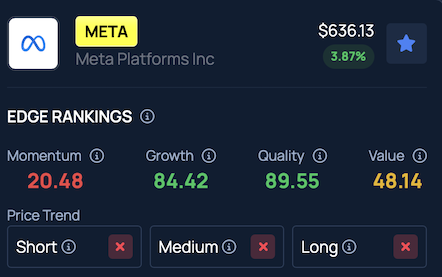
Meta stock ranks in the 89th percentile for Quality in Benzinga Edge Ratings, but is currently trending downward across short, medium and long-term timeframes.

Disclaimer: This content was partially produced with the help of AI tools and was reviewed and published by Benzinga editors.
Photo Courtesy: gguy on Shutterstock.com
Recent Comments