
Europe has entered a new phase of economic pressure as energy markets react sharply to Middle East tensions. Jet fuel and diesel prices have surged to record highs, and inflation is re‑accelerating across the euro area.
Supply chains are once again being tested by geopolitical risk. This has revived fears of a renewed energy‑driven shock just as the region had begun to stabilize.
Weekly Chart: NW European Jet Fuel Prices Surge
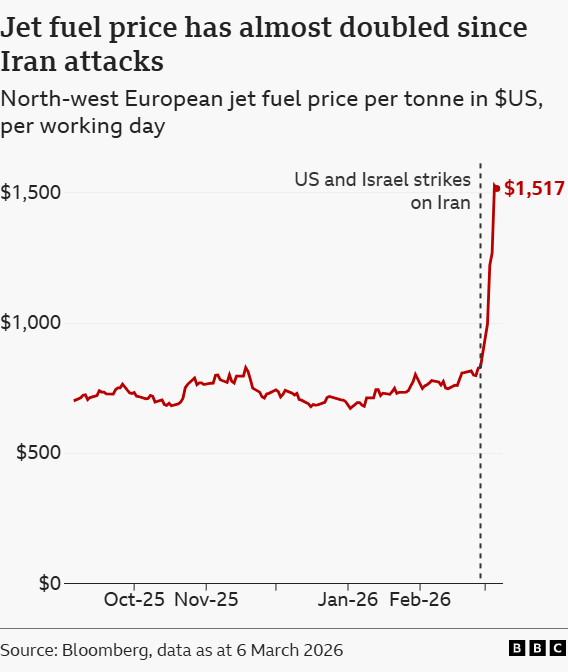
Northwest European jet fuel and diesel prices surged to new record highs on Thursday. Jet fuel was assessed at $1,903.50/t and diesel at $1,604/t as traders braced for escalation in the Middle East. The jet fuel benchmark rose by almost $300/t in a single day. It moved more than $100/t above the previous record set on March 20.
Reduced availability of Gulf-origin jet fuel flowing into Europe has pushed prices higher. About 30% of Europe’s jet fuel imports normally come from the Persian Gulf.
Source: BBC
Euro Area, German Inflation Accelerates
The war has started to push prices higher in Europe. Euro area annual inflation climbed to 2.5% in March, up from 1.9% in February.
This marked the highest rate since January 2025. This pushed inflation above the ECB’s 2% target as energy costs rose 4.9%, the first annual increase in about a year. This was the sharpest increase since February 2023.
Germany’s inflation rate climbed to 2.7% year-over-year in March, up from 1.9% in February. This is the highest level since January 2024, driven by a 7.2% spike in energy prices. This is the first increase in energy prices since December 2023.
Why it matters: For airlines and consumers, the concern is not just higher prices. It is the prospect of a genuine supply squeeze if Middle East disruptions persist. A sustained spike in jet fuel costs would force carriers to raise fares more aggressively, cut capacity, or delay routes. This would tighten travel conditions just as demand is recovering.
Global air travel remains severely disrupted. Many people are still unable to fly as planned after the Iran war forced the closure of major Middle Eastern hubs.
Geopolitics: Trump Warns Iran with ‘Living in Hell’
US President Donald Trump issued his latest expletive-filled threat against Iran via Truth Social, setting Tuesday for Tehran to reopen the Strait of Hormuz or face devastating strikes on its power plants and bridges. He called it “Power Plant Day, and Bridge Day, all wrapped up in one.”
He warned that Iran would be “living in Hell” if it failed to comply, ending with “Praise be to Allah.”
This ultimatum extended a series of prior deadlines. Trump has repeatedly pushed them back amid stalled ceasefire talks and a conflict now in its sixth week. The US and Israel have struck Iranian nuclear sites and civilian infrastructure.
Iran rejected the demand, with its military warning of “far more devastating” retaliation, labeling the threats as potential war crimes.
Trump has alternated between threats and hints of a deal, including preconditions like halting uranium enrichment and proxy support. Iran has effectively shut down the Strait of Hormuz, a trade route through which 20% of the world’s oil passes.
Axios Reports US, Iran Negotiating Deal
The U.S., Iran, and a group of regional mediators have discussed the terms for a potential 45-day ceasefire that could lead to a permanent end to the war, Axios reported, citing four US, Israeli, and regional sources with knowledge of the talks.
The US and Iran are negotiating a two-phase deal through Pakistani, Egyptian, and Turkish mediators, Axios reported. The sources said the mediators are discussing with the parties the terms for a two-phased deal.
The first phase would be a potential 45-day ceasefire during which a permanent end to the war would be negotiated. The ceasefire could be extended if more time were needed for talks, one of the sources said.
The second phase would be an agreement on ending the war. The sources said mediators think that fully reopening the Strait of Hormuz and a solution for Iran’s highly enriched uranium — either through its removal from the country or dilution — could only be a result of a final deal.
Why it matters: Global markets remain on edge as the fate of the Strait of Hormuz, with the world’s most sensitive oil chokepoint hanging in the balance of the talks. Any delay in reopening the strait risks keeping energy prices elevated and prolonging supply disruptions. A breakdown in negotiations could trigger a broader regional escalation.
Weekly Data: Euro Area Retail Sales, German Factory Orders, and Italian Industrial Production
Euro area:
- Retail Sales YoY (Wednesday): Previous reading +2% (January)
Germany:
- Factory orders MoM (Wednesday): Previous reading -11.1% (January)
- Balance of Trade YoY (Thursday): Previous reading €21.2 billion (January), up from €15.9 billion a year earlier
- Industrial Production MoM (Thursday): Previous reading -0.5% (January)
Italy:
- Industrial Production MoM (Friday): Previous reading -0.6% (January)
- Industrial Production YoY (Friday): Previous reading -0.6% (January)
Why it matters: This week’s data will show how quickly Middle East tensions are feeding into Europe’s real economy. Rising energy costs have squeezed households and manufacturers. This has raised the risk that the region drifts toward a stagflation mix of weak growth and stubborn inflation.
Stock in Focus: IAG Climbs 1.4% Last Week
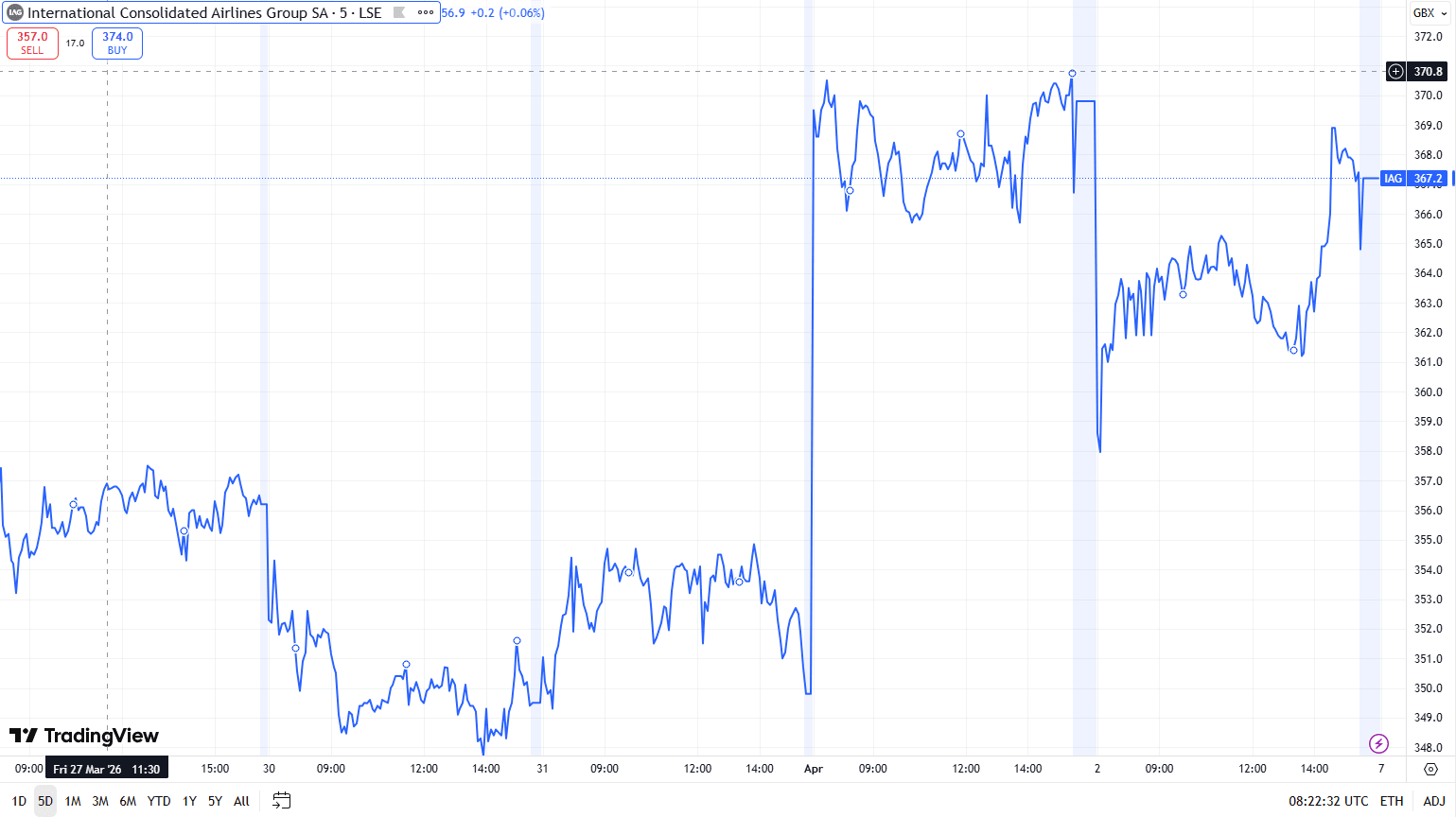
International Consolidated Airlines Group SA, which owns British Airways, climbed 1.4% last week. The airline has extended cancellations of flights to Amman, Bahrain, Dubai, and Tel Aviv until May 31 and to Doha until April 30. It added flights to Bangkok, Singapore, and the Maldives until April.
IAG’s low-cost airline, Iberia Express, has cancelled all flights to and from Tel Aviv through May 31.
Why it matters: Higher oil prices are pushing airlines’ fuel bills sharply higher, forcing carriers to raise fares, trim routes, and pass more costs onto passengers. If energy prices remain elevated, the squeeze could spread across the broader UK services sector, reinforcing inflationary pressures just as policymakers hoped for relief.
The uncertainty comes as British business investment fell 2.5% quarter-on-quarter in the three months to December. The latest figure published on Tuesday marked the sharpest contraction since the third quarter of 2023, pointing to a clear slowdown in corporate spending.
On an annual basis, business investment rose 2%, in line with initial estimates, though this was the weakest growth since the second quarter of 2024.
Policy Moves: EU Takes Steps for €90 billion Ukraine Support Loan
The European Commission has taken preparatory steps for the implementation of the €90 billion Ukraine Support Loan, aimed at securing necessary budgetary support and accelerating urgent defense procurement for Ukraine in 2026 and 2027.
The package adopted on Wednesday includes a proposal for the Council to approve the overall amount of the EU’s support to Ukraine for 2026 and a decision validating the use of procurement derogations for the first defense product schedule under the Loan, which will focus on drones.
“Today, we are taking the necessary preparatory steps to mobilize this year’s budget and procure defense equipment, with a focus on Ukraine’s cutting-edge drone industry,” European Commission President von der Leyen said. “With this, we send a clear message: the Commission stands ready to move forward.”
The EU will also deliver €1.4 billion in revenue from immobilized Russian assets to be used for support to Ukraine. These funds come from Russian Central Bank assets immobilized under EU sanctions, imposed in response to Russia’s war of aggression against Ukraine.
Why it matters: The EU’s €90 billion loan framework is designed to keep Ukraine solvent and militarily supplied through 2026–27, signaling long‑term European commitment despite battlefield uncertainty. The use of frozen Russian assets marks a significant shift in EU financial policy, deepening fiscal integration while testing the limits of sanctions enforcement.
Europe in the News: German Men Must Inform Military of Foreign Trips
A new German military service law will require most young men to inform authorities when leaving the country.
The defense ministry confirmed to AFP on Saturday that men aged 17 and above are required to obtain prior approval from the German armed forces for foreign stays lasting longer than three months.
Approval will be granted as long as “no specific service as a soldier is expected during the period in question,” a ministry spokesman told AFP.
The move underscores Berlin’s accelerating shift toward a more assertive defense posture, reversing decades of suspended conscription and signaling a broader recalibration of European security policy.
Disclaimer: Any opinions expressed in this article are not to be considered investment advice and are solely those of the authors. European Capital Insights is not responsible for any financial decisions made based on the contents of this article. Readers may use this article for information and educational purposes only.
Benzinga Disclaimer: This article is from an unpaid external contributor. It does not represent Benzinga’s reporting and has not been edited for content or accuracy.
Recent Comments