
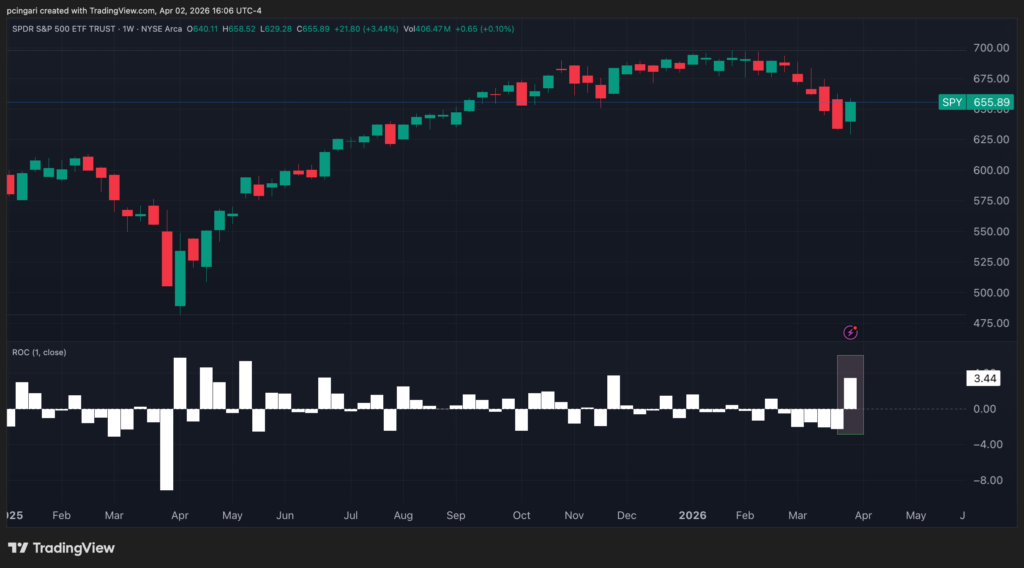
It took a shortened week and an unexpected diplomatic signal to finally snap Wall Street’s worst losing streak since 2022.
The S&P 500 – as tracked by the SPDR S&P 500 ETF Trust (NYSE:SPY) – posted its strongest weekly gain since late November, snapping a five-week slide in a holiday-shortened week that ended Thursday, with markets closed for Good Friday.
The relief was real — if incomplete.

From Ceasefire Hopes To ‘Stone Age’ Threats: Trump’s Message Whipsaws Markets
The catalyst arrived Tuesday, March 31, when President Donald Trump declared that U.S. and Iranian negotiators had shared “good and productive conversations,” adding that a ceasefire agreement could come “very soon.”
The S&P 500 surged 3% — its best single session in nearly a year. Oil fell toward $85 a barrel. For one day, the market priced in a world where the Strait of Hormuz reopens.
The euphoria didn’t last for long.
In a televised address Wednesday night, Trump said Iran must formally accept U.S. terms before any agreement would be recognized, reaffirming an April 6 deadline. He also warned that Iranian infrastructure would be hit “extremely hard” over the next two to three weeks, threatening to push Tehran back to the “Stone Ages.”
The optimism that brought crude below $100 quickly reversed, while U.S. stocks cooled but didn’t collapse.
Oil Closes The Week At June 2022 Levels As Supply Shock Fears Intensify
West Texas Intermediate crude – as tracked by the United States Oil Fund (NYSE:USO) – closed the week above $110 a barrel — its highest closing price since June 2022.

More striking than the level was a structural shift: for the first time since 2009, WTI is trading at a premium of more than $3 over Brent crude, inverting a relationship that held for more than a decade.
Analysts attribute the flip to U.S. refiners ramping demand at the start of the spring driving season, drawing on domestic crude that international buyers cannot easily access while the Strait remains closed.
Gold, which had collapsed 11.5% in March — its worst monthly performance since October 2008 — rebounded 3.7% this week. The catalyst was a shift in Fed expectations.
Speaking at Harvard University on Tuesday, Fed Chair Jerome Powell said monetary policy is in “a good place for us to wait and see how that turns out” — language the market read as a signal that the Fed intends to look through the oil shock rather than hike into it.
Nike Sinks To 2014 Lows As War Shock Hits Consumer Outlook
The war’s costs and uncertainties are beginning to show up in corporate earnings.
Nike Inc. (NYSE:NKE) beat estimates Tuesday but buried alarming guidance inside the report: China sales expected to fall 20% year-over-year, with management explicitly citing “unplanned volatility due to disruption in the Middle East and rising oil prices.”
The stock fell 15% Wednesday and closed Thursday at its lowest level since October 2014.
For Michigan-based stocks, the week offered little comfort. Ford Motor Co. (NYSE:F) and General Motors Co. (NYSE:GM) are both down 12.6% year-to-date, hovering near their 2026 lows.
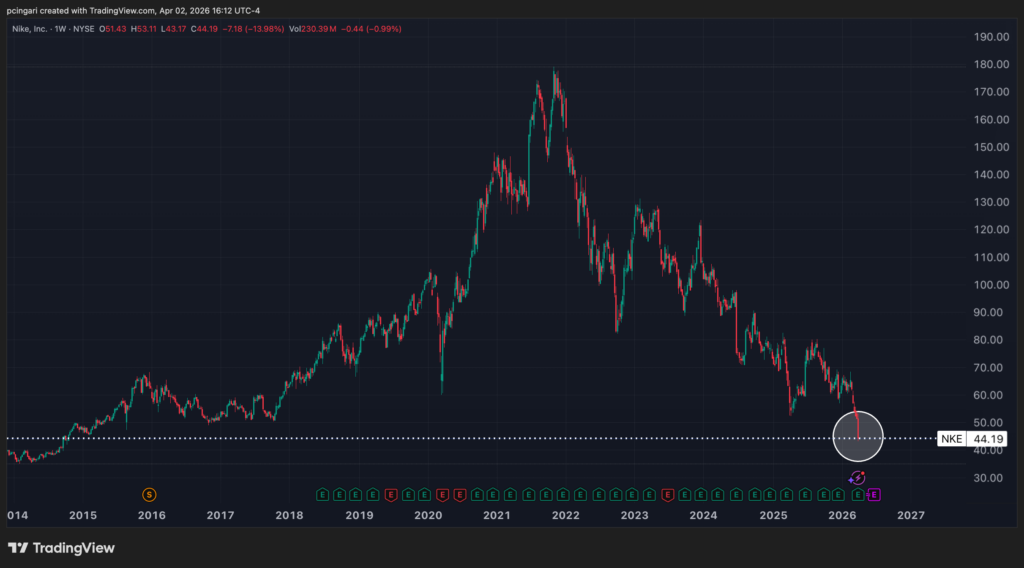
Image created using artificial intelligence via Midjourney.
Recent Comments