
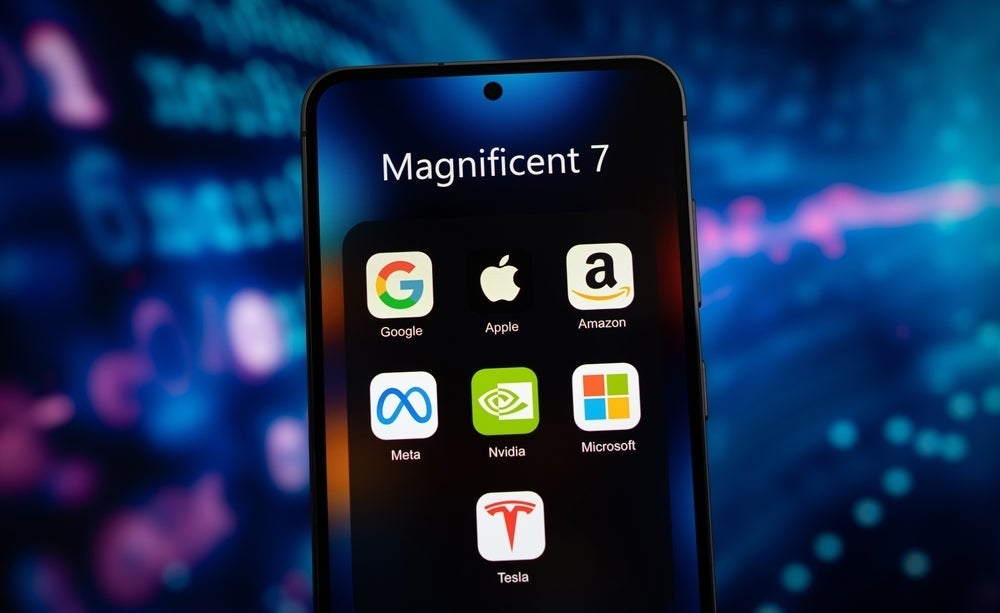
Something shocking is happening to the world’s most powerful stocks. One month into the Iran war, six of the Magnificent Seven have entered bear market territory.
Amazon.com Inc. (NASDAQ:AMZN) is trading at its lowest forward price-to-earnings multiple since November 2008 — a key metric that measures the stock against expected earnings over the next 12 months.
Meanwhile, Microsoft Corp. (NASDAQ:MSFT) has slipped to valuation levels last seen in December 2016 — before the cloud era fully took hold and before Azure emerged as a dominant force in enterprise computing.
For Nvidia Corp. (NASDAQ:NVDA), the reset is even more striking.
The world’s largest company is currently trading at around 20x forward earnings — its lowest valuation since December 2018, four years before OpenAI launched ChatGPT.
In other words, the market is pricing NVIDIA as if the AI boom never happened.
Is this the opportunity investors have been waiting for to pile into the Magnificent Seven trade?
And what if the Iran war has just unleashed the Fed’s nightmare scenario?
The Valuation Reset No One Was Expecting
Even before President Donald Trump‘s “Operation Epic Fury” began on Feb. 28, the U.S. economy got off to a rough start in 2026 due to job losses, rising gasoline prices and high-interest rates.
Then came the Middle East geopolitical shock. The consensus on Wall Street was that U.S. technology stocks — protected by AI spending momentum and resilient earnings — would prove immune. That narrative has now completely broken.
Six of the seven Magnificent Seven components have crossed the bear market threshold — defined as a decline of 20% or more from all-time highs.
Apple Inc. ((AAPL) is the sole holdout, down 14.15% from its peak — entering a correction territory.
| Company | Below ATH | Status | P/E (NTM) | Valuation Context |
|---|---|---|---|---|
| NVIDIA Corp. | -21.04% | BEAR | 20.2x | Lowest since December 2018 |
| Apple Inc. | -14.15% | CORRECTION | 28.9x | — |
| Alphabet Inc. (NASDAQ:GOOGL) | -22.01% | BEAR | 23.6x | — |
| Microsoft Corp. | -34.76% | BEAR | 20.3x | Lowest since December 2016 |
| Amazon.com Inc. | -22.04% | BEAR | 25.7x | Lowest since November 2008 |
| Tesla Inc. (NASDAQ:TSLA) | -27.11% | BEAR | 174.8x | — |
| Meta Platforms Inc. (NASDAQ:META) | -33.02% | BEAR | 17.4x | Lowest since October |
Amazon At A 17-Year Valuation Low
Amazon is the most statistically extraordinary case in this selloff.
Its forward price-to-earnings ratio has compressed to 25.7x, a level last seen in November 2008 when the global financial crisis was at its most acute.
An Amazon price-to-earnings ratio of 25.7x means investors are paying $25.70 for every $1 of expected earnings.
Context matters here. In 2008, Amazon was a retail company with nascent cloud ambitions and negligible operating margins. Today, Amazon Web Services generates over $100 billion in annualised operating income, and the company’s free cash flow profile has transformed beyond recognition.
This is not a modest discount. It is a generational valuation event.
Microsoft’s Worst Streak Since The Financial Crisis
Microsoft Corporation has posted six consecutive months of losses — the longest losing streak since January 2009.
The stock is down 26% in the past three months, its worst quarterly performance since December 2008.
Microsoft’s forward P/E of 20.3x is now where it stood before Satya Nadella had fully transformed the company into a cloud powerhouse.
It is lower than at any point during the 2020 COVID crash. It is lower than during the 2022 bear market.
The 2022 Downside Scenario: How Much Worse Can It Get?
For investors tempted by the dip, one historical analog demands honest confrontation: the 2022 inflation and rate-hike cycle.
When the Federal Reserve raised interest rates aggressively to combat post-pandemic inflation, the Magnificent Seven experienced drawdowns that make the current damage look modest.
If the Iran war sustains oil prices at elevated levels — contributing to an inflation spike above 3% and forcing the Fed to consider rate hikes rather than cuts — the 2022 framework becomes the relevant downside scenario.
| Stock | 2022 Cycle Max Drawdown | Current 2026 Drawdown |
|---|---|---|
| Meta Platforms | -77% | -33% |
| Tesla | -75% | -27% |
| NVIDIA | -68% | -21% |
| Amazon | -57% | -22% |
| Alphabet | -45% | -22% |
| Microsoft | -38% | -35% |
| Apple | -32% | -14% |
The critical observation is that Microsoft is at 34.76% below its all-time high, already approaching the 2022 cycle’s maximum drawdown of 38%. It has almost no margin of safety against a repeat.
Every other stock in the cohort has significant theoretical downside remaining relative to that historical floor — with Meta, Tesla, and Nvidia representing the most exposed.
What This Means For Investors
The valuation collapse across the Magnificent Seven has produced a genuine analytical paradox.
The fundamental argument for buying is historically strong: Amazon at a P/E last observed during the financial crisis, Microsoft at its cheapest since the pre-cloud era, NVIDIA priced as if three years of AI infrastructure spending never happened.
These are not normal readings.
The question is not whether these stocks are cheap. They are.
The question is whether cheap is enough when the macro environment is still deteriorating.
The risk argument is equally coherent. The 2022 inflation cycle proved that apparent valuation floors are traversable — NVIDIA felt cheap at 30x before it traded to 20x; Meta felt cheap at 40x before it hit 9x.
Valuations compress further when rates rise and liquidity contracts. The same dynamic could recur.
If the Federal Reserve is forced to pivot from rate cuts to rate hikes under a stagflation scenario, the 2022 drawdown framework suggests that current Magnificent Seven prices are not the floor.
Image: Shutterstock
Recent Comments