
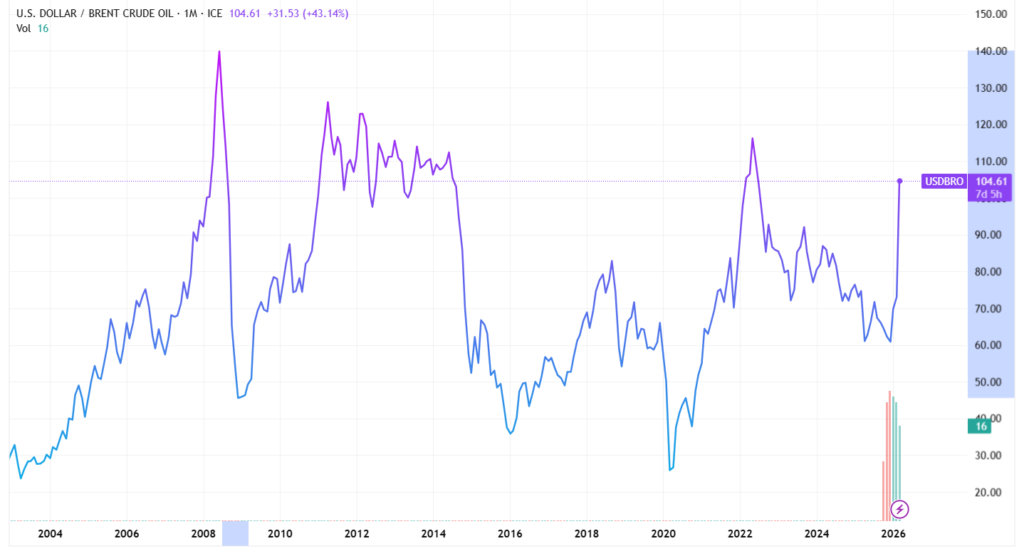
Oil prices are rising again, but we’ve been down this road before. Our initial reaction may be to invest in oil, but history shows us that’s just the beginning of the story. What drives investment returns isn’t oil prices. It is what oil prices do to inflation, economic growth, and monetary policy. And that’s where ETF leadership begins to shift.
Energy Rallies First, But Rarely Leads For Long
The initial response to any oil price shock tends to be predictable. Energy-focused ETFs such as the Energy Select Sector SPDR Fund (NYSE:XLE) and Vanguard Energy ETF (NYSE:VDE) tend to perform well when oil prices increase, as higher crude prices flow straight into oil company earnings.
These ETFs are built for supply shocks and geopolitical risk, and they often outperform sharply at the start. They tend to perform well when oil prices increase. However, oil price movements tend to be a short-term response.
History Shows: Oil Spikes Don’t Last—But The Aftermath Matters
If this sounds familiar, it should. Markets have gone through this cycle several times, and it is astonishing to see how consistent the pattern is.
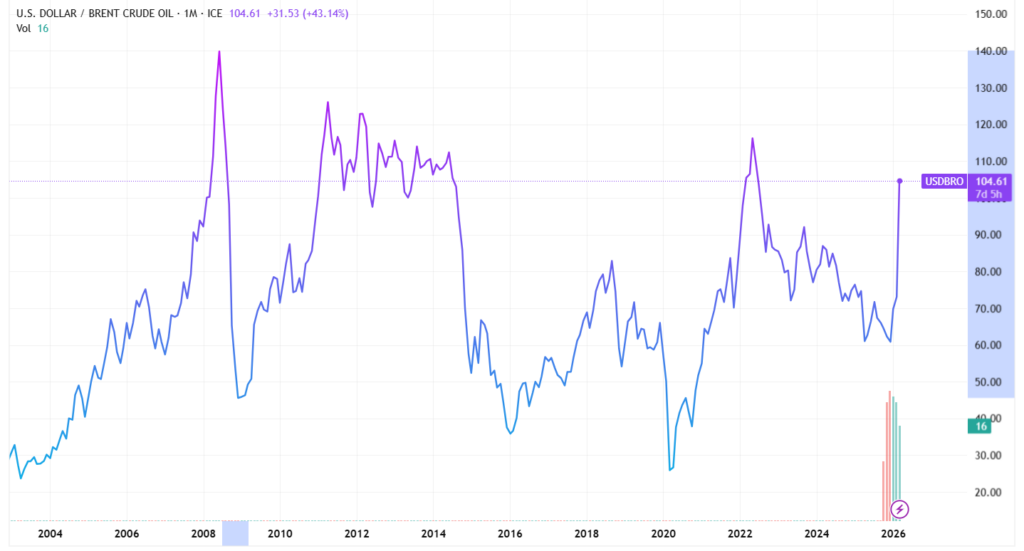
Let’s take, for example, the 2008 financial crisis. Oil prices rose to new records, surpassing $140 per barrel, driven by strong demand, tight supply, and a surge in commodity prices. However, the party was short-lived. As the global economy disintegrated, oil prices tumbled by around 70% in a matter of months.
A similar story was repeated in 2014, but the reasons were vastly different.
Oil prices rose sharply in June 2014 due to escalating tensions in Iraq, which led to a fear of supply disruptions. At the same time, oil production was halted in Libya, and strong demand was coming from the U.S. and China, leading to a surge in oil prices.
However, the rally was short-lived. As the supply increased, especially from the U.S. shale sector, and the global oil inventory built up, the oil price entered a glut stage. The price declined by nearly 44% from June to December, per CEPR, and continued to face downward pressure over the next two years.
In 2022, once again, the price increased with the invasion of Ukraine by Russia. The prices increased due to the fear of a supply shock, but with the tightening of the monetary policy and the slowdown in the economy, the prices fell again from the highs.
In each case, the causes for the price movement were different—excessive financial leverage in 2008, a glut in the market in 2014, and the invasion of Ukraine by Russia in 2022. But the effect of the price movement was similar—a sharp move followed by a price reversal.
Thus, the current price rally due to geopolitical tensions may not be the only factor for the price movement. The real story for ETF investors is not that the price increases but that the subsequent price movement is the key to the opportunities that lie ahead.
From Oil To Inflation: The Trade Broadens
Nonetheless, if prices stay high, the ripples will be felt across the rest of the market.
This is when commodity funds will be in the spotlight. For example, the Invesco DB Commodity Index Tracking Fund (NYSE:DBC) and the iShares S&P GSCI Commodity-Indexed Trust (NYSE:GSG) will profit from the strength in commodities, not just oil.
At the same time, inflation protection will be key. For example, the iShares TIPS Bond ETF (NYSE:TIP) will gain traction as investors hedge their bets on inflation.
The Real Pivot: The Fed
The real turning point, however, will not be driven by the price of oil, but rather by the response from the Federal Reserve.
If inflation is still a concern, and the Fed is hawkish, then real assets and value will be the place to be. But if growth is becoming more of an issue, and the Fed pivots, then things will change quickly.
That’s when duration becomes the trade. For example, the iShares 20+ Year Treasury Bond ETF (NASDAQ:TLT) will be higher as interest rates fall.
Rotation Beneath The Surface
Even as the overall numbers may be steady, the underlying rotation can be significant. The broad market ETFs such as the SPDR S&P 500 ETF Trust (NYSE:SPY), may experience energy leading the way initially, commodities dominate if inflation accelerates, and defensives or bonds step in as growth slows.
That’s the actual lesson from past oil shocks. The first trade is obvious. The rest, in all aspects of inflation, rates, and sectors, are where the markets are truly decided.
Photo: Shutterstock
Recent Comments