
A single uncomfortable question defined the week on Wall Street: Has the Iran war permanently reset the inflation and interest rate outlook for 2026?
By Friday, markets had an answer — and it wasn’t reassuring.
The Strait of Hormuz remains closed. Brent crude ended the week above $110 per barrel.
But the crisis has now moved from Hormuz to the gas station: U.S. retail diesel crossed $5 per gallon — up 35% from $3.69 just a month ago, and closing in near the 2022 record. Gasoline is approaching $4.
Consumers have noticed. So have money markets.
Traders are now pricing in a scenario that felt unthinkable three weeks ago: rate hikes.
The Federal Reserve — which President Donald Trump has spent his entire second term trying to push toward cuts — may now be forced to move in the opposite direction.
Oil Shock Triggers Inflation Warnings
The University of Michigan documented a dramatic shift in inflation expectations in the nine days following the start of U.S. military operations: expectations for gas price increases over the next year surged to 42.6%, from just 10% beforehand.
Year-ahead inflation expectations climbed from 3.3% to 3.5%, while long-run expectations rose from 3.1% to 3.3% — an early signal that the energy shock may be reshaping how Americans think about prices more broadly.
Prediction markets have moved sharply, too.
Traders now assign a coin-flip chance that annual March inflation will exceed 3.4% — compared to 2.4% in February.
A one-percentage-point jump in annual inflation over a single month is historically rare, occurring only a handful of times in modern history, almost always around major energy crises.
Read also: Trump Meets Diesel Shock: This Scary Chart Shows Inflation Hitting 8%
The Federal Reserve took notice at its meeting this week.
In its updated Summary of Economic Projections, policymakers raised their inflation forecasts, with Chair Jerome Powell acknowledging that energy-driven price pressures represent a meaningful upside risk to the inflation outlook.
The Fed held rates steady but pointedly declined to rule out future increases.
Markets interpreted the message quickly and harshly. By Friday, money markets were pricing a better-than-even chance the Fed raises rates by October.
U.S. short-term Treasury yields spiked toward 4%, on pace for their biggest monthly jump since February 2023.
Read also: Trump’s Iran War Is Doing What No One Expected: Bringing Rate Hikes Back On The Table
The result was a brutal week for rate-sensitive assets.
Gold, which had surged through last year on expectations of falling rates, tumbled 9.8% by midday Friday — its worst weekly performance since 1983.
Silver and gold mining stocks fell sharply in sympathy.
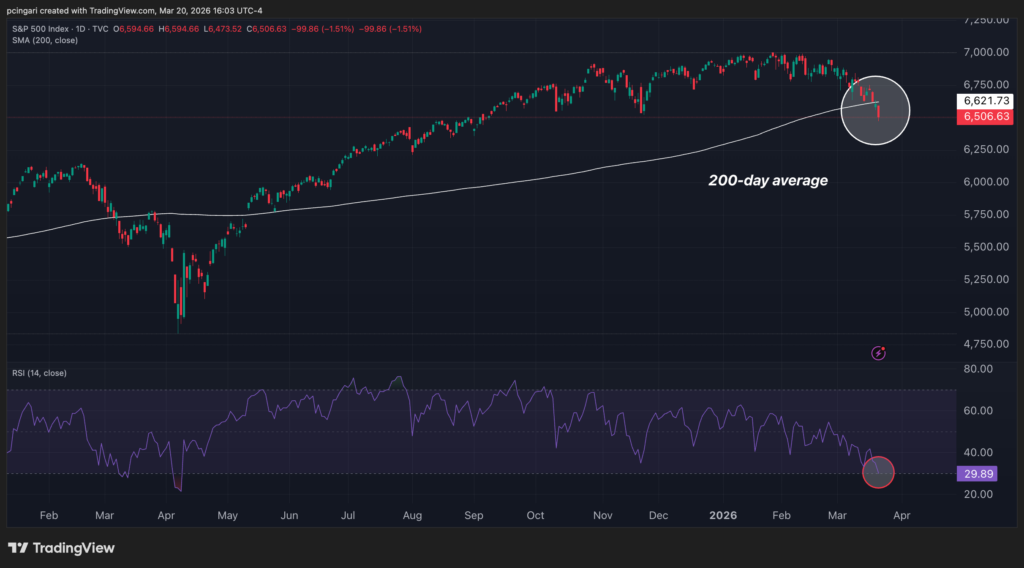
The S&P 500, Nasdaq 100, and Dow Jones all closed below their 200-day moving averages at the end of the week, for the first time since March 2025.
The S&P 500’s 14-day RSI dropped below 30 for the first time since the April 2025 tariff shock — crossing into oversold territory as selling pressure showed no sign of letting up.
Every major sector finished in the red, save one: the Energy Select Sector SPDR Fund (NYSE:XLE), which remains the sole beneficiary of the crisis.
Chart of The Week: S&P 500 Closes Below 200-day Average, Hits ‘Oversold’ RSI
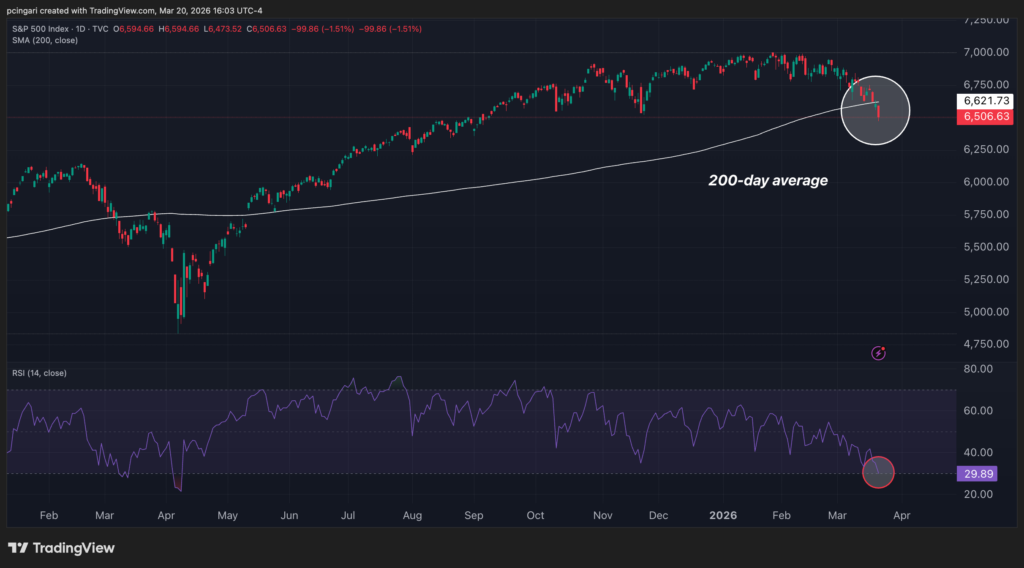
Image created using artificial intelligence via Midjourney.
Recent Comments