
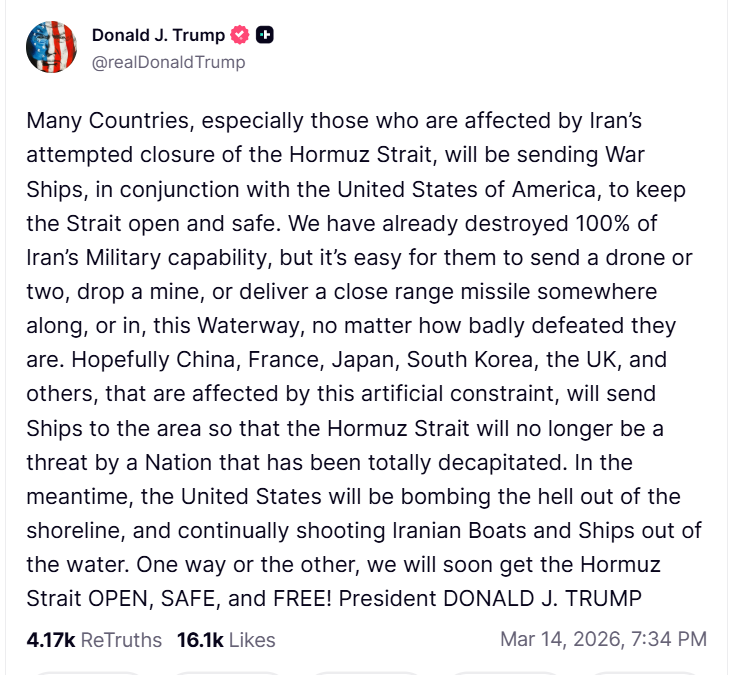
On Saturday, President Donald Trump said multiple countries will join the U.S. in dispatching warships to keep the Strait of Hormuz open after Iran’s attempted shutdown of the waterway. The push comes days after U.S. Central Command struck military sites on Iran’s Kharg Island, a key node for oil exports about 300 miles from Hormuz, as Kharg Island raid raised the stakes for a route tied to roughly one-fifth of global oil flows.
In a post on Truth Social, Trump said nations “affected” by the attempted closure will send ships alongside the U.S. to keep the passage “open and safe.” He also argued that even with Iran’s forces badly degraded, Tehran could still harass traffic using drones, mines, or short-range missiles.
Trump listed China, France, Japan, South Korea and the U.K. among countries he wants in the naval effort, adding “others” he said are also impacted. He said the goal is to remove the risk of disruption from what he called an “artificial constraint” on shipping.

What Trumps Strategy Means For Oil Markets
The Strait of Hormuz is a chokepoint for about 20% of global oil supply, making any threat to transit a direct issue for energy markets. Trump also linked U.S. choices around Kharg Island to whether Iran interferes with shipping through Hormuz.
In his Friday comments about Kharg Island, Trump said U.S. Central Command hit military targets there while leaving oil infrastructure intact for now. He warned that could change if Iran, or another actor, tries to obstruct maritime movement through the strait.
“Should Iran, or anyone else, do anything to interfere with the Free and Safe Passage of Ships through the Strait of Hormuz, I will immediately reconsider this decision,” he wrote in the post on Truth Social on Friday.
Iran’s Military Weakening Amid U.S. Pressure
In earlier statements, Trump emphasized that Iran has apologized and pledged not to attack its regional neighbors, framing this as a significant capitulation following relentless U.S. and Israeli military actions. He labeled Iran as no longer the “Bully of the Middle East,” suggesting that this shift in posture has occurred after what he described as their first loss to surrounding countries in “thousands of years.” This historical context highlights the perceived weakening of Iran’s military status, which may influence ongoing U.S. strategies in the region.
Trump’s insistence on Iran’s “unconditional surrender” further complicates diplomatic relations, as Iranian officials publicly rejected external influence on their succession politics. The narrative of Iran’s decline under pressure from the U.S. and allies feeds into the broader context of Trump’s strategy to maintain security in the Strait of Hormuz, particularly as he calls for allied naval support to ensure safe passage through this critical shipping route.
Can Global Allies Secure The Strait?
Trump’s post described a coalition-style maritime plan built around escorting and protecting commercial traffic, while anticipating low-cost attacks such as mines or drones. He said U.S. forces would also keep striking along Iran’s shoreline and target Iranian boats and ships.
In a Fox News Radio interview with Brian Kilmeade aired on Friday, Trump said the U.S. would escort ships through the strait if needed. He also said the U.S. would hit Iran “very hard over the next week.”
Beyond the naval plan, Trump urged Iran’s military and those tied to the regime to lay down their arms. He also claimed, in a later post, that Iran’s plans against the region and Israel are now “dead.”
The High Stakes Of Kharg Islands Control
Kharg Island sits about 16 miles off Iran’s coast and is described as handling about 90% of the country’s oil shipments, putting it at the center of any squeeze on Tehran’s export revenue. Its location—roughly 300 miles from the Strait of Hormuz—ties the island’s security to the wider fight over safe passage.
Trump said the U.S. has the world’s most advanced weapons but chose not to destroy the island’s oil facilities, while keeping that option on the table if shipping is threatened. As reported by Truthsocial, Trump said the U.S. and partner navies will “soon get the Hormuz Strait OPEN, SAFE, and FREE.”
Recent Comments